Character, not Caricature: Cardinal Sarah Beyond the Labels
COMMENTARY: A pastor who faced danger in his homeland and later served the Church in Rome, Cardinal Robert Sarah remains above all a man on his knees before God.
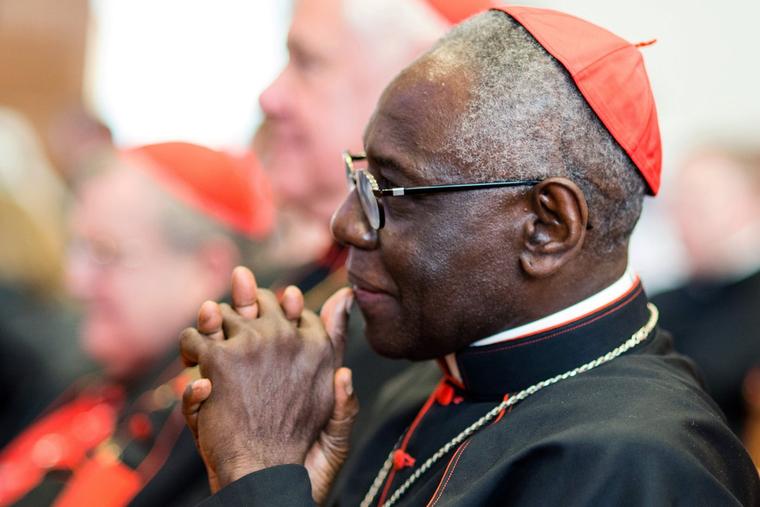
The internet, that great distorter of information, tells me that Cardinal Robert Sarah is “a member of the right wing of the Catholic Church.” An outsider might look at this and wonder if the Catholic Church is a hockey team with right and left wings. If it were, Cardinal Sarah would be the center, harboring the hope that his two defensemen and goalie would protect his team against enemy assault.
I recall speaking with a priest, who refused to wear clerical attire, telling me that he is so “left wing” that even when he enters a movie theater he feels obliged to sit on the left. I did not respond at the time. Sometimes silence is the best expression of charity.
If I were in a less charitable mood, I might have asked, “Have you ever thought of becoming a Catholic?” On another occasion I was dining with an orthodox priest in the refectory of a Catholic college. He pointed out that the left-wing people dine on one side of the room, while the right-wing coalition dine on the other side. There is not much dialogue between the two factions.
That being the situation, how could they possibly begin a dialogue with people outside the Church? I am told that in some cities, the telephone directory informs people of which Catholic Churches are “liberal” and which ones are “conservative.”
By dividing the Church into right and left wing, conservative and liberal, traditionalists and progressivists, what is lost is her unity, as well as her intelligibility. Pope Benedict XVI has stated that “labeling a person conservative is practically synonymous with social excommunication, for it means, in today’s language, that such a one is opposed to progress, closed to what is new and, consequently, a defender of the old, the obscure, the enslaving; that he is an enemy of the salvation that change is expected to bring about.” There are high hopes but small gains.
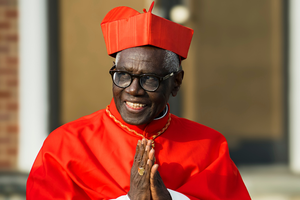
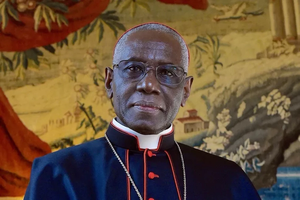
Label is often libel. Stereotypes do not express the truth. They are often conduits that facilitate the flow of prejudice. Who is Robert Cardinal Sarah? He is a strong and solid character. It is a gross injustice to characterize him in a caricature. Let us take a look at the man for what he is.
Robert Sarah is alive today by the grace of God. He was born in a remote village in Guinea, in West Africa. His parents converted to the Catholic faith from “animism” thanks to the Holy Ghost Fathers, missionaries from France. Sarah became one of the first natives to become a priest.
In 1979, at the age of 34, he was named the youngest bishop in the Catholic Church. His predecessor as archbishop of Conakry, Archbishop Raymond-Marie Tchidimbo, had been imprisoned by the Marxist dictator, Ahmed Sékou Touré. It was a dangerous position for the young bishop, for Touré had been responsible for the murder of tens of thousands of people during his regime. It was inevitable that Sarah would be scheduled for execution. One month before that fatal day, Touré died of a heart attack. The execution was canceled.
Cardinal Sarah’s contributions as a servant of the Church have been generous and extraordinary. In 2010, Pope Benedict XVI named him head of Cor Unum, the department that administers the practical charitable works of the pope, and made him a cardinal. In 2014, Pope Francis made him responsible for liturgical oversight as Prefect of the Congregation for Divine Worship.
Father Raymond de Souza wrote, “Cardinal Sarah has led one of the great Christian lives of our time.”
“How improbable,” he went on to say, “that a boy from a remote Guinean village, whose parents were counted among the first Christians of his land, would take senior positions in the three Vatican departments dealing with the triplex mission of the Church — evangelization, liturgy and charity?”
Yet, what best characterizes Cardinal Sarah is that he is a man of prayer. “Man is only great,” the cardinal proclaims, “when on his knees before God.” Concerning the crisis in the Church, he says, “Prayer is the only great remedy.”
It is most unfortunate that a great character can be reduced to a caricature. There is one Church. It is neither left nor right. Why must so many Catholics persist in dividing it? No doubt pride is a significant factor. The enticement of the world is another.
Cardinal Sarah, though a man of prayer, is also a man of intellect. He is well read. In his book The Day Is Now Far Spent, for example, he cites Charles Péguy and Pope St. Pius X, who expressed their grave concern about the Church losing her moorings.
According to Péguy: “Christianity is in no way and by no means a religion-in-progress: nor (perhaps even less of if that is possible) is it a religion of progress. It is a religion of salvation.”
According to Pope Pius: “Oh! How many navigators, how many pilots, and — God forbid — how many captains, trusting in profane novelties and in the deceitful science of the age, have been shipwrecked instead of reaching the port!”
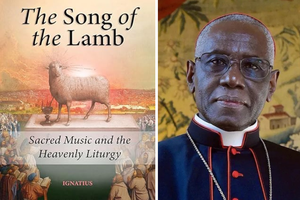
In addition to The Day Is Now Far Spent, Cardinal Sarah has written The Power of Silence: Against the Dictatorship of Noise; God or Nothing: a Conversion on Faith; Catechism of the Spiritual Life; Does God Exist: The Cry of Man Asking for Salvation, and others. Pray for him.
- Keywords:
- cardinal robert sarah