Death Seems Random, God Seems Silent — and Only the Cross of Christ Reveals Why
COMMENTARY: Wrestling with the mystery of death and the suffering of innocents can draw us deeper into the meaning of Christ’s own passion.

The feast of All Souls on Nov. 2 kicks off a month the Catholic Church dedicates to prayer for the faithful departed — and invites us to treat this time as a kind of memento mori for ourselves as well.
Our culture does not like to focus on death. Lacking a substantively real faith in God, the modern world vacillates between a nihilistic atheism that views death as annihilation and a vague spiritualism that affirms the possibility of life after death but leaves it so vaporously thin that it scarcely can bear any great hope. It also creates no real connection between the next life and this one, beyond a few sentimental notions of being “rewarded” somehow in the next life for being a “good person” in the here and now.
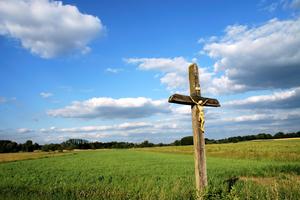
But Christianity is different from all other religions. The death of Christ and what it accomplishes is central to our faith. The crucifix is the central icon on and behind our altars. And we are enjoined to view our own sufferings — and then our own deaths — as, in some mysterious way, a “participation” in the death of Christ.
As St. Paul tells us (Romans 6:4), in baptism we are buried with Christ — and therefore we will also rise with Christ. Therein lies our hope that, having put to death our old sinful selves, we will now put on the mind of Christ and rise to glory.
But is that all there is to it? In our faith, there is indeed a sure hope of salvation. But does not the existential reality of death still grip us and fill us with a certain dread? We are all, after all, still fallen creatures, and the graces Christ brings do not for most of us lead to the level of cooperation with grace that gives us the sanctification required to be completely at peace with the reality of death. We stubbornly cling to our sins, and therefore certain aspects of death still vex us.
In particular, what haunts us is the sheer randomness of death — its reign of terror giving us no discernible pattern of meaning. Death is no respecter of persons; it seems to strike with a severe and opaque randomness that shocks us with its apparent lack of any coherent guiding principles. This is of no issue for the atheist, since such randomness is precisely what they would expect.
But for the Christian, convinced of the reality of God and the resurrection, the randomness of death is a nettlesome theological “problem” — yet also a provocation to deeper reflection and thus a deepening of faith.
Such randomness, devoid of a clearly perceptible rational purpose, unsettles our souls in profound ways. The suffering and death of the innocent troubles us the most.
Innocent children die every day in the most horrific of circumstances — war, disease, famine, abuse and random accidents. And yet little Adolf Hitler rode his Austrian tricycle in peace and tranquility as a boy, with nary a scratch, and survived the bullets and bombs of World War I. Hitler survived the war, and yet the wonderful French writer Charles Péguy died from a bullet to the head in that same war.
The upshot of the apparent randomness of death is that it leads millions of people into either overt atheism or, at the very least, into an agnostic apophaticism that claims any and all divine actions are equally inscrutable. The fact that death’s randomness seems devoid of any orientation to fairness creates within us a sense of despairing meaninglessness.
Perhaps it is impious to ask such questions. And some would indeed say that we should not ask them. But in such questions lies a deepening of spiritual insight into the full meaning of our participation in the death of Christ.
For example, the psalmists in their lamentations routinely cry out in the agony of what seems to be divine abandonment of God’s covenant promises to Israel. They frequently lament the shocking sufferings of God’s righteous ones at the hands of evildoers. In doing so, they wonder aloud — in the form of prayer — why God’s kingdom seems a random jumble without a discernible pattern of divine action regarding the righteous versus the unrighteous.
The shocking nature of the Psalms, unparalleled in world religions, is the bracing honesty of their questionings of God’s ways that appear so indifferent to the plight of Israel. And this, once again, gives biblical warrant to the questions we ask. Revelation, in other words, indicates that God actually blesses such questioning as part of the path to wisdom.
Therefore, those who see in such questions nothing but blasphemous doubting of God’s ways are actually being unbiblical. The friends of Job come to mind in this regard, since they offer up all the usual pious “formulas” that seek to impose a theological rationality on his apparently random and unmerited sufferings.
When it comes to the ineradicable randomness of the events of our lives and of the natural world — and to the untimely deaths of the innocent — we are granted by God himself the permission to be disturbed. Indeed, the disturbance in our souls caused by such random evils devoid of discernible rational purpose seems to be the biblically warranted way of coming to a deeper appreciation of the full weight of sin, especially in light of all its downstream consequences.
Jesus himself quotes the lament at the beginning of Psalm 22: “My God, my God, why have your forsaken me?” — a deeply anguished plea from the psalmist for God to deliver him from the ongoing assaults of evil people. Importantly, the Psalm begins with a complaint that God seems deaf to the prayers of the righteous and strangely indifferent to such plaintive pleas for help. The psalmist is in the midst of intense suffering at the hands of evil people and is in extremis — and yet God remains horrifically silent.
Significantly, the psalmist refers to evildoers as “bulls” and “dogs,” implying that their actions are those of nonrational, and thus nonmoral, animals. In other words, evil is portrayed in the Psalm as the irruption of the irrational and the random, indicating too the pointlessness of evil’s undifferentiated rage against righteousness.
The essence of the complaint, therefore, is that the application of God’s saving actions seems strangely random — to the point of being non-existent in any humanly discernible way.
Of course, the Psalm ends with a resounding affirmation of God’s steadfast love and confidence in his ultimate vindication of the righteous — a vindication that will lead all the peoples of the world to worship the one true God of Israel.
So too with our experience of the vexing randomness of death. If Jesus himself, in quoting Psalm 22 from the cross, validates our own lament about the randomness of death, we can be certain that no amount of theologizing will ever bring us to a level of rational closure that will “square that circle.” We are not given to know the “answer” to this problem through some exegetical magic decoder ring.
But we can at least say that the patternless nature of death is perhaps the pattern. Our pursuit of holiness should never be tied to clear and transparent quid-pro-quo forms of reward and punishment. The holiness Jesus beckons us to is grounded in motivations that transcend a calculation of risk and reward — as if the moral life could be properly adjudicated by an insurance actuary. Jesus himself (Luke 13:4-5) points out that those killed by the falling tower at Siloam were not bigger sinners than anyone else.
This shows us once again that in the Gospel, the randomness of death is viewed not as a theological problem but as a call to living in precarity — realizing that our lives may be called to the Lord at any moment, regardless of our moral standing.
As Jesus warns (Luke 12:20): “You fool! This night your soul is required of you.” And it is only in the incalculable nature of the mystery of death that such precarity can be lived. For only in precarity can we come to see that “all is gift,” and that only in our sacrificial descent (kenosis) with Christ into the mysterious depths of death can we achieve salvation.
- Keywords:
- death and dying
- adolph hitler
- memento mori