We Prayed to St. Jude — and the Doctors Were Astonished
COMMENTARY: A family’s gratitude to the ‘patron of the impossible’ blossomed into a lasting witness of hope and intercession.
My father, who suffered from peptic ulcers most of his life, was near death after physicians had performed a gastrectomy.
My entire family lived in the same home — my parents, brother, sister, two cousins, aunt and bachelor uncle — and they all gathered around the bed of my father.
I was an 8-year-old-boy who was all too familiar with death. Like other boys and girls my age, I sang in the children’s choir at many requiem Masses for deceased soldiers, sailors, airmen and Marines who returned home in coffins. I had an acquaintance with and even a kind of understanding of death that few children my age in peacetime ever could.
Our beloved pastor of St. Michael’s Church and close friend of the family, Father John Dronzek, came to the hospital and recited the prayers of the sacrament of extreme unction, now called the sacrament of the anointing of the sick. There wasn’t a dry eye in the room. I took my father’s hand and clung to it, believing that as long as I held it, he would remain alive. My mother, aunt and sister tried to comfort me, but my loud sobbing filled the room.
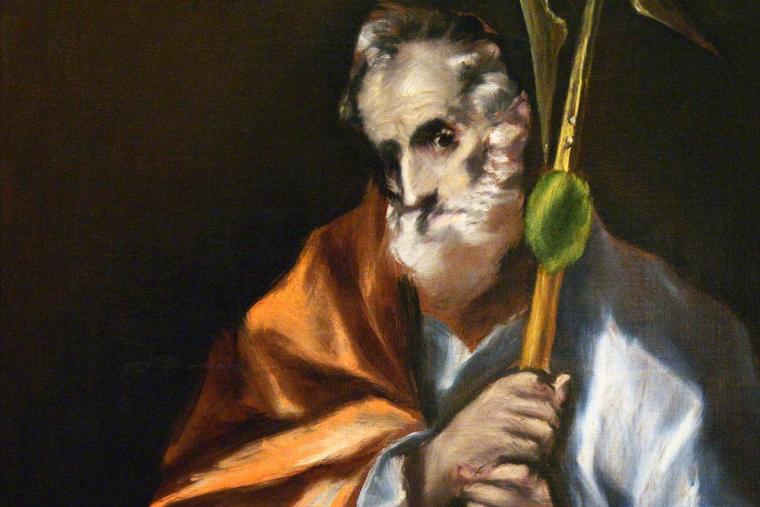
Suddenly, everyone became quiet when Father John recited a prayer to St. Jude Thaddeus, patron of desperate situations and lost causes. “He was the cousin of Jesus,” Father John said at the end of the prayer.
“Jesus wouldn’t let down his own cousin!” I said between sobs. (Years later, I learned there is still no consensus among theologians about St. Jude’s exact relationship to Jesus Christ.)
I joined my mother and aunt, who read from a small booklet that contained prayers to the amazing saint, known for his evangelizing in Armenia. It was there that he was martyred and venerated by Catholic and Orthodox Christians. Later, his remains were interred in St. Peter’s Basilica in Rome.
I remember that half the members of the family took turns going to the hospital so that my father would never be alone. My determination to be with my father in the hospital as much as possible trumped my mother’s insistence that I should not miss so many classes at St. Michael’s School. My mother tried to maintain her stoic bearing during this sad, stressful time, but her emotions broke through one day when Father John made one of his many visits to see my father.
I recall one evening in particular, sitting at my father’s bedside. I held his hand tightly and told him how much I loved and needed him. Aunt Rose, who came to live with us after she separated from her alcoholic husband, was with me that night. Her gentle, kind manner, coupled with a warm smile, reached out and enveloped me.
After countless prayers, especially appeals to St. Jude, my father suddenly improved. The physicians were astonished.
No sooner had my father been released from the hospital to recuperate at home than my parents announced to the family that they would purchase a statue of St. Jude, which would have a prominent place in St. Michael’s Church. Father John readily agreed with my parents that he would initiate a monthly novena to St. Jude.
While my father recuperated at home, my mother and Father John went to Boston, where she purchased a magnificent statue of St. Jude.
In the months that followed, my parents never missed a novena to the great saint. The novenas to St. Jude became so popular that Catholics from other parishes in Lynn, Massachusetts, attended them. Even after our family moved to Florida in 1949, the novenas at St. Michael’s continued.
Before we left for Florida, my parents wanted to visit the National Shrine of St. Jude in Our Lady of Guadalupe Church in Chicago. The Shrine had been established by Claretian Father James Tort, with the first novena offered in February 1929.
Father Tort took this initiative when his parishioners, most of whom were steel-mill workers, had lost their jobs during the Great Depression. Thereafter, especially during World War II, it became a major place of pilgrimage.
Today, the name of St. Jude is even better known because of the philanthropy of Danny Thomas, the popular entertainer from the 1950s to the 1970s. He vowed that he would build a shrine to St. Jude if he helped him during a time of personal and professional hardship.
When his career skyrocketed, Danny Thomas, true to his vow, established and funded St. Jude Children’s Research Hospital in 1962.
My Polish-born father, who had graduated from grammar school before he came to the United States, continued his education by extensive reading. He especially enjoyed the writings of the great Polish writers, Joseph Conrad, Adam Mickiewicz and Henryk Sienkiewicz. He also read everything he could on St. Jude, to whom he was dedicated until the end of his life.
Dad was aware of the theological debates about the relationship of St. Jude to Jesus Christ and St. Jude’s authorship of the Epistle of St. Jude in the New Testament. It never affected his devotion. There was a genuine closeness he felt toward the saint, who is traditionally believed to be a farmer, which was my father’s occupation before he left Poland for the United States.
When I was a high school student, my father confided to me that after the operation that came perilously close to taking his life, his prayers became more akin to daily conversations with St. Jude.
Curious by what he said, I asked him: “Papa, do you mean like the conversation we are having now?”
“Not exactly, Dicky. It’s more like a prayer coupled with questions to the great saint.”
I couldn’t resist asking, “Does he respond?”
“Not in an earthly way,” Dad said. “I sense his response in the inner warmth I feel. I think it is what you would call a spiritual answer.”
One of my father’s legacies to me is my own devotion to St. Jude, which my wife also shares. We have expressed our thanks to St. Jude for the past 45 years by monthly donations to St. Jude Children’s Research Hospital.
When I have my conversations with St. Jude, I always think of my beloved father.
- Keywords:
- st. jude
- miracles
- healing
- devotion to the sacred heart