Colorado Goes After Religious Liberty in ‘St. Mary v. Roy’
COMMENTARY: May Colorado exclude Catholic preschools from its Universal Preschool Program — a publicly funded benefit available to virtually every other provider in the state — simply because those schools operate according to their faith?
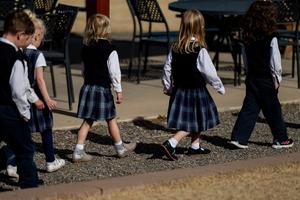
In a small parish preschool classroom in Littleton, Colorado, 4-year-olds learn to pray, hear Bible stories and begin to understand that they are children of God. Their parents chose this place deliberately because its approach to childcare aligns with their Catholic faith. And the state of Colorado wants to make them pay extra for that choice.
That is the human reality at the heart of St. Mary v. Roy, which the Supreme Court has agreed to review. The question: May Colorado exclude Catholic preschools from its Universal Preschool Program — a publicly funded benefit available to virtually every other provider in the state — simply because those schools operate according to their faith? An amicus brief I just filed on behalf of The Conscience Project and five Catholic families from the Archdiocese of Denver argues the answer is No.
Colorado’s program promises 15 hours of free weekly preschool to every family. But to participate, private schools must agree to enroll children regardless of “sexual orientation” or “gender identity” of the child or family — a condition the Archdiocese of Denver cannot accept without violating its own carefully developed guidance on human sexuality, rooted in the Church’s understanding of the human person. The result is that Catholic preschools are shut out of a program funded by the same taxes Catholic parents pay.
The Conscience Project brief grounds this fight first in Catholic teaching. The Second Vatican Council’s Gravissimum Educationis, cited in the amicus brief, declares parents the “primary and principal educators” of their children. Writing on the 60th anniversary of this document, Pope Leo XIV reaffirmed these principles in his apostolic letter Drawing New Maps of Hope — also referenced in the brief — writing that “when faith is true, it is not an added ‘subject’ but a breath that oxygenates every other subject.” Colorado’s mandate, which conditions participation in Catholic schools by altering precisely those identity-shaping practices, strikes at the core of what the Holy Father has defined as authentic Catholic education.
The legal argument is equally strong. Under the Supreme Court’s decisions in Trinity Lutheran, Espinoza v. Montana and Carson v. Makin, states that offer generally available educational benefits may not exclude religious schools for actually practicing their faith. Carson is especially clear that a state cannot condition public benefits on a school abandoning the religious instruction that makes it religious. That is precisely what Colorado has done.
Colorado also cannot hide behind Employment Division v. Smith. There, the Supreme Court allowed generally applicable laws to take effect even if they burdened religious exercise. Fulton v. City of Philadelphia added nuance to the rule in Smith that is important here, explaining that a law is not generally applicable whenever the government has built in a system of individualized exemptions.
Colorado’s program is riddled with such exemptions. The state grants categorical carve-outs for providers serving only children with disabilities, only low-income families, or exclusively LGBTQ-identified children and maintains a discretionary “catchall” through which individual preschools may seek additional accommodations, case by case. A program that bends for all of these secular interests but finds itself suddenly inflexible when a Catholic school asks to serve families who share its faith is not generally applicable. It is selectively rigid and that selective rigidity is precisely what Fulton held triggers strict scrutiny. Colorado’s exclusion cannot survive it.
What makes this case so compelling are the families at its center. Thousands of Catholic families in Colorado have been told that their faith disqualifies them from a program they, as taxpayers, help fund.
The Conscience Project amicus brief is not a document that treats religion merely as an identity label to be protected. It treats Catholicism as a complete vision of the human person that cannot be traded away as the price of admission to a government program.
The Conscience Project brief is one of more than two dozen amicus briefs in support of fairness in Colorado’s program. The United States explains that Colorado’s exclusion violates the Free Exercise Clause by conditioning participation in a generally available public benefit on abandoning religious practice. Twenty states warn that the decision threatens school choice programs nationwide by allowing governments to discriminate against faith-based providers.
Religious liberty organizations, Catholic and evangelical ministries, Jewish and Muslim organizations, legal scholars, and parental rights advocates each reinforce a different dimension of the case, but all arrive at the same conclusion: Governments may not treat religious schools as second-class participants in public life simply because they faithfully carry out their religious mission. The extraordinary breadth of support reflects a growing recognition that this case reaches far beyond one Catholic preschool in Colorado. The Supreme Court’s decision will shape whether religious schools across the country can participate equally in publicly funded educational programs without compromising the beliefs that make them distinct.
Letting Colorado selectively exclude Catholic preschools from its universal preschool program sends a chilling message to every religious school, parish ministry, and faith-based organization in America that they may operate freely, but not as equals in public life. The Supreme Court has an opportunity to correct that.
Until it does, Catholics can stand with these schools and the families who want their children to attend them, follow this case closely, and support the organizations fighting this battle.
- Keywords:
- colorado
- u.s. supreme court
- religious liberty