Catholic Charities Distributes Thousands of Masks in Twin Cities Amid Widespread Wildfire Smoke
Wildfires in Canada and Minnesota have spread smoke over much of the country, reducing air quality and visibility in major U.S. cities.
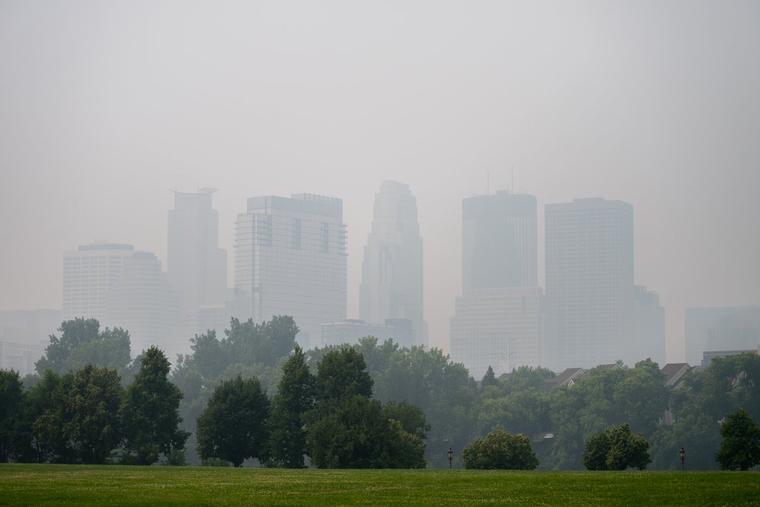
Catholic Charities workers in Minnesota distributed thousands of masks to vulnerable residents this week amid widespread smoke from raging wildfires both in Minnesota and in Canada.
Data from the Canadian government shows more than 120 “out of control” fires burning in the country, with a large portion concentrated north of Minnesota in the Ontario province.
The Minnesota government, meanwhile, issued an emergency declaration this week as wildfires spread across the northern part of the state. State Gov. Tim Walz said the fires “are posing an increasing threat to lives, property, and our wilderness.”
On its Facebook page, Catholic Charities Twin Cities — which serves the Minneapolis-St. Paul region — said it was distributing N95 face masks at its Saint Paul Opportunity Center. The center was also offering water, meals, showers, and refuge from the ongoing heat wave.
In a video shared by the charity, one Twin Cities resident said the smoke in the region was “very hazy,” making it “really hard to breathe.”
Catholic Charities is “really helping us,” said the man, who was wearing an N95 mask. The Saint Paul shelter “gives us a place to come inside [where] we’re away from this.”
Elizabeth Heger, the vice president of emergency services at the charity, told local outlet MPR News that the organization “went into high gear” after the air quality rapidly deteriorated.
“Our goal is to always make sure that folks are safe and that they have all the resources they need, especially in times like this when the air quality is really bad,” she told MPR.
A spokesperson for Catholic Charities Southeast Michigan, meanwhile, told EWTN News on July 17 that the organization had urged workers to work from home if possible to avoid the poor air quality.
The spokesperson said the charity was also shifting some of its caseload to house calls so that vulnerable residents would not have to venture out into the smoke.
As of July 17 there were more than 800 wildfires total burning across Canada. Numerous cities in the northeastern U.S., as well as cities further into the midwest region of the country, were under widespread air quality alerts.
Cities including Boston; New York; Washington, D.C.; and Baltimore all saw poor air quality accompanied by alerts mid-week, along with other cities including Detroit and Grand Rapids, Michigan.
Pervasive smoke was expected to continue into the weekend, though shifting wind patterns projected for next week were expected to give much of the U.S. a reprieve from the haze and poor air quality.
One U.S. lawmaker, meanwhile, has proposed sanctioning Canada over the wildfire crisis.
Sen. Bernie Moreno, R-Ohio, said on July 16 that he would introduce legislation to sanction the country for allegedly “fail[ing] to invest in wildfire prevention methods” such as “forest thinning, fuel reduction, prescribed burns, and stronger enforcement against arson.”
- Keywords:
- catholic charities
- wildfires
- canada
- minnesota