Running Barefoot Into America’s Debate on Life
COMMENTARY: When abstractions become daughters, arguments become conversations — and the Church’s defense of life is heard more clearly.
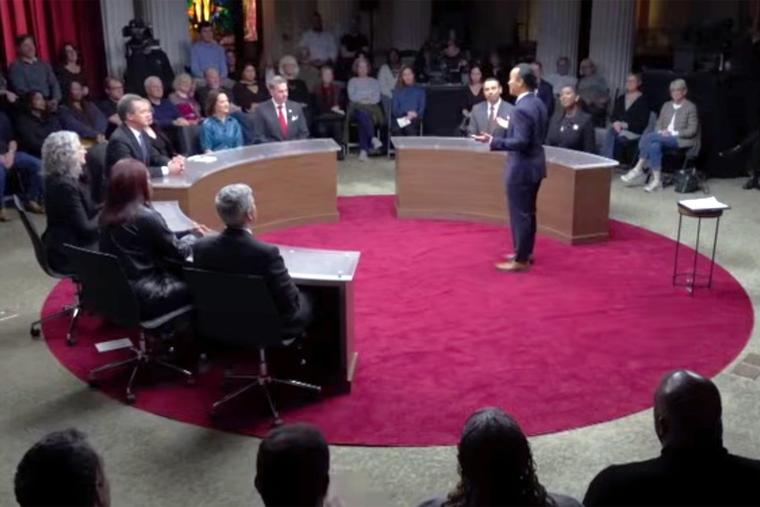
When a dear friend called recently at 10 a.m. asking if I could get to New York City that afternoon to film a PBS show, I should have asked more questions. But this was not just any show.
Breaking the Deadlock places real people of influence — academics, advocates, social media personalities — into scenarios where they must work through difficult moral questions: questions that touch on the sanctity of human life, while playing characters consistent with their actual beliefs.
The premise is simple but audacious: can Americans with deeply opposing views on hot-button issues find common ground when confronted with the human complexity behind their positions?
My friend, Roger Severino, vice president of economic and domestic policy at the Heritage Foundation, was in a bind. But he wasn't the only one. The show’s producers were in real trouble. Two other conservative women had fallen ill and declined at the last minute, and without at least one female conservative voice, the entire premise would collapse. The show could not break deadlocks between divergent views if those views weren't fairly represented. Could I possibly make it?
I said Yes and launched into my own version of Planes, Trains and Automobiles — minus the plane.
Airport security was not going to happen. So I pivoted to Washington, D.C.’s Union Station, kicked off my pumps, and sprinted barefoot through the terminal. I am reasonably fast in heels, but Olympic-level speed requires bare feet and desperation. I arrived just in time to watch the train doors close. Somewhere, Steve Martin was laughing at me.
An Uber to Manhattan it was. Hours later, somewhere in what I am pretty sure was either Pennsylvania or New Jersey, my driver pulled over for gas and a bathroom break. Meanwhile, back at production headquarters, the show's organizers were monitoring my location dot on their phones, wondering if their pro-life panelist had been abducted or simply abandoned the mission entirely. I assured them I was doing just fine.
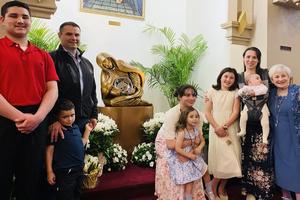
By the time I arrived at the spectacular New York Historical, my fellow guests greeted me like a returning war hero — or at least like someone who had survived a very ill-advised travel decision. We were quickly mic’d up, and only then did I get the full briefing. They needed “a pro-life woman with kids.” Boy, do I have kids. Ten of them. I qualified.
This was the third episode of the series, and I have to admit to being starstruck — both by those who had appeared in previous episodes and by my fellow panelists that day. This episode would tackle abortion, euthanasia and voluntary sterilization. No softball topics here. These are precisely the life issues that the Catholic Church has consistently defended, and where Catholic teaching offers moral clarity and pastoral sensitivity.
The show’s moderator, Aaron Tang, professor of law at the University of California-Davis, proved masterful at guiding us through these treacherous waters. His slow, deliberate rollout of each scenario’s complex details kept the conversation moving forward even as the moral stakes escalated. Just when we thought we had reached a resolution, Tang would introduce another complicating factor — a medical detail, a legal constraint, a character's previously undisclosed motivation — forcing us to grapple with the messy reality that real families face.
Here is what struck me: Watching the real pressures that women, girls and families face play out in front of us changed the room. Most of my fellow panelists are vocally pro-abortion.
But as the scenario became personal — as we accepted the fear, confusion, and competing loyalties of parents, neighbors, lawmakers and frightened teenagers — something softened. Not in everyone (the abortionist remained unmoved), but in enough people to matter.
When abstractions become daughters, arguments become conversations. This is where the Church’s consistent life ethic meets people where they are — not abandoning truth, but accompanying those who struggle.
The scenarios we grappled with are not hypotheticals for most Americans. They are the actual dilemmas families navigate in hospital rooms and around kitchen tables.
People are making these decisions right now, often feeling isolated in their struggle. The solutions should favor life. Catholic social teaching reminds us that every human person, from conception to natural death, possesses inherent dignity. But sharing this truth in the public square requires something our political discourse often lacks: the willingness to see the real struggles and real people wrestling with contradiction, and a return to our shared humanity.
That evening, running barefoot through Penn Station to catch my train home (yes, again with the barefoot sprinting), I reflected on what makes America exceptional. Despite the noise insisting that we are irreconcilably divided, we remain a people capable of genuine concern for one another. Even the most ardently opposed voices can sit together, listen, and recognize each other’s humanity.
The disagreements in that room were profound and real. No one abandoned their convictions. But we demonstrated something increasingly rare: the capacity to engage difficult questions without retreating into tribal certainties or dismissing those who disagree as enemies.
As we approach our 250th anniversary as a nation, Americans face no shortage of deadlocks. But perhaps the path forward is not about winning every argument or achieving perfect ideological consensus. Perhaps it is instead about recovering the ability to see each other as more than opposing positions — to recognize the struggling parents, the frightened teenagers, the brothers caring for their dying father in every policy debate.
If a diverse group of strangers can do that work together — even if it requires one of them to sprint barefoot through multiple train stations to get there — then maybe we have not lost the capacity for the difficult, messy, essential work of democratic citizenship rooted in the recognition of our shared human dignity after all.
- Keywords:
- prolife
- andrea picciotti-bayer
- abortion
- debate
- culture of life
- culture of death
- assisted suicide
- sterilization