‘That Baby Was Me’: Bishop Cozzens Moves Crowd With True Pro-Life Story
At a 40 Days for Life closing in Minnesota, the Crookston bishop recounts how his mother refused an abortion recommendation — and how that decision shaped his lifelong pro-life witness.
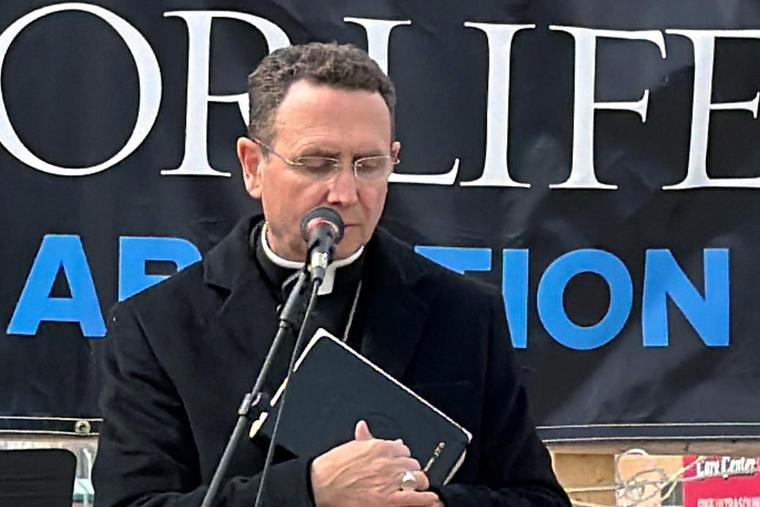
On March 29, pro-life advocates in the city of Moorhead, Minnesota, gathered to close in song and celebration their area’s first spring 40 Days for Life campaign.
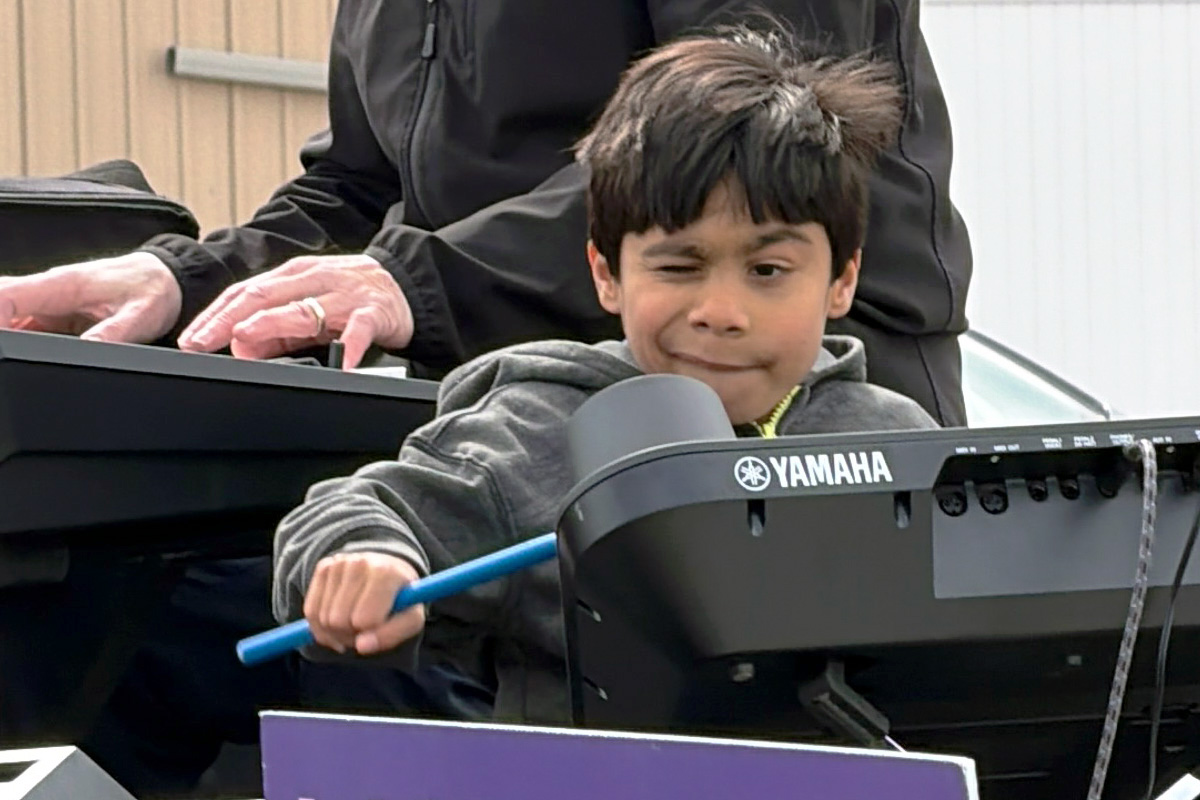
The focal point of the event was a makeshift stage on a flatbed hooked to a pickup, on which two musicians were perched — Tim Mosser, director of the neighboring Diocese of Fargo’s respect life office on the keyboards, and his adopted son, Romeo, 8, on digital drums.
Along with several local witnesses, who told of a baby saved from abortion the first day of the campaign, and another possible save at its end, was a distinguished, but humble, special guest, who’d come with prayerful words of encouragement and a story that brought zealous applause.
“We don’t want abortion clinics anywhere, but especially in my diocese, right?” said Bishop Andrew Cozzens, shepherd of the Diocese of Crookston, seemingly reclaiming the area over which he has spiritual authority that had fallen into the enemy’s hand.
It wasn’t his first visit to the area. Bishop Cozzens had stood in the same place under a large tent for a pro-life gathering on Aug. 19, 2022.
Roe v. Wade had just fallen a few months earlier, and the only abortion facility in North Dakota, the Red River Women’s Clinic, had, earlier in the month, pulled up their stakes and headed across the Red River, just a few miles east, to Fargo’s neighboring city, Moorhead, Minnesota.
They were adamant that abortions were going to keep happening in an area that would otherwise now be without an abortion business.
But area Catholics and pro-life advocates had their own plans, and on that summer evening, they rallied to protest the move. Hosted by the St. Paul-based Pro-life Action Ministries (PLAM) and headlined by international pro-life leader David Bereit, that event brought another special guest who quietly appeared among the throng — a bishop who’d just been named to the diocese.
That night, Bishop Cozzens spoke with the concerned citizens, and to the crowd, sharing his thoughts on what these recent decisions and moves would mean. His return to the area four years later seemed significant.
The spot across the street from the abortion facility near where that rally occurred back in 2022 now boasts a Women’s Care pregnancy resource center. As Bishop Cozzens shared his thoughts, its pink sign could be seen behind him, testifying that this battle is not yet won by the enemy after all.
Recounting the history of that dead-end street, Bishop Cozzens said, “I’ve really felt the weight of what that means; that here we have a place in our own backyard, our own home, where death is considered a solution.”
He continued, “We know that the only ones who rejoice in that are the enemies of God. Which aren’t the people who work here — they aren’t the enemies of God. It’s the forces that influence them. That’s our only enemy.”
And though the 40 Days for Life campaign has ended for now, he said, “The death does not, and so we continue to find ways to dedicate ourselves to prayer and sacrifice to be here.”
A few minutes earlier, Bishop Cozzens had shared a story that left those gathered visibly moved. It was about a pregnant mother who, at 20 weeks, was hospitalized when her water broke too early.
“The next morning, the doctor came in and said, ‘I’m sorry to inform you that the child in your womb is severely deformed, and I think we should induce labor,’ which would have been effectively an abortion at this point,” he shared.
But being Catholic, the woman said she didn’t care if her baby had deformities, because he was a gift from God, he explained. “You don’t understand,” the doctor replied, as the bishop shared. “This child is a freak.” To which the woman replied, “You don’t understand. I want a new doctor.”
From there, she was placed in the care of a retired physician, a specialist, and put on bedrest. But because the new doctor wasn’t covered by her health insurance, he suggested they strike a deal with the first doctor; that if the baby were born healthy, that doctor would have to pay the bill, and if deformed, he would cover all of it himself.
The child was born about a month early, Bishop Cozzens said, and, aside from some allergies, was completely healthy. “Go get the other doctor and let him come see this freak,” the new doctor said, admiring the newborn.
“You might have figured out by now that that baby was me,” Bishop Cozzens said. “And that woman was my mother.” He’d been told this story many times throughout his life, he said, and because of that, and how his life “almost didn’t happen,” he’s “always had this place in my heart for the pro-life movement and importance of it.”
In fact, when he was first named a bishop in 2013, one newspaper headline reported, “Freak becomes bishop,” and went viral, translated into Italian as, “Il mostro diventa un vescovo.” “I got emails from all around the world when I was named a bishop.”
“Of course,” he added, “what that woman would do is what any of you would do — which is, simply, love the child God gives us. That’s actually secondary to the truth that we know — which is the dignity of a human life.”
The bishop continued, “That’s why we stand here today, praying that our culture would just recognize the dignity of a human life. That’s a dignity that’s inalienable, we say, because it comes from God.”
In this culture of death, he remarked, death becomes an acceptable solution to problems, but death is never a solution to problems. “Life is always God’s choice, and always God’s solution.”
Bishop Cozzens also mentioned the congruency between the 40 Days for Life campaign and the 40 days of Lent just past, and how “the Lenten sacrifice is an imitation of Jesus’ sacrifice and 40 days in the desert, where he went out to do battle with the devil.”
Likewise, he said, “This is the place where we know that the enemy has a lot of power in the world, and so we come here to witness to Jesus and to his life, and give thanks for it, and to continue that struggle — which Jesus desires — the struggle against evil.”
After reading from the prologue of St. John’s Gospel, and offering a blessing and closing prayer, the musicians continued leading the crowd in a few more inspirational songs, with little Romeo on the drums, proudly offering his gifts to the world.
- Keywords:
- abortion
- prolife
- bishop andrew cozzens