‘We Must Learn to Listen to Each Other’: Homily for Italian Priest Who Died by Suicide
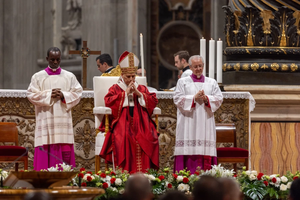
The funeral of Father Matteo Balzano, a young Italian priest who recently took his own life at the age of 35, was held July 8 in the presence of the faithful — especially young people — he served at the parish in Cannobio in the Piedmont region.
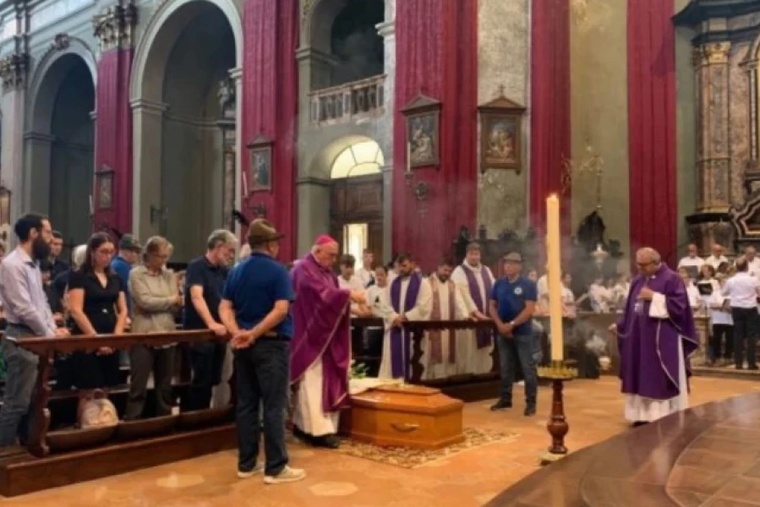
The funeral of Father Matteo Balzano, a young Italian priest who recently took his own life at the age of 35, was held July 8 in the presence of the faithful — especially young people — he served at the parish in Cannobio in the Piedmont region.
Bishop Franco Giulio Brambilla, of Novara, who offered the funeral Mass, gave an impromptu homily marked by hope but with considerable effort due to the fact that he was, as he put it, “devastated by grief.”
Before the tragic event, Father Balzano had resumed his mission among the young people at the oratory of the parish in Cannobio, so Bishop Brambilla wanted to address them in particular: “I was struck by the inconsolable grief of the young people, the same ones who are here before us today,” he commented.
Addressing the faithful of the Diocese of Novara, Bishop Brambilla openly shared that the “unimaginable and incomprehensible news of the traumatic death” of the young priest left him “shocked and speechless.”
He also expressed his gratitude to the priests and laypeople who have written to the diocese to express their closeness: “I have noticed that, above all, such a tragic circumstance has made us rediscover what is true, profoundly true, in our lives: the profound bond that unites us in the Lord Jesus,” he noted.
He then shared some reflections that he said arose from his “heart torn apart” by grief.
First, he recalled when Jesus sent the apostles to prepare the Passover and explained that, in the same way, all the faithful “must help the bishop, the families of priests, the priests, and especially the younger ones, not lose the compass that points to the deepest meaning of the priest’s mission: to prepare the Passover, to eat the Passover.”
“Preparation, setting the table for Passover, is the meaning of our entire mission, which means guiding the life of every person, every family, every child, adolescent, and young person to understand that the most difficult, but also the most beautiful moment of life, is to go through the Passover, which means ‘passage,’” he explained.
He pointed out that, when difficulties arise, “it’s important to understand that there is something greater that drives us forward, and that is the Lord Jesus, who dies with us, accompanies us, and makes us rise with him.” Thus, he encouraged priests to “never lose” the sense of this reality.
Faced with this reality, he emphasized that “our language, our ways of speaking, must be edifying and reveal the communion that unites us. Only in the face of the truth of life and death can it be revealed whether our language edifies and whether our actions build communion,” he added.
He also noted that, after what happened with the young priest, he understood that “we must learn to listen to each other, to speak the truth more simply, to not hide our most intimate sufferings, to be open with one another in a transparent way, because this is the essential condition for building together the preparation for Jesus’ Passover.”
At the end of his homily, he invited those present to “take more care for the soul” and give less importance to material things: “Our homes are too full of things, but poor in what is meaningful for living,” he said.
“Don Matteo’s presence, his contagious spirit, his beautiful person, all these people present today in these saddest of circumstances, reveal to us precisely that there exists a profound bond, without which we run the risk of suffering from spiritual anemia,” he commented.
The Italian prelate confessed that he doesn’t know if his heart “will ever stop crying, but I know that from now on and forever I will never be able to forget Don Matteo.”
Suicide is contrary to the dignity of life, as the Catechism of the Catholic Church explains, but help and hope are available. If you or someone you know needs help immediately, call or text 988; Catholic resources may be found here.
This story was first published by ACI Prensa, CNA’s Spanish-language news partner. It has been translated and adapted by CNA and the Register.
- Keywords:
- praying for the dead
- suicide