St. Rita of Cascia: Augustinian Patroness of the Impossible
SAINTS & ART: The feast of St. Rita of Cascia, celebrated May 22, reminds us of the healing power of prayer, penance and forgiveness — and her spiritual kinship with Pope Leo XIV, the Church’s new Augustinian pope.

Although an optional memorial on the U.S. liturgical calendar, we should pay attention to St. Rita for two reasons:
- She is in many ways the patroness of people with unhappy or difficult marriages; and
- She was an Augustinian saint, worthy to note two weeks after the first Augustinian, Leo XIV, became Pope.
St. Rita was born in the Umbria region (from which Francis of Assisi came) in 1381. She expressed a desire to become a nun (there were Augustinian nuns in her parish) but her parents had other plans: she entered an arranged marriage at age 12 with Paolo Mancini. Mancini was abusive and some sources claim unfaithful. Their marriage lasted 18 years and she bore him two sons. It ended when he was murdered by a local family with which he had been carrying on a blood feud. Throughout her marriage, Rita was known to have tried to persuade her husband to change his ways and live a faithful, Christian life.
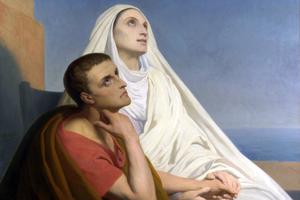
According to local custom, her sons should have killed somebody from the rival family to avenge their father’s death. While she forgave her husband’s killers, social expectations were that her boys pursue the vendetta. Like St. Monica, Rita prayed fervently for her boys that they not commit that sin. God seems to have answered her prayers by letting both die from natural causes first.
Now alone, Rita sought to pursue her original path and enter the convent. Twice she applied and twice she was refused, apparently because one of the rival families had members in the convent and Rita’s presence would be disruptive to the community. While she forgave the other family at her husband’s death, the families themselves remained at enmity. She invoked her three patrons — St. Augustine, St. Nicholas of Tolentino and St. John the Baptist — and managed to reconcile the families, even by a signed agreement. Around 1417 she finally entered the Augustinian convent, where she would remain as a model religious for 40 years.
On Good Friday 1442, contemplating Christ’s Passion, St. Rita asked to have even a small share in Jesus’ suffering. A thorn (as in the Crown of Thorns) appeared and pierced her forehead. Until the end of her life, Rita bore this partial stigmata of Jesus’ Passion.
Before she died, St. Rita received a visitor from her native area, who asked if she could do anything for her. Rita asked for a rose from the family garden. The visitor left, baffled by the request — it was January. But when she passed Rita’s old home in Roccaporena, she found a single white rose blooming, which she brought back to St. Rita. The land had been where St. Rita’s contentious husband Paolo and her two youthful sons had been buried, three persons for whom she had prayed fervently over those many years. As the Augustinians put it:
The dark, cold earth of Roccaporena, which held their mortal remains, had now produced a beautiful sign of spring and beauty out of season. So, Rita believed God brought forth, through her prayers, their eternal life despite tragedy and violence. She now knew that she would soon be one with them again.
St. Rita of Cascia died May 22, 1457. Upon her death, a local carpenter who was grateful for the social peace Rita brought to Cascia said, “If only I were well, I would have prepared a more worthy place for you.” He was then healed, making a coffin that held her remains for several centuries.
Because she made peace between families that considered it impossible, because she contributed at least partially to her husband’s reform, and because she prayed so ardently for her husband’s and sons’ salvation, Rita has often been spoken of — like St. Jude Thaddeus — as a patron of “impossible causes” and of difficult marriages. Her incorrupt body remains in a glass coffin in Cascia, Italy (about 100 miles northeast of Rome) today. And 125 years ago on May 24 another Leo — Leo XIII — canonized her.
The Augustinians have established and maintain the National Shrine of St. Rita of Cascia in Philadelphia. Originating as a stable turned into a South Philadelphia parish church, the Augustinians ministered to the English and Italian community of the area. Later, when the parish was in danger of closing, an effort was launched to reinvigorate devotion to St. Rita, and the current national shrine designation dates from 2003.
The painting I chose to depict St. Rita is a retablo, painted in watercolors, coming from early 19th century New Mexico. Pedro Antonio Fresquís (1749-1831) painted a lot of religious art in this primitive American style (e.g., two-dimensionality) in the Santa Fe region. He is sometimes called the “Master of Truchas” because of two altar screens in a church in that town.
St. Rita is depicted in the black religious habit of the Augustinians, with accent placed on her penitential mortifications: she holds a crucifix and a skull (reminding of mortality). It is unclear to me whether she holds a rosary or, more likely, a metal cilice for penance. The eyebrows extending into the nose are characteristic of Fresquís’ art. The two cypress trees are claimed by one commentator to represent her sons. The painting is on display in a rich but somewhat less well-known art collection: Philadelphia’s Barnes Foundation, renowned for its Impressionist, Post-Impressionist, and Van Gogh holdings. It also holds five other Fresquís religious paintings.
On the centenary of her canonization, St. John Paul II described Rita thusly: “Rita interpreted well the ‘feminine genius’ by living it intensely in both physical and spiritual motherhood.” Family peace and spiritual conversion — let us invoke her spiritual motherhood in our times.
- Keywords:
- st. rita of cascia
- saints & art