St. Rita Chose Peace Over Revenge — and Found Christ in Suffering
Through prayer, peace and sacrifice, the “saint of the impossible” shows how suffering can become union with Christ.

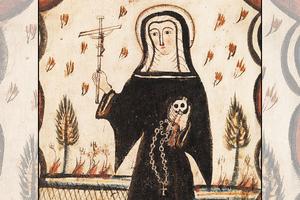
St. Rita of Cascia (1381-1457) was born in Italy. From a young age, she had a strong faith and prayer life. Unfortunately, she was pushed into marriage. During her marriage, she raised twin boys. Her husband was a cruel man who had a terrible temper. He died nearly two decades into their marriage in a brawl.
Both of Rita’s sons were enraged following the death of their father. They desire to seek out revenge towards those responsible for his death. Even though their mother cautioned them against such actions, they could not be convinced otherwise. Rita took to prayer and intensely asked God for help so that her sons would not commit murder. Her sons died not long after the death of their father by illness, never committing such an action. Rita entered the Augustinians and dedicated her life to deep prayer and works of charity.
The mission of her life can truly be summarized in her following words: “Love God above all things. His goodness being infinite and his beauty without comparison, you should keep always before your minds the great love he has for you as Father, Spouse, and Master. ... May you always remain in holy peace and love with your beloved Spouse Jesus Christ.”
Her first line can be confusing to some people, Catholics and non-Catholics. How can someone say that you should love God more than one loves their spouse or child? Doesn’t that mean that I don’t truly love my family if I love someone else more than I love them?
This mindset is common but not problematic. To place God first in one’s life means that one is placing the correct priority as number one. God is the source of our life and he is the only one that can truly satisfy the longings of the human heart. Second, loving God above all else enables a person to love their family more. The closer we are united with God, the more we become like him. The more we become like God the more that we will become sacrificial and loving. Rita knew this and experienced it in her daily life.
Rita’s twofold use of the term “spouse” is also significant. Many saints write and talk about the analogy of spousal love in the spiritual life. Being a disciple and living one’s faith is ultimately the acceptance into the love story of our existence. The God of the universe, who knows you by name, desires to have a deep relationship with you. He desires to encounter you powerfully each and every day.
The depths of love that Christ longs to convey to us can be seen in one important moment in the life of St. Rita.
One year, on Good Friday, Rita was meditating on the sufferings of Christ. In her loving embrace of Jesus crucified she desired to comfort Christ in his last moments. She even offered to relieve him of some suffering, if he desired her the grace to do so. In this moment, she received a rare form of the stigmata. A wound appeared on her forehead as if she had been pierced by the crown of thorns. This mark remained on her forehead for 15 years.
In keeping God as the most important thing in her life and in desiring to be attached to Jesus in all that he loved (including his suffering), St. Rita reveals that drawing close to God is the pursuit of two lovers. Just as a spouse seeks to make sacrifices for their beloved, we can make offerings for Jesus and for others. Just as a spouse seeks intimacy with their beloved, God seeks to give us a pathway into his heart.
Both our offerings and our intimacy with God are accomplished first through the movement of his heart toward us. However, the encounter with him hinges on our acceptance of deep prayer time with him each day. Today, may we be urged to meditate more deeply on the love of Christ — so that the witness and words of St. Rita may change us in the process.
- Keywords:
- st. rita of cascia