Wounded in Battle, He Fought for Christ: The Story of St. Ignatius Loyola
SAINTS & ART: A cannonball shattered his leg — and set him on the path to sainthood, founding the Jesuits and transforming the Church.
The founder of what traditionally has been the largest male religious order in the Catholic Church — the Jesuits — came into the world in 1491 (a year before Columbus sailed) as Iñigo de Loyola. His family’s castle was in Loyola, in the Basque country of northern Spain. His birthplace today is a sanctuary.
His family was part of the nobility and Ignatius may have spent some time at court. His connection to the court, Juan Velásquez de Cuellar, died in 1517, which led to the next major change in Ignatius’ life: a turn to military service. It would also lead to his decisive conversion.
Ignatius took part in resistance to the French siege of Pampeluna in May 1521 when a cannon ball ripped open his left leg and shattered his right. When the Spanish surrendered, he was brought back to Loyola for recuperation — which consisted of having to rebreak and reset his leg and later to saw off protruding bone.
During his forced recuperation, Ignatius read. He wanted to read tales of chivalry but the castle primarily had books of lives of the saints which, for lack of other reading material, became Ignatius’ literature.
With his enforced convalescence, the reading has its effect. Always ambitious and striving to distinguish himself, Ignatius rethought his life priorities: Why fight for a king when he could fight valiantly for the king of kings? Living up to the valor of the saints began to appeal to him.
Upon his recovery, Ignatius made his way to the shrine of Montserrat, where he made a general confession and donned sackcloth. He left his sword and dagger at Our Lady’s altar, then continued on his way. He found himself in Manresa where, in a cave, he retired to pray and meditate. He experienced attacks of scruples but managed to fend them off with the help of a good confessor. This period also led to the beginnings of his great work, The Spiritual Exercises, which remains a part of every Jesuit’s formation.
He then sailed for Jerusalem, from whence the Franciscans in charge of the Holy Land sent him back, not wanting to multiply the Christian prisoners for whom they paid ransoms. Again in Europe, he dedicated himself to studies, eventually at the University of Paris, where he took his master’s. The group of men he assembled around himself there eventually took vows in 1534. In 1537, their efforts to reach the Holy Land barred by war with the Turks, they were ordained priests.
The question then became the establishment of an order. Ignatius wanted it to be the “Company” of Jesus — like a military company — and its profile did have something of a military chain-of-command structure. The new order was envisioned, however, to differ from earlier ones, most prominently by its members living and functioning more like diocesan priests, i.e., without the obligation of common choral recitation of the Divine Office. A strong emphasis was also put on obedience to and being at the disposition of the pope. In 1540, it received approval.
Its constitutions, originally somewhat fluid, took the shape they have even today in the 1550s under Ignatius as the first Father General of the order. Among the Society’s missions would be undertaking foreign missionary work at the pope’s behest and educating youth from all social classes. The distinctive and prolonged Jesuit formation process (“a reward for a lifetime well spent”) all took shape. The Society quickly grew and spread, especially in northern Europe, where the Jesuits were instrumental in rolling back parts of the Protestant Revolt during the Counter-Reformation.
Ignatius died in Rome in 1556. He was beatified in 1609 and canonized in 1622. His body rests in the Jesuit Church in Rome, the Gesù.
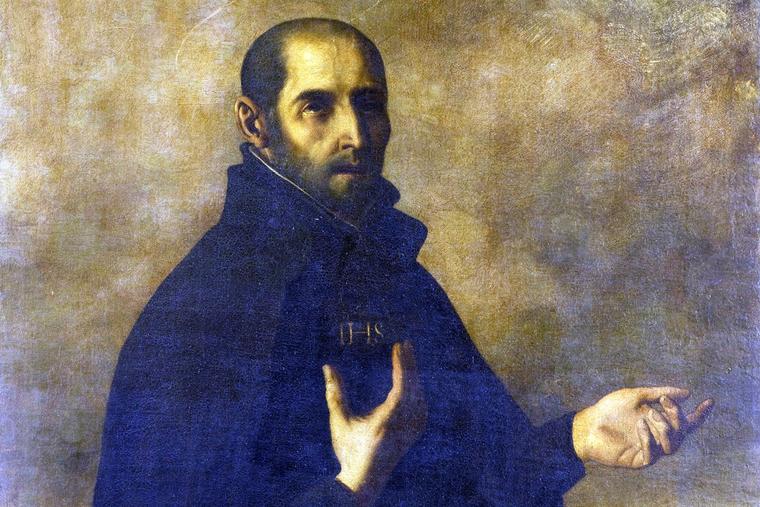
Our saint is depicted artistically by Spanish Baroque painter Francisco de Zurbarán (1598-1664). The oil painting is roughly 40 by 35 inches and is — paradoxically — held by the British Royal Trust Collection. According to its opinion, the painting is probably cut down from a full-length portrait of the saint.
In contrast to usual Baroque conventions, the color palette — brown and black — is austere, stark, and astringent (which reflected Ignatius and his rule). He wears a priest’s cassock, in keeping with the Jesuit desire not to have a distinctive habit. The saint is depicted touching a heart with the letter IHS — the first three Greek letters of Jesus’ name — symbolizing the Jesuits. Jesuit devotion to the Sacred Heart would come into its own with the development of devotion to the Sacred Heart in the 17th century.
Other richer depictions of Ignatius in this Baroque era (a style the Jesuits promoted) were painted by Flemish painter Peter Paul Rubens. The Norton Simon Museum in Pasadena, California, owns one such Rubens depiction of Ignatius.
On a personal note, I owe a great deal to the Jesuits. They enabled me to pursue graduate studies in theology at Fordham from 1981-85, first as a Loyola Fellow and then as a graduate assistant. Without their support, I would never have been able to complete higher theological studies. I join, therefore, in their motto: ad majorem Dei gloriam (“to the greater glory of God!”).
One of St. Ignatius’ famous prayers, often recited after Communion, here.
- Keywords:
- st. ignatius of loyola
- saints & art