Father Mike Schmitz on Charlie Kirk’s Death: Don’t Let Anger Harden Your Heart
“Is it a fool’s errand to try and make sense of something like this?” Megyn Kelly asked the Catholic priest.
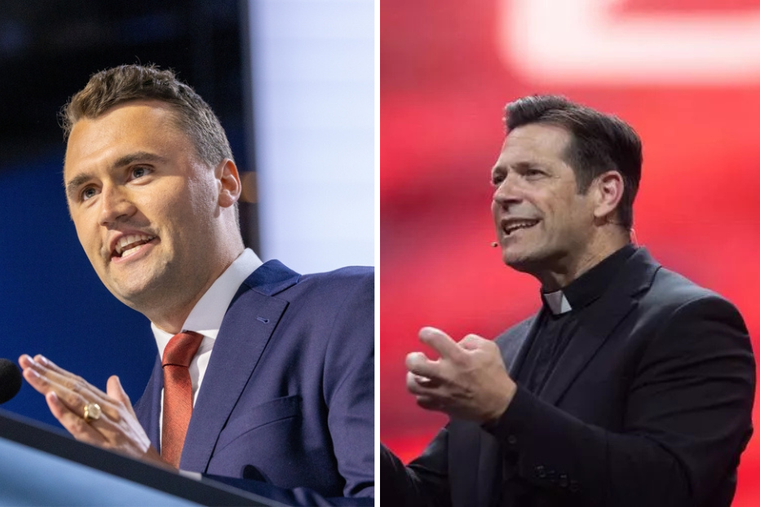
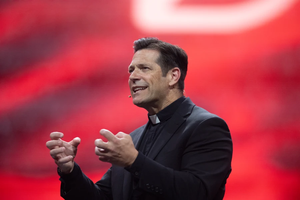
Just moments after reporting the devastating news of the tragic killing of conservative thought leader Charlie Kirk of Turning Point USA, prominent podcaster Megyn Kelly invited Father Mike Schmitz on to her show to try and find some hope amid such sorrow.
The assassination of Kirk on a Utah college campus has gripped the nation, as Americans and people around the world pray for his widow and two small children — all while grappling with how best to move forward after such a harrowing week of madness and murder.
“Please help us understand. I don’t know how to process it,” Kelly implored Father Schmitz, who serves as chaplain of a Newman Center in Minnesota and is a popular podcaster.
“I know that you and Charlie have spent time together ... and you have been in the trenches with him, and you have had so many conversations with him offscreen as much as onscreen,” Father Schmitz said to Kelly. “Please know of my prayers for him and for you and for every other person who has loved him and been touched by his life.”
“Is it a fool’s errand to try and make sense of something like this?” Kelly then asked.
“Yes and no. ... I mean, your previous guest had pointed out that, for Christians, we know we live in a broken world,” the Catholic priest responded. “We know we have this freedom to be able to do horrible, horrible things to each other. And it’s not what God wants. And so to get to that point where we say, ‘How do you make sense of this?’”
“Here is what we believe,” the host of The Bible in a Year podcast told Kelly.
“We believe that God is good; he made this world good. But then, simply put, with our freedom, we chose to break the world. And we continue to choose to break the world, even though God continues to break into it.”
He continued, “I mean, just think about Charlie’s life as an example. The example is that he had come to this place of knowledge of and faith in the goodness of God in a broken world. And what is the symbol of Christianity? You might know this weekend is the Exaltation of the Holy Cross. And the symbol of Christianity is a cross.”
Father Schmitz reminded Kelly that the cross is a contradiction, explaining that “the Catechism says: There is no part of the passion of Christ — there is no part of his life, death and resurrection — that is not in some way God’s attempt to answer: ‘Why suffering?’ And so we have to know that that faith that Charlie has in that God, that God who has broken into this broken world, doesn’t take the pain away, doesn’t take the grief away, doesn’t undo his tragic murder, but, hopefully, in some way, we can console his family.”
“There is no way Charlie would want a single pundit to hold back on their commentary — no way. He would certainly not want this to encourage a crisis of faith,” Kelly interjected, going on to explain her current feelings. “He absolutely would not want to see that. And yet … I feel so angry. I was talking to my guest earlier, and my friend was saying we have to learn how to react in love and come together as a country. And I was just honest, saying: It makes perfect sense, and I know he’s right, but right now all I feel is deep anger. And I know I’m not alone — and how do you process that? That’s not a healthy emotion; it’s not something you should stay mired in. It corrodes you from the inside, and yet I know millions are feeling it.”
“Well, I think anger is the proper response. Really, when it comes down to it,” Father Schmitz carefully explained to Kelly, who was visibly upset during the interview.
“There is a time for everything: grief as well as anger; there is time for acceptance and those pieces of moving forward,” the priest added.
“Let’s use Jesus as our example. There were times when Jesus saw injustice and evil, and he was angered. There were people who refused to say it was good to reach out to help the helpless, and it very clearly says in Scripture: ‘Jesus looked at them with anger.’”
“And there’s a piece of that that’s like, ‘Okay, if I can look at evil and suffering and death, and senseless, tragic death, like two weeks ago — the shooting in Minneapolis — and now in Utah, to be able to look at that and not experience anger, is to have our metric off, to have our barometer off,” he continued.
“The proper human response to evil is anger because God’s response to evil is anger.”
“How do we keep that away from us?” Kelly implored Father Schmitz.
She then delved more deeply: “I look at my kids, and I think, ‘I don’t want these devils near them. I don’t want the devil near them. I don’t want evil coming for them.’ We talked about: How does one get to heaven? And is it just being a good person? And you said, no, it’s not just that. God expects you to work to get in. You have to actively be doing good deeds. And you have to be advancing his word and live in harmony with him. And, yes, I want to do all of that. Right now, I also want vengeance. I’m not sure that’s in line. I want to hurt whoever did it; I want him to suffer. And then I also want to do whatever I have to do to keep the devil away from the next one and certainly from all the people I love.”
“Yeah, and that’s why anger can be a positive emotion,” Father Schmitz said.
“C.S. Lewis writes about this: He says that sometimes we look at anger or violence or fighting as the wrong thing. No, we need to tamp that down. Sometimes we have to fight for the right thing. So when William Wilberforce saw slavery, he was angered by this, not merely grieved, but angered. And that grief, but also that anger, moved him to do positive things. And you and I know this: We know that anger indulged can become vengeance. And it also can become something worse, which is resentment and bitterness. Anger is an active emotion. Resentment is when things settle. What I mean by that is ...”
“You have to get through anger,” Kelly added.
“Anger can move us to do good,” the priest explained. “Anger can move us to say, ‘This is wrong, and I need to do something about this.’ For you to say I need to go on air, and we need to talk about this so that others don’t experience this, so that people know they are not alone; so that we can rally and say, ‘How would Charlie want us to respond to this?’ To use that anger to move forward … to do good. … Anger is like concrete that can be moved, but resentment is when I set that. And now I have hardened my heart toward a certain group of people, towards a certain individual; I’ve hardened my heart to the world. I’ve hardened my heart to God. So we can’t afford to go into resentment. But we have to know how to choose what to do with our anger. And so your response to anger, it would be a defect of humanity to not experience anger.”
As Kelly and Father Schmitz wrapped up their conversation, the priest reminded Kelly of Kirk’s own words:
“What did Charlie say so many times? … Why does he go on campus? Why did he go to Utah? Why does he go to any campus? He said because when people stop talking, then they start becoming violent. ... Even the fact that he gave witness to the reality — we fight through debate; we can argue. And what did he say? When we stop talking, then we devolve into … either we separate ourselves completely, or all we have is violence. And he did not want either of those to be a reality.”
- Keywords:
- father mike schmitz
- charlie kirk
- anger

Alyssa Murphy Alyssa Murphy is the Register's Managing Editor of Digital Assets. Starting her career on the airwaves in San Francisco, she has worked in all facets of media. Alyssa enjoys writing and covering stories that inspire and uplift. Register readers may be familiar with her voice from EWTN radio's Morning Glory. Alyssa currently lives in New Jersey just outside Manhattan with her husband Andrew and young daughter, Annabelle.