The US Bishops Have a Message on Immigration. But Will Anyone Listen?
It’s not just the White House that seems to be tuning out the Catholic hierarchy. In Baltimore, the bishops were open about their ongoing struggle to connect with a different group: American Catholics.
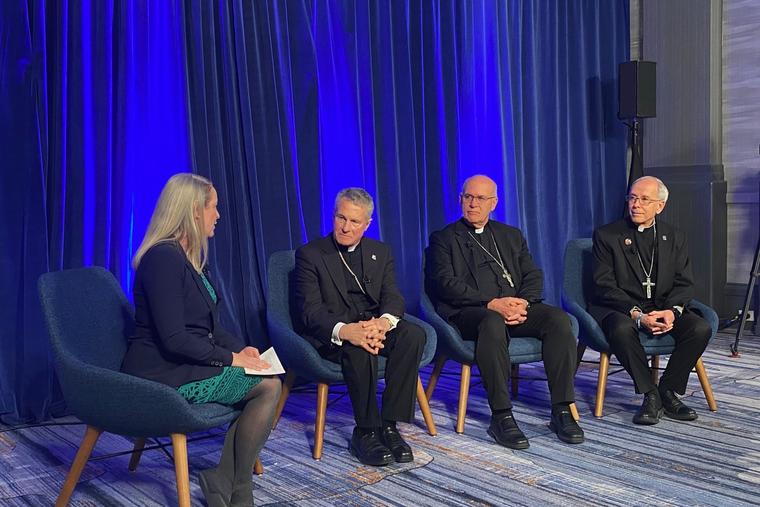
The Catholic bishops of the United States just delivered a forceful message on immigration in the face of the Trump administration’s crackdown. The first “special message” from the full body since 2013, the statement expressed solidarity with migrants without legal status, decried a climate of “fear” and “vilification,” and opposed the “indiscriminate mass deportation of people.”
Now, the bishops’ challenge will be getting relevant parties to read it.
That includes the Trump administration itself. During the U.S. Conference of Catholic Bishops (USCCB) Nov. 10-13 meeting in Baltimore, the bishops revealed that there is currently no direct line of communication between the USCCB and the top levels of the Trump administration on immigration enforcement.
“We’d love to see the time when we could just have a face-to-face, a reasonable exchange of views, and that would go for this administration as well,” said Bishop Mark Seitz of El Paso, the USCCB’s immigration head. “We’d love to do that. Unfortunately, we haven’t succeeded in having many contacts with this administration.”
The lack of open channels of communication on immigration enforcement between the bishops and the administration, which includes prominent Catholics like Vice President JD Vance, Secretary of State Marco Rubio, and border czar Tom Homan, stands in contrast to ongoing dialogue over religious worker visas.
Bishop Seitz said during the Baltimore meeting that he was “very optimistic” that conversations with the administration, which are being facilitated by Rubio, would help resolve a backlog of requests made by foreign priests serving in the U.S.
But regarding Trump’s deportation policies, the bishops are running into a wall. Bishop Seitz added that annual meetings between USCCB leadership and the White House, which were a fixture in previous administrations, have not taken place under this Trump administration.
Bishop James Massa, an auxiliary bishop of Brookyln and the USCCB’s doctrine committee chair, shared that while there are some “sympathetic listeners” within the Trump administration, his understanding is that “the most fruitful conversations so far have been unofficial.”
He also expressed concerns about the bishops receiving a listening ear “unless there’s leadership from the top that indicates this is the time that we have to move toward a comprehensive solution to the problem.”
Disconnect With Catholics
But it’s not just the White House that seems to be tuning out the Catholic hierarchy on immigration. In Baltimore, the bishops were open about their ongoing struggle to connect with a different group: American Catholics.
While America’s bishops are united in their opposition to the Trump administration’s current immigration policies, the picture among lay Catholics is more mixed.
Campaigning on mass deportation, Trump won the Catholic vote in 2024 by 12%. And while post-election polling of Catholic views on the administration’s policies have yet to be publicized, some have argued that a “silent majority” of American Catholics are in favor of Trump’s immigration crackdown.
In Baltimore, the bishops acknowledged that prudential applications of the Church’s teaching on immigration can vary. But their overriding concern is that too many Catholics aren’t even taking the Church’s teaching to heart to begin with.
In his farewell address, outgoing USCCB president Archbishop Timothy Broglio addressed this concern head-on, lamenting the apparent disregard among Catholics for the Gospel mandate to “have special care for strangers, aliens, and sojourners.”
“It’s not rocket science; it’s the Word of God,” said the head of Archdiocese for the Military Services, USA, adding that the bishops still have their “work cut out for [them]” in terms of proclaiming Church teaching on immigration.
But several bishops told the Register that their message isn’t just being ignored; it’s also being actively distorted. For instance, unsubstantiated claims that the bishops’ immigration advocacy is financially motivated are often circulated as a way of delegitimizing their message, including by Catholic organizations. Likewise, the bishops are routinely dismissed as being for “open borders,” despite clear evidence to the contrary.
“Give us some credit for being reasonable people,” said Bishop Seitz, who underscored that the bishops have consistently stated that a nation has the responsibility to secure its borders and have an orderly immigration process. The point was again included in the bishops’ Nov. 12 message, which states that “human dignity and national security are not in conflict. Both are possible if people of good will work together.”
In Baltimore, bishops also pointed out that the Biden administration failed to manage immigration responsibly, resulting in a surge of illegal border crossings, while the USCCB had advocated for comprehensively addressing America’s broken immigration system for decades.
But if the bishops’ message is so clear, why isn’t it landing with ordinary Catholics?
The problem, the bishops say, is that they’re up against powerful ideological voices with, as Bishop Seitz put it, “a much larger megaphone than ours.”
Archbishop William Lori of Baltimore, who just ended his term as USCCB vice president, agreed.
“The partisan messages are out there. They’re vitriolic; they’re pervasive; they are ubiquitous. It’s hard to compete with that,” he said.
The Baltimore archbishop added that the deeper problem is that some Catholics are taking their cues primarily from these partisan sources, rather than from the Church’s teaching. He said that when he receives mail that is critical of the bishops’ stance on immigration, he can easily tell “who reads what newspaper or listens to what podcast,” based off the talking points being used.
“The key is that our faith is not subservient to our politics,” said Archbishop Lori. “That’s the shift that has to be made.”
Explaining the Church’s Teaching
Several bishops expressed concern that some Catholics seem so deeply rooted in ideology that it can be difficult to make appeals to reason or Church teaching.
“Some people are blinded by ideology,” said Bishop Kevin Rhoades of Fort Wayne-South Bend, Indiana, who was just elected USCCB secretary. “And their first loyalty isn’t necessarily to the Church.”
But Bishop Rhoades told the Register that he thinks that group is a minority, even among Trump voters.
“I know a lot of Catholics who may have voted one way, but they’re with the Church on this issue,” said Bishop Rhoades, an adviser to the White House’s Religious Liberty Commission who has raised concerns about immigration-enforcement detainees lacking adequate access to the sacraments.
The key, he said, is continuing to explain the Church’s teaching on immigration, which he has found to be an effective approach in his diocese.
For instance, the bishops reiterated in Baltimore that immigration-enforcement measurements must be “proportional.” That is, as a matter of justice, penalties for entering the country illegally should have a similar weight as the original offense.
As an example, Bishop Rhoades said that automatically deporting an undocumented immigrant who has lived in the country for decades, paid taxes, broken no additional laws, and raised children in the U.S. lacks proportionality. A more fitting penalty, he suggested, would include paying a fine as a form of restitution as part of a pathway to legal residence.
“Is that saying it was okay that they entered illegally?” he said rhetorically. “No. But it’s having compassion” and avoiding a punishment that is “disproportionate to the infraction.”
Related to this is the bishops’ opposition to “indiscriminate” mass deportation. The term is meant to underscore that the Trump administration’s enforcement should distinguish between violent criminals and those who pose no threat and/or have been in the country for a significant amount of time. But while Trump said that deporting criminals would be his priority, the bishops contend that his actions have been far broader than that and have undermined due process.
“We lament that some immigrants in the United States have arbitrarily lost their legal status,” the statement reads. “We are troubled by threats against the sanctity of houses of worship and the special nature of hospitals and schools.”
At the same time, Bishop Massa acknowledged that overstating the Church’s teaching on immigration enforcement can be counterproductive.
For instance, some have argued that any form of “mass deportation” is “intrinsically evil,” citing St. John Paul II’s inclusion of the term in a list of moral evils in Veritatis Splendor. But St. John Paul II listed the term in close connection to genocide, not immigration enforcement, and Bishop Massa suggested that it is unhelpful to speak of “intrinsic evil” in contemporary conversations about deportation.
“I don’t think invoking that moral category is appropriate, nor is it effective,” he said, adding that Catholics must make “prudential judgments about particular policies.”
At the same time, Bishop Massa said that what is not up for debate is the responsibility of the Church to “aid those who are suffering.” The Brooklyn bishop specifically called out family-separation practices and indiscriminate roundups and also decried the Trump administration’s rhetoric, which has included comparing immigrants without legal status to a wave of virulent parasites that must be destroyed.
“You’re saying that about a 5-year-old who’s come with his family seeking a safe and better life for them? It’s appalling. It plays to a mentality that is deeply harmful and corrosive of the moral consensus of the culture. It’s not helpful. It really isn’t.”
Bishop Massa added that the bishops “hope for the day that we can get some more prudent and less incendiary rhetoric and leadership from our people in government.”
Engaging Effectively
With or without government engagement, the bishops are committed to preaching their message on immigration.
“It’s not enough to advocate with legislators about the principles the Church brings forward,” said Bishop Seitz. “We have to reach the grassroots in our country.”
To that end, the bishops are aiming to establish a network of USCCB immigration liaisons in each diocese who can “propose ways of bringing the message to parishes in each diocese,” Bishop Seitz explained.
The bishops are also committed to making the content of the USCCB’s guide on “Faithful Citizenship” and Catholic social teaching, more readily available. The plan is to promote it, including its messaging regarding immigration, not just during election season, but year-round. The bishops will also aim to present the document’s contents in more “accessible” ways, including on social-media venues like TikTok.
“That’s where the folks are,” said Archbishop Lori. “That’s where this has to go. We have to communicate with the culture we find ourselves in.”
Bishops are hoping to form the hearts and minds of Catholics not only through formal teaching, but also through experience. The conference is encouraging ways for U.S. Catholics to connect with immigrants who may be a part of their same diocese or even parish, but with whom they rarely come into contact.
“We’re in a position among all the faith communities in the United States to witness to the possibility of integration and peaceful coexistence within the diverse cultural reality that is the United States,” said Bishop Massa.
The bishops remain open to dialogue with the Trump administration and said as much in their Nov. 12 message. But they’re also prepared to continue their advocacy regardless.
“We would love to work with them, but we also see it as our responsibility to teach,” said Bishop Seitz. “That teaching has implications in life outside the church doors. It did for Jesus, clearly, and it got him in trouble. It will for any true disciple.”
- Keywords:
- catholic teaching on immigration
- usccb
- u.s. bishops meeting
- u.s. bishops
- immigration crisis