This Year, Popayán’s Holy Week Processions Are an Answer to Prayer
Art restorer Patricia Caicedo Zapata says a sacred image of Jesus that is carried in the Colombian city’s annual processions communicated a miraculous healing to her uncle last fall.

POPAYÁN, COLOMBIA — Patricia Caicedo Zapata believes she experienced a personal miracle last November, while working on one of the sacred images currently on display daily during this Colombian city’s unique Holy Week celebrations.
At the time, the art-restoration specialist was rescuing the Santo Ecce Homo, one of Colombia’s two most honored imagenes, or sacred images (the other is El Señor de los Milagros, a crucifix located in the city of Buga). The nearly-life-size figure, carved in 1680, had come near to disintegration; its wooden components and Italian-style sophisticated coloring suffered from cracks, cavities, termites, fungus and destructive earlier “repairs.”
The Santo Ecce Homo (“Behold the Man” in Latin) resides in Popayán, a community of 240,000 in southern Colombia. The city’s universities and colleges, representing an academic tradition dating back to the 1700s, have educated 17 Colombian presidents. Less honorably, the region harbors the nation’s primary coca and cocaine production, along with the gold ore that originally generated an urban enclave in the northern spur of the Andean cordillera.
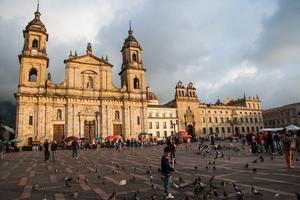
But Popayán’s strongest claim to renown? Its Semana Santa processions. Every Easter season, the city hosts Christendom’s oldest continuously observed Holy Week processions, dating back to 1558. Each evening, from Tuesday through Saturday, male citizens shoulder-carry 150 painted wooden figures, mounted on richly decorated pasos (platforms), along a 22-block route through the architecturally well-preserved colonial city center.
Pilgrims from across the country rally to Popayán at Easter. “The entire city core gets packed shoulder-to-shoulder,” said Felipe Velasco Melo, an orthodontic surgeon who is the current president of the Junta Permanente Pro Semana Santa. This volunteer organization, which has administered the celebration since 1937, estimates peak attendance at upwards of 100,000 on Good Friday.
Unlike the carnal Carnivals of New Orleans and Brazil, Popayán’s Holy Week parades are pious. Army and police bands are included in the nightly processions. The thunderous drumming creates a solemn chorus for the portable portraits of the Messiah’s whipping and crucifixion; the high-pitched chirping of xylophones negates an overly military effect.
Loud conversation and disrespectful behavior by onlookers are forbidden by stern black-dressed regidores (marshals), who carry black wooden crosses as staffs. Throughout the city center, military patrols bearing automatic weapons keep watch for more serious disturbances, although the mountain-laired narco-guerrillas who conduct the cocaine trade have not troubled the city in recent years.
Healed by Santo Ecce Homo?
Most of the Semana Santa’s holy figures, which almost all date from the 17th to the 19th centuries, were carved in Quito. That city, now the capital of Ecuador, was the center of ecclesiastical education and art in New Granada, a Spanish colony which at that time embraced all of northern South America.
Santo Ecce Homo, the oldest of Popayán’s imagenes, represents Jesus Christ at the moment of his presentation to the mob by Pontius Pilate. Caicedo, who holds a master’s degree in art restoration from Bogotá’s Jesuit-run Universidad Pontificia Javeriana, considers its meticulous restoration a highlight of her 35-year career. Last fall, however, she found herself unable to focus on the work.
“My Uncle Luis, who supported me for my first two years of university training in Quito, had suffered a severe embolism. His mind was already incoherent, and his entire right side was paralyzed,” recalled the 54-year-old professional. “The surgeon warned us that he was near death. Even if the emergency operation went well, a full recovery was considered very improbable by the doctor.”
“As I worked, I prayed to Jesus through the Santo Ecce Homo for a miracle. A profound peace came over me. I knew my uncle would be fine,” Caicedo recounted. “The operation drained 250 millilters of blood from one side of the brain, 50 milliliters from the other. Just one day later, however, the surgeon was surprised to discover that Uncle Luis was recovering quickly. Mentally and physically, his recovery has proven complete and stable.”
Caicedo’s faith in the imagenes is characteristic of her city, customarily seen as the most intensely Catholic in Colombia. The art restorer arrived from Bogotá in 1983, shortly after an earthquake with a magnitude of at least 5.5 — the most severe of the nine serious temblers that have rocked its history — had devastated many of its buildings, including churches.
The cathedral’s massive dome, for example, collapsed completely, destroying most of the structure. The death toll was 267. Skeptics noted that, ironically, the disaster struck on Thursday morning smack in the middle of Holy Week. Rubble choked the streets, preventing the two remaining processions of the week.
The faithful, in turn, noted that not one of the sacred imagenes — sitting on their pasos in churches, awaiting that evening’s procession — suffered any damage whatever. Caicedo’s arrival, which brought top-flight restoration skills to Popayán for the first time, formed part of the Catholic community’s massive effort to preserve its heritage of religious art and architecture.
A Faithful Belgian Participant
Also arriving in 1983 was a Belgian visitor who would come to play a unique role in the Semana Santa. Patrick Vanryckeghem, a banking accountant, immediately admired the city’s fortitude in addressing its earthquake damage. Raised in a devout Catholic family, he returned for the Semana Santa in 1984. And thus he entered the unique culture that supports the solemn festivity.
“The nightly processions include up to 18 pasos, and the pasos carry one to four imagenes,” Vanryckeghem explained. “The pasos change with every procession. In charge of each paso is the sindico, who appoints a team to do the necessary work. The sindico is a hereditary position, which has been passed down for centuries through the same families. Most sindicos are men, but women are not rare.”
There are 71 sindicos in total, whose teams total 40 to 50 people apiece. Before the procession, men and women “arm” the paso with gold and silver aplenty (the bases under the imagenes, canopy supports, candelabras, large medallions and more), rich clothing for the imagenes, candles and flowers. “From the start, I helped with these preparations in humble ways, like passing a hammer,” the 59-year-old Belgian said. “And I kept returning, year after year.”
Eventually, a sindico made the Belgian a pichonero. These porters carry the paso for one city block at the beginning and end of the route, but no farther. When Colombian President Juan Santos Calderón attended the event several years ago, he willingly accepted the role of pichonero.
Santos was not offered the infinitely more august role of carguero, nor would the president have dreamed of asking for such an honor. Laboring in teams of eight, cargueros carry the pasos for 20 blocks. The work can be heavy: A paso can weigh as much as 300 kilograms (660 pounds).
Payanesos (residents of Popayán) easily appreciate the contributions to their annual festival by choirs and orchestral musicians, bishops and priests, the regidores (marshals) who maintain parade order, the streaming files of students bearing candles, the children who remove the accumulating wax off of the tall paso candles with long-handled scrapers and so forth.
But in the minds of payanesos, the cargueros in particular epitomize personal devotion to Jesus Christ, the Virgin and the saints. Their names have long been registered, and that register contains the name of only one foreigner: Patrick Vanryckeghem.
“Honestly, I never sought the role, but, of course, I feel very honored,” the Belgian said. “And I am personally a true santero, someone who is devoted to the Semana Santa. My home city is Tournai, an ancient center of Catholic worship. Today, Sunday services are held in only one of the 10 churches in its historic district. So I appreciate that Popayán preserves its traditions and its faith.”
Mike Byfield is a Canadian journalist currently traveling in Latin America.
- Keywords:
- colombia
- holy week
- mike byfield
- popayán