Recap: A Mexican Mission of Mercy for Pope Francis
During an intense five-day trip, Pope Francis devoted special attention to Our Lady of Guadalupe, met with the nation’s bishops and visited some of Mexico’s most impoverished peripheries.
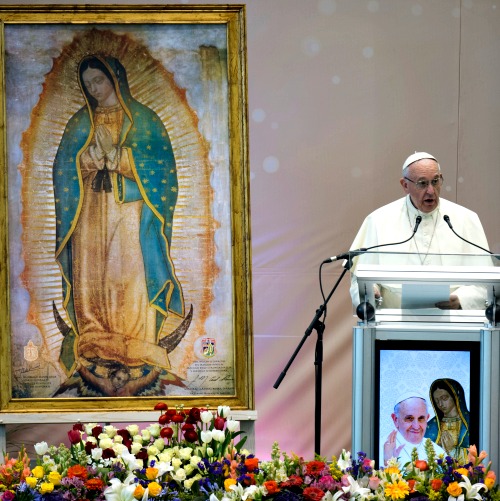
ROME — Pope Francis landed back in Rome Thursday afternoon after an intense five-day apostolic voyage to Mexico, in which he crisscrossed the world’s second-largest Catholic country, visiting some of its most impoverished and peripheral areas.
A “Missionary of Mercy and Peace” was the Holy Father’s chosen theme for the visit, one that corresponded “perfectly” to what he achieved in the country, said Vatican spokesman Father Federico Lombardi on the last day of the trip. Francis offered “a great spiritual, pastoral service” that encompassed “the dramatic themes” experienced in Mexican society today, such as “migration, the drug trade, trafficking in persons, violence.”
As is customary on papal trips, the Pope began with a speech to the country’s civic leaders and members of the diplomatic corps. He drew attention to the country’s multiculturalism and its relatively large number of youth — “an invitation to look to the future with hope.” But he also warned how seeking a “path of privileges” for the few to the detriment of the good of all “becomes a fertile soil” not only for corruption, but also the drug trade, exclusion, violence, human trafficking and slow development. His comments came at a time when Mexico’s ruling government has been losing popularity due to corruption scandals.
Address to Bishops
Also during his first full day in Mexico City Feb. 13, the Pope gave a wide-ranging speech to the country’s bishops. Dividing it up into aspects of the “maternal gaze” of “La Guadalupana,” he spoke first on the “gaze of tenderness,” which, he said, is the “only power capable of conquering” people’s hearts. Rather than the “instruments or force of law,” he said, it is the “omnipotent weakness of divine love” that is an “irresistible force,” due to its “gentleness and irrevocable pledge of its mercy.”
Referring to Mexico’s “long and painful history,” he reminded the bishops how the Christian faith “is capable of reconciling” the past and stressed the importance of having an outlook “capable of reflecting the tenderness of God.” He urged them not to “lose time or energy” on gossip, intrigue and careerism.
The Holy Father spoke of his concern for many people “seduced by the empty power of the world,” urged the bishops “not to underestimate” the challenges posed by the drug trade and stressed that only with the family as a bedrock of society is it possible to embrace “the fringes of human existence.” Under the heading “a vision that can build,” he urged them to “rediscover the wise and humble constancy” handed down from the “Fathers of the Faith” and to show “singular tenderness” to indigenous people.
He further called on the bishops not to “fall into that paralyzation of standard responses to new questions” and to overcome the temptations of aloofness, clericalism, coldness, indifference, triumphalism and self-centeredness. He appealed for a restoration of a sense of the sacred, noting that its loss is perhaps the root cause of a “lost sense of the sacredness of human life,” “fundamental values,” “wisdom” acquired over the centuries and respect for the environment.
Lastly, he proposed a “holistic and unified vision” and called for the preservation of communion and unity. Speaking off the cuff, he told the bishops if any of them must argue, then do so “as men, face to face,” and then go and pray together.
“We do not need ‘princes,’” the Pope said, “but, rather, a community of the Lord’s witnesses.” He also appealed to the bishops directly to accompany migrants and to “strengthen the communion” between the Mexican and the North-American episcopates.
Our Lady of Guadalupe
That evening, the Pope celebrated Mass at the Basilica of Our Lady of Guadalupe, where he encouraged the faithful to “look at the Blessed Mother from within our own sufferings,” because then “we will hear anew what she says to us once more.” Do not let “trials and pains overwhelm you, she tells us,” the Pope said. Be her ambassadors by serving the poor and the needy, forgiving others and then, “in the silence, tell [God] what is in our hearts.”
The Pope had said on the plane to Mexico that it was his “deepest wish” to pray before Our Lady of Guadalupe and entrusted himself to her, so that his journey be an “opportunity for encounter, unity and peace.” He spent some time praying at the Marian shrine after the Mass.
“Lent is a time for conversion,” he reminded the people of Ecatepec, an impoverished, crime-ridden suburb of Mexico City, the following day. In his homily at Mass there, he spoke of three temptations for the Christian: wealth, in the sense of not sharing it; vanity, meaning the pursuit of prestige that excludes others; and pride, putting oneself on a higher level than others. He also stressed that dialogue with the devil is impossible because he always wins; only the “power of God’s word can overcome him.” Jesus’ name is “our wealth,” Francis said.
At a pediatric hospital in Mexico City the following day, the Pope underlined the importance of feeling “cared for and accompanied” when sick and stressed that “kindness therapy” is “so important.” Sometimes a caress “can greatly help the process of healing,” he said.
Chiapas and Morelia
On Monday, Feb. 15, the Pope flew to the southernmost region of Mexico, Chiapas, the poorest region of the country, where he celebrated Mass with indigenous communities. He told them they had “much to teach” the Church and humanity, having experienced marginalization and exploitation. “Today’s world, ravaged as it is a by a throwaway culture, needs you!” he said.
After a flight by helicopter to nearby Tuxtla Gutiérrez, the Pope met with families and regretted how the family is today “weakened and questioned” and regarded as a “model that has done its time.” He said he preferred wounded families that work at love, rather than those “sick from isolationism or a habitual fear of love.” He favored a family with “tired” and “wrinkled” faces from generous giving and “faithful love,” over a family with faces “full of makeup that know nothing of tenderness and compassion.” Again, he turned to Our Lady of Guadalupe, reminding those present she is a “Mother [always] ready to defend our families, our future.”
On his penultimate day in Mexico, the Pope traveled to Morelia, a center of drug-related violence. At a Mass with priests, religious and seminarians in a local stadium, he warned them that the devil uses the temptation of “resignation” to “paralyze us” and confine “us in our ‘sacristies’ and false securities.” This not only hinders looking to the future, but stifles the desire to “take risks and to change,” he said.
He also met young people in the city, encouraging them to “value themselves” and telling them that “the great obstacle to hope” is when one is made to feel unimportant by others, particularly friends or family. The “biggest threat” to hope is when money becomes central and seen as a means to buy the love of others, he said.
“You are the wealth of Mexico,” he told them more than once and stressed that Jesus Christ is our hope. “Never let go of Jesus’ hand; never leave him,” he said, and “never, never put the family to one side.” It is “the founding stone upon which a great nation is built.”
Ciudad Juárez
On his final day, the Pope flew to the border city of Ciudad Juárez in the very north of the country. At a local prison, he said jails are an “indication of the kind of society we are” and often a “sign of the silence and omissions that have led to a throwaway culture.” He said the problem of security is not resolved by incarceration, but by “confronting the structural and cultural causes of insecurity.” The Pope placed a strong emphasis on mercy, telling the detainees it offers the possibility of starting anew.
The Pope also addressed the “world of labor” in Ciudad Juárez and spoke out against human trafficking: “God will hold us accountable for the slaves of our day,” he said. “The flow of capital cannot decide the flow and life of people.”
His final major event was to celebrate Mass in the northern town that is located across the Rio Grande from El Paso, Texas. Conscious of the sensitivities in a presidential election year, he stayed away from saying anything on this politically charged issue that might be used and exploited. (However, this did not prevent a subsequent exchange of public criticisms between the Pope and Republican U.S. presidential candidate Donald Trump regarding their differing views on immigration.) Instead, he emphasized that forced migration is a “human tragedy” measured in “names, stories, families.”
“No more death! No more exploitation!” the Pope exhorted. “There is still time to change; there is still a way out and a chance, time to implore the mercy of God.” Now is the time for “conversion,” he said, “the time for mercy,” and he called on the Lord to “have pity on us” and “cleanse us from our sins and create in us a pure heart, a new spirit.”
Warm Reception
The Pope was given a very warm reception by the Mexican people, and large crowds followed him to each of his destinations. Some have criticized him for not meeting the parents of the 43 college students from Ayotzinapa who disappeared in 2014, who requested a meeting but were invited to the Mass in Juárez instead. He also didn’t meet with victims of clerical sex abuse, nor condemn drug dealing in Morelia, as some were hoping for.
Others, however, felt he issued strong and sufficient condemnations of the drug trade, corruption and human trafficking.
For his part, Pope Francis appeared satisfied with how it went. “Mexico is always a surprise,” he said in his farewell address. “I have felt welcomed and warmly received by the love, the celebration, the hope of this great Mexican family: Thank you for having opened the doors of your lives to me, the doors of your nation.”
“May Mary, Mother of Guadalupe, continue to visit you, continue to walk on your lands, helping you to be missionaries and witnesses of mercy and reconciliation.”
Edward Pentin is the Register’s Rome correspondent.
- Keywords:
- edward pentin
- mexico
- pope francis
- year of mercy

Edward Pentin Edward Pentin is the Register’s Senior Contributor and EWTN News Vatican Analyst. He began reporting on the Pope and the Vatican with Vatican Radio before moving on to become the Rome correspondent for EWTN's National Catholic Register. He has also reported on the Holy See and the Catholic Church for a number of other publications including Newsweek, Newsmax, Zenit, The Catholic Herald, and The Holy Land Review, a Franciscan publication specializing in the Church and the Middle East. Edward is the author of The Next Pope: The Leading Cardinal Candidates (Sophia Institute Press, 2020) and The Rigging of a Vatican Synod? An Investigation into Alleged Manipulation at the Extraordinary Synod on the Family (Ignatius Press, 2015). Follow him on Twitter at @edwardpentin.