How Beatrice’s Beauty Led Dante to God
The beauty that Dante sees shimmering upon the face of Beatrice is not some momentary bewitchment or spell, but the real truth about her.
What makes a woman beautiful? Is there a formula she needs to follow? Or might her beauty be so embedded with her being that she needn’t add anything to it? The lines of her loveliness having already been drawn, what else is left for her to do but allow such unspoiled beauty to be seen and admired by all?
Yes, but only in an unfallen world, a world so pristine that the appearance of beauty does not awaken the least disordered desire. Only then will there be the pure experience of disinterested love. But, of course, we lost such innocence a very long time ago. Only with grace and the virtues that follow can we hope to get it all back again.
An occupation for the saint, one would think. “No occupation either,” as the poet Eliot reminds us, “but something given / And taken in a lifetime’s death in love, / Ardour and selflessness and self-surrender.
For most of us, there is only the unattended
Moment, the moment in and out of time,
The distraction fit, lost in a shaft of sunlight…
What we need, in other words, is a gaze undistracted by sin, not lost in any sort of shaft, least of all the kind cast by the surface glitter of evil. We must, under the impetus of grace, train the will never to objectify the other, reducing her to the status of a thing to be used, then discarded like used tissue. Not a piece of property purchased at an agreed upon price, but a person for whom there can be no price. Like the pearl, which is not the oyster’s mistake, but a thing beyond all price, where the only licit relation is that of I—Thou, never I—It. In short, a being so radiant and wonderful as to light up the entire world. Giving off glints of a genuine glory not finally of this world.
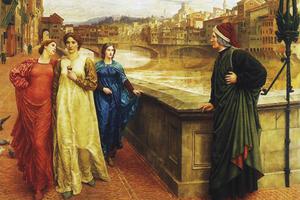
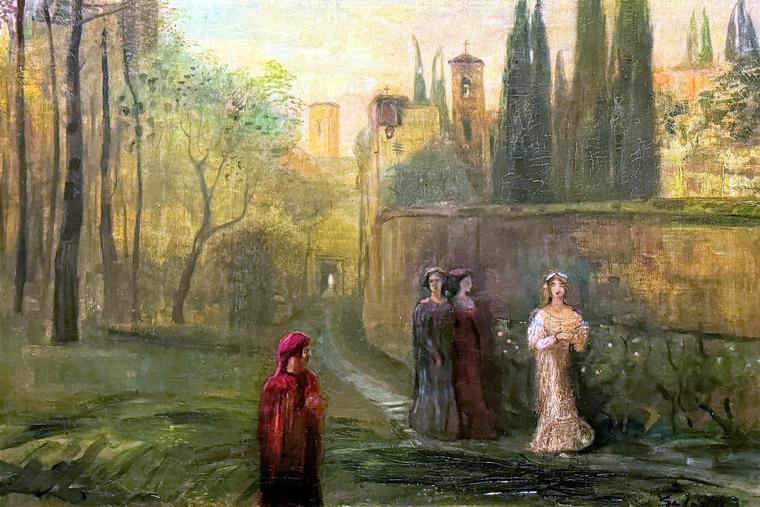
“In the experience of a great love,” says Romano Guardini, “all that happens becomes an event related to that love.” Dante would have understood. Indeed, from the moment of his meeting with young Beatrice, the Florentine girl who first caught his eye, whose beauty enraptured his heart, life would never be the same again.
“A kind of dreadful perfection had appeared in the streets of Florence,” writes Charles Williams in The Figure of Beatrice, a book W. H. Auden said he would re-read every year. “Something like the glory of God was walking down the streets towards him.” Williams calls it “the Beatrician moment,” in which a sudden, unmerited glimpse is given of the joys that may await us on the other side of death.
“He who loves a woman,” he tells us, “and brings her life to present realization in his own, is able to look into the thou of her eyes and see a beam of the eternal Thou.”
The beauty that Dante sees shimmering upon the face of Beatrice is not some momentary bewitchment or spell, but the real truth about her. She really does shine like the sun and Dante cannot escape the aura of luminosity that surrounds her. Nor does he wish to do so. In fact, he will carry the image of this young girl, purified of all its dross, into the heart of the unimaginable God himself. “Who speaks the things that Love him shows,” exclaims the poet Coventry Patmore, “shall say things deeper than he knows.”
But at what cost before so transcendent a transaction? “Costing not less than everything,” is the answer Eliot gives in the final lines of Four Quartets. “A condition of complete simplicity,” he calls it, can come at no less a cost.
All shall be well and
And all manner of thing shall be well
When the tongues of flame are in-folded
Into the crowned knot of fire
And the fire and the rose are one.
And where does it all take place? At an altar where sacrifice is offered in order that two people may consecrate their very selves for the sake of the other. Isn’t this why so many love songs turn out badly, ending in frustration and grief? Because love wants to take us to the altar and we remain too selfish to go there? Having forgotten what an altar is for, which is the place where something must die in order that something else may live, we refuse to go, disdaining the gift of self for the sake of another.
“Be worthy of the flame consuming you,” writes Paul Claudel. And too many of us choose not to be worthy, preferring the path of the self-centered self, not yet realizing perhaps that it leads straight to hell.
“It is most amusing,” writes G.K. Chesterton, “to listen to the opponents of marriage on this subject. They appear to imagine that the ideal of constancy was a yoke mysteriously imposed on mankind by the devil, instead of being, as it is, a yoke consistently imposed by all lovers on themselves.” Thus have they invented a phrase, “a black and white contradiction,” he calls it, “in two words — ‘free love’ — as if a lover ever had been, or could be, free. It is the nature of love to bind itself, and the institution of marriage merely paid the average man the compliment of taking him at his word.”
They respect neither the man who wants to burn his boats for the sake of the woman he loves, nor the woman who welcomes an offer no more reckless and wonderful than any she can imagine. “Everywhere there is the persistent and insane attempt to obtain pleasure without paying for it. Thus in love the free-lovers say: ‘Let us have the splendour of offering ourselves without the peril of committing ourselves; let us see whether one cannot commit suicide an unlimited number of times.’”
It will most emphatically not work, Chesterton assures us. And so he ends his little essay “In Defense of Rash Vows” on a note of triumph, telling us exactly why:
There are thrilling moments, doubtless, for the spectator, the amateur, and the aesthete: but there is one thrill that is known only to the soldier who fights for his own flag, to the ascetic who starves himself for his own illumination, to the lover who makes finally his own choice. And it is this transfiguring self-discipline that makes the vow a truly sane thing. ... All around us is the city of small sins, abounding in backways and retreats, but sooner or later, the towering flame will rise from the harbour announcing that the reign of cowards is over and a man is burning his ships.
- Keywords:
- truth
- beauty
- dante alighieri