The Unfinished Symphony of St. Norbert
A new English translation of Father Dominique-Marie Dauzet’s biography traces the dramatic life of the founder of the Norbertines.
In his Entering the Twofold Mystery, Bishop Eric Varden of Trondheim, Norway, rightly observes that we “speak too readily, perhaps, of ‘life-changing’ experiences” — so too of the “world-changing,” despite our definite ignorance of what the world is or into what it ought to be changing.
We like to view the past as a sequence, ultimately climaxing in today. But isn’t a symphony a more apt historical metaphor?
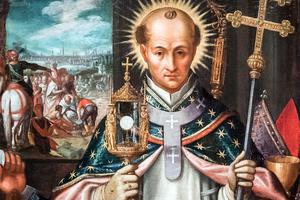
Thus posits Norbertine Father Dominique-Marie Dauzet in his biography of his own spiritual father, St. Norbert (1080-1134) — the unfamiliarity of whose name suggests that if his life possesses world-changing significance, its symphony must now be in the broader movement.
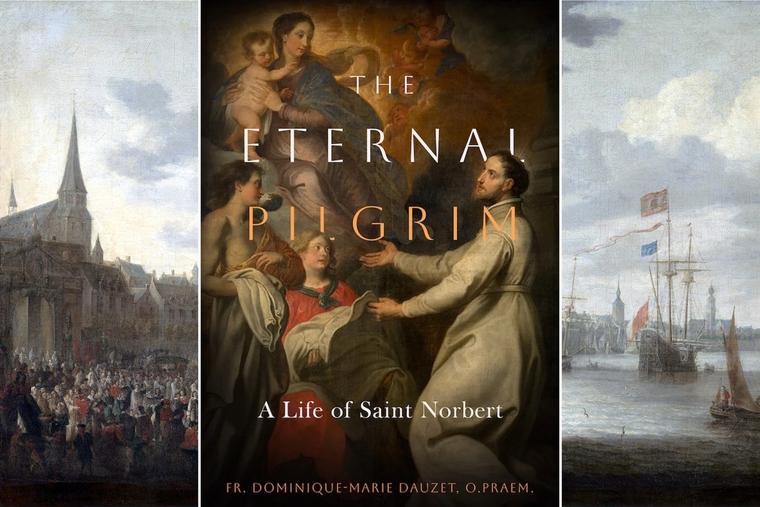
The introduction of Father Dauzet’s work, recently published in English by Sophia Institute Press as The Eternal Pilgrim, describes the broad strokes of the saint’s life as an “unfinished symphony.” The third son of the count of Gennep, he began public life as the court chaplain of Holy Roman Emperor Henry V, the very image of a wealthy secular cleric many associate with the High Middle Ages — before the reforms of Gregory VII had taken root, and before Sts. Francis and Dominic.
Norbert accompanied the emperor amid the failed negotiations in Rome of the year 1110 that ended with the emperor abducting Pope Paschal II. At the conclusion of this infamous expedition, the young, quickly advancing court chaplain foreshadowed his coming conversion.
“Norbert slipped away,” Dauzet recounts, continuing: “He went to find the august prisoner who was weeping in his well-guarded tent, a little further away.”
Rather than joining in the emperor’s revelry: “The young chaplain approached, knelt, and humbly asked the pontiff’s forgiveness for this violence done to the successor of Peter. The pope was moved. He blessed the imperial chaplain, and gave him absolution.”
But this movement of pity was not the life-changing moment in the future-saint’s life. He lingered among the rich and powerful until a Pauline conversion on the road to Vreden in 1115. Norbert embarked full of lust, or at least vanity, but returned, struck from his horse by a bolt of lightning, a repentant man.
Father Dauzet, who received a doctorate in Church history from the Sorbonne in Paris, effectively analyzes the medieval life of Norbert against the hagiographical tradition and in the context of other contemporary sources. He thus effectively illuminates the historicity of the account while presenting the message intended by the faith of the author.
This concise, award-winning biography, Petite vie de saint Norbert, was published in French in 1995. Father Dauzet seamlessly weaves the latent narrative from the plentiful but little-known and widely scattered historical and hagiographical documentation.
After St. Norbert’s literal and analogical lightning-bolt conversion, the musical score of Norbert’s life transitions, as Father Dauzet describes in the Introduction, from itinerant preaching, to founding the Norbertine Order, to both an unwanted and unplanned episcopal election, and then it concludes:
Our protagonist is now an archbishop-chancellor, a confidant of the emperor, one who has a say in all the great affairs of the West. Then the line is broken again: this last Norbert is brought down prematurely, at the age of fifty-four, by malaria contracted in Italy.
And to most of the world — the world outside his See of Magdeburg and unaffiliated with his Order, that is — Norbert slowly faded from the scene.
Bishop Varden follows his observation that we too readily speak of life-changing events by proceeding to recount an episode “without which I should not have been the same.”
One might speak similarly, on a world-historical scale, of this now-little-known Salic German. At its peak, his sons filled more than 500 religious houses with more than 10,000 members, evangelizing much of northern Europe single-handedly. But after Reformation and revolution, much of this history is forgotten.
But as an Allegro and an Andante are followed, if not by a Vivace, at least by a Menuetto, so too a slow revitalization of the order is occurring in America. The Norbertine Fathers of St. Michael’s Abbey in California who produced this volume were founded in 1961 by seven Norbertines of Csorna Abbey, fleeing communist Hungary. It has grown to a canonry of over 100 members, spreading to Los Angeles; La Crosse, Wisconsin; and Springfield, Illinois.
Just as the salient moments of one’s life are recognized only in death, so too St. Norbert’s — or any saint’s — full impact will be understood only in eternity. But, until then, The Eternal Pilgrim will revive, at least in the reader’s consciousness, a life otherwise likely lost in the nigh-mythical illuminations of hagiography and the sparsity of medieval chronicles.
Norbertine Frater Simeon John Lee is a seminarian of St. Michael’s Abbey in Orange County, California.
- Keywords:
- st. norbert
- norbertines