Pope Leo XIV Is Promoting Unity — One ‘Hat Tip’ to His Papal Predecessors at a Time
ANALYSIS: Through his words, gestures and even liturgical picks, the new Pope is synthesizing what came before him.

In the hours after Pope Leo XIV’s election on May 8, speculation swirled: Would the first American pontiff be a sequel to Francis — or more along the lines of St. John Paul II or Benedict XVI?
If the new Pope’s choice of words and vestments is any indication, the answer appears to be “all of the above.”
Since becoming pope, Leo XIV has blended the phrases, concepts and even liturgical insignia of several of the pontiffs who preceded him, sending the message that he intends to draw deeply from all of them in his leadership of the universal Catholic Church.
And with the Church deeply divided following Francis’ tumultuous pontificate, Leo’s “unity by synthesis” approach — and focus on continuity with all who came before him — could go a long way to healing ruptures.
Throwbacks and Ferulae
These signals include but go beyond Pope Leo XIV’s initial public appearance, when he stepped onto the loggia of St. Peter’s Basilica speaking positively of a “synodal Church,” a reference to Pope Francis’ signature reform effort, but also wore the traditional red vestment called a mozzetta, which his immediate predecessor had eschewed.
For one, he has made a point of including iconic phrases associated with other popes in his various public remarks.
During his May 11 Regina Caeli address at St. Peter’s Square, the new Pope went off script to tell young people, “Do not be afraid! Accept the invitation of the Church and of Christ the Lord!” Several commentators pointed out the echo of St. John Paul II’s own “Be not afraid!” speech at his inaugural homily in 1978, which became a central theme of the Pole’s pontificate. In the same address, Leo XIV also replicated St. Paul VI’s famous 1965 call for “Never again war!”
The new Pope also borrowed from John Paul II when he spoke in his first homily of “practical atheism,” a term referring to the way that Christians can live as if God didn’t exist that his Polish predecessor had popularized in encyclicals like Fides et Ratio. Pope Benedict XVI used the term even more extensively, tying it to his criticisms of rising secularity and relativism.
At the same time, Leo XIV has made a point to praise Pope Francis and the late Pontiff’s contributions. In the new Pope’s May 10 address to the College of Cardinals, he hailed his predecessor’s 2013 exhortation Evangelii Gaudium as a blueprint for implementing Vatican II and spoke positively of synodality.
In the same brief remarks, however, he also made a point to cite Benedict XVI and Francis side by side when discussing Christ as the ultimate hope of people of goodwill. The move signaled an interest in broad continuity and was also a noticeable departure from Francis’ tendency to minimally cite his predecessors.
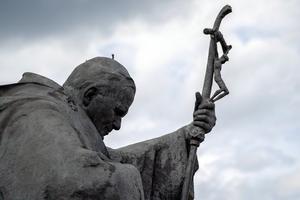
The new Pope’s synthesizing signals have been found in his liturgical decisions, too. For instance, within a three-day span, he used the ferula, or pastoral staff, of two predecessors. During his first Mass as pope in the Sistine Chapel on May 9, Leo XIV had in his hand a golden staff originally crafted for Benedict in 2009 but seldom used by Pope Francis. Two days later, he carried a silver ferula originally made for Paul VI in 1965 but made famous by John Paul II throughout his pontificate.
And perhaps to make the point even more obvious, Pope Leo XIV followed up visiting Pope Francis’ tomb at the Basilica of St. Mary Major on May 10 by praying in front of the remains of popes, including Benedict XVI and Pius XII in the Vatican Grottoes on May 12.
Symbolic but Impactful
Given how much heightened attention there is on a new pope during his initial stretch holding the Petrine office, there’s little doubt that Leo XIV has been intentional in his widespread papal “head nods.” They indicate that he is sensitive to the need to unify diverse groups within the Church — or at least to not get himself pigeonholed as unduly connected to just any one pontificate.
Of course, perhaps the most important decision made in this vein was Leo XIV’s call not to choose the name of any post-Vatican II pope. Instead of becoming John Paul III, Benedict XVII or Francis II, he chose to make his namesake Leo XIII, who reigned a full 60 years before the Second Vatican Council. The choice was a masterstroke for a pope likely looking to avoid pressure to “resolve” the true meaning of Vatican II or stake his flag too firmly with one papal interpretation over another.
And, at least to some extent, Leo XIV’s moves seem to be working.
In particular, some traditionalist groups that were put off by the Francis pontificate seem to be embracing his successor, despite Leo’s strong association with Francis, who made him a bishop and brought him to Rome to serve as prefect of the Dicastery for Bishops.
The editors of the traditionalist blog Rorate Caeli, who were among the harshest critics of Francis, wrote on May 11 of “an increasingly warming kinship with Leo XIV.”
“There is something unmistakably good about him. He has a good heart. He seems sincerely kind. That is already a huge asset for a bishop, and not as common as it should be.”
However, other traditionalist voices are not coming around so quickly. Some, like Timothy Gordon, warn that the Pope’s early gestures that appeal to more conservative Catholics are part of a “PR campaign” that ultimately proves nothing about the direction he’ll lead the Church.
Real Tests Ahead
The fact remains that Leo XIV’s “unity by synthesis” approach remains largely symbolic at this point. A series of “hat tips,” but nothing truly substantial. The real test of just what — and how much — he pulls from each of his predecessors will come when he puts his own stamp on matters like the future of the traditional Latin Mass, or on big questions like the possible decentralization of doctrinal authority.
But Leo’s gestures thus far mean something. And for figures like Cardinal Timothy Dolan of New York, who had hoped before the conclave for a mix of Francis, Benedict XVI and John Paul II, it looks like Leo XIV is delivering. In the process, he’s giving hope that his pontificate will not be one of rupture nor retrenchment, but of reconciliation.
- Keywords:
- pope leo xiv
- catholic unity