Full Text: Pope Leo XIV Answers Questions From 5 Teens During NCYC 2025 Digital Encounter
'Now is the time to dream big, to be open to what God can do through your lives.'
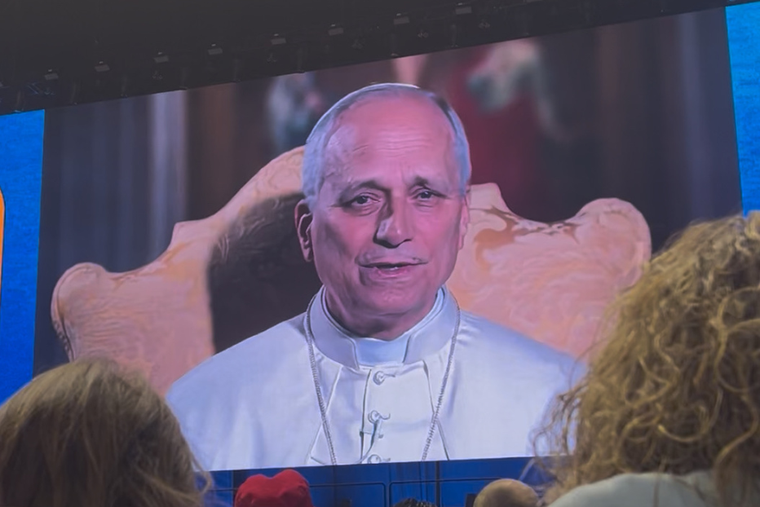
Editor’s Note: Please find below a full transcript of Pope Leo’s remarks and responses during the National Catholic Youth Conference on Friday, Oct. 21, 2025, in Indianapolis, broadcast on EWTN with the help of Vatican Media. Watch the full event in the video posted at the end of the transcript.
Dear young people, dear friends, good morning. I’m very glad to be with all of you through this digital connection. I want to greet everyone gathered at the National Catholic Youth Conference in Indianapolis, Indiana. And I also want to greet all of you who are joining online or via television from across the United States and from other parts of the world.
I’m grateful to everyone who helped organize this event and made it possible for us to be together today, even if it is only through a screen. We’re meeting during a special moment in the life of the Church, the Jubilee Year. It is beautiful that this Jubilee is centered on hope because we are seeing signs of hope everywhere. Millions of people have come to Rome to walk through the holy doors, to pray at the tombs of the apostles, to deepen their faith.
In dioceses around the world, many churches have been named Jubilee churches. This highlights the important role they play in their communities and gives people who visit them an opportunity to receive special graces. At the recent Jubilee of Youth in Rome, more than a million young people came together to celebrate, to meet each other, to meet young Catholics from across the world who share the same faith.
What a blessing it is to see so many young Catholics seeking the Lord with sincerity and joy. As I looked at your conference schedule, I was happy to see how much time is dedicated to adoration, to daily Mass, to the sacrament of reconciliation. These are not simply program activities. They are real opportunities to meet Jesus.
Today is also a special day for the church, as it is the memorial of the Presentation of the Blessed Virgin Mary. We remember how Mary, even from her youth, offered her whole life to God. She invites us to do the same: to entrust everything to him. So as we begin our time together, let us ask Our Lady to watch over this digital gathering and to protect our families and friends.
So I invite you to pray together: Hail Mary, full of grace, the Lord is with you. Blessed are you among women, and blessed is the fruit of your womb, Jesus. Holy Mary, Mother of God, pray for us sinners now and at the hour of our death. Amen.
I’m grateful to have this opportunity to speak with you young people. You all hold a special place in my heart, and I look forward to answering your questions. Thank you very much.
Archbishop Perez: Thank you, Your Holiness. We are so excited to have you dialogue with young people. I am here with five selected presenters here and those watching from schools, parishes and homes across the country and around the world.
They are Elise from Iowa; Ezequiel from California; Christopher from Nevada; Mia from Maryland; and Micah from Hawaii.
They are honored, excited and a bit nervous to speak with you today.
Holy Father, it is also my great honor to present Katie Prejean McGrady to facilitate this dialogue. Katie has a wealth of experience in pastoral ministry with young people, having served as a teacher, author, SiriusXM host, podcaster, and a past NCYC participant, and speaker.
Katie Prejean McGrady: Well, good morning, Holy Father. It’s great to see you again. Thanks for joining us. The last time I saw you, I gave you a pair of socks, and I feel like I have to let you know I’m still wearing some “pope socks,” just, you know, so we’re in solidarity. We are thrilled to have you joining us. There are 16,000 young people with burning questions and a lot of hope for this moment. Selfishly, I’d love to know your opening word for Wordle, but we’ll talk about it later.
The questions they have range across the spectrum. We want to know about prayer, and we want to talk about technology. And you mentioned a moment ago how this conference changed my life as a teenager and is changing their lives right now. This conference provides opportunities for prayer and for confession, to go to Mass, to be at Mass with so many bishops.
So we have a starting question. Mia, how about you ask the Holy Father a question about the sacraments.
Mia Smothers: Thank you, Katie. Good morning, Holy Father. My name is Mia Smothers from the Archdiocese of Baltimore, Maryland. In my experience, it’s been difficult to voice my mistakes. Is it hard for you to accept God’s mercy when you make mistakes or feel like you’ve let people down?
Pope Leo: Thank you for your question, Mia. Before I answer it, I just want to say I only wear “white socks.” And I use a different word for Wordle every day. So there’s no set starting word, in case you’re wondering.
Mia, I want to thank you for your question. It’s an important one because all of us struggle with this at times. The truth is that none of us is perfect. St. Paul teaches that everyone has sinned and fallen short of the glory of God. He tells us that in his Letter to the Romans. Because of original sin, we sometimes do the opposite of what we know is right. But there’s good news. Sin never has the final word. Whenever we ask for God’s mercy, he forgives us.
Pope Francis said that God never gets tired of forgiving. We sometimes get tired of asking for forgiveness. So even when we fall again, we should remember St. Paul’s words. Christ Jesus came into the world to save sinners. He came for us knowing our weaknesses. Jesus told many stories about God’s joy when someone returns to him.
For example, we all know the story of the prodigal son: that son who made terrible choices and yet, when he came home, his father ran to embrace him. Jesus also called himself the Good Shepherd who searches for the lost sheep. Even on the cross, he forgave the Good Thief and prayed for those who crucified him. We may struggle to forgive. But God’s heart is different. God never stops inviting us back.
We experience this mercy of God in a special way in the sacrament of reconciliation. In confession, Jesus meets us through the priest. When we honestly confess our sins and accept our penance, the priest gives absolution and we know with certainty that we are forgiven.
So, yes, it can be discouraging when we fall. But do not focus only on your sins. Look to Jesus. Trust his mercy and go to him with confidence. He will always welcome you home.
Katie Prejean McGrady: Thank you so much, Holy Father. Holy Father, that’s powerful advice and I think a remarkable encouragement for young people to go back to Jesus, but they struggle at times, and this world can present a lot of hardships.
Mental health is certainly something that we heard [about] from a lot of young people as we prepared for this conversation. And whether a young person is dealing with a diagnosis personally or has somebody that they love that is struggling with depression or anxiety or ADHD, it’s a weight. It’s a weight to communicate it. It’s a weight to ask for help.
I see you nodding, so I know we’re excited to continue the conversation.
Ezequiel, we were chatting about this. Why don’t you ask the Holy Father?
Ezequiel: Good morning, Holy Father. My name is Ezequiel Ponce, and I live in the Archdiocese of Los Angeles, California. Growing up in public school, I got to see my peers and even myself struggle with our faith.
My question is, there are moments in which a lot of us feel sad or overwhelmed. And even if we pray or try to have faith, friends and family often say, “Just give my problems to the Lord.” But how can I really give my problems to God and feel that he is close to me even if I feel like this?
Pope Leo: Thank you for your question, Ezequiel.
In his first letter, St. Peter tells us to give all our worries to Jesus because he cares for us. Jesus does not just understand our struggles from a distance. He actually wants us to hand them to him because he loves us. And that kind of trust starts when we have a real relationship.
We cannot give our problems to someone who we barely know. Think of your closest friends, for example. If they were hurting, you would talk to them. You would listen to them. You would stay close. Our relationship with Jesus is similar. He knows when life feels heavy. And Scripture reminds us that he is near to the brokenhearted.
Even when we do not feel his presence, our faith tells us that he is there. To entrust our struggles to Jesus, we have to spend time with him in prayer. We have to have a relationship with him. In quiet, we can speak honestly about what is in our hearts. During Eucharistic adoration, you can look at Jesus in the Blessed Sacrament and know that he looks at you — and he looks at you with love.
He often speaks to us gently in stillness. That is why daily moments of silence are so important. Whether through adoration, reading Scripture, talking to him, looking for those little spaces of time where we can be with him, little by little, we learn to hear his voice to feel his presence both within and through the people that he sends to us.
Giving our problems to Jesus is something we can do, we need to do, again and again. Each morning we can invite him to be with us during the day. Each night we can talk with him about our day. And remember also Mary, the mother of Jesus and our mother. She understands what we go through, and she prays for us.
There’s a powerful way to ask for help her help, and that’s praying the Rosary. Through her intercession and with all the saints praying for us, we can confidently place everything in God’s hands, knowing that he always hears us. He’s always with us.
Katie Prejean McGrady: You know, Ezequiel, we were chatting earlier, and you said you wanted to talk a little more about that communication, right? Listening to the Lord, but also communicating with each other, listening with each other, listening from experts. So, why don’t you keep it going?
Ezequiel: Thanks, Katie. And I just want to acknowledge something that you said about building a relationship with the Lord, and by doing that, by morning prayer or even praying the Rosary. So my next question to you is: It’s easy at times to feel lost, but I’m afraid to talk about it because I don’t think others will really understand how I feel.
What can we, the youth, adopt to communicate better with others and help them understand us?
Pope Leo: In the time that I’ve spent with young people, which through the years has been rather significant, I’ve seen that you really carry with you authentic joys and hopes, but also struggles and heavy burdens. I saw that clearly during the Jubilee of Youth.
And I want you to know that I pray for you, asking the Lord to help you grow in love for him and in virtue. I know that the Lord is working in your hearts. But I also believe he draws you closer to himself through the people in your life, hopefully through your parents, teachers, priests, brothers and sisters, good friends, youth ministers.
When you find someone you truly trust, don’t be afraid to open your heart. It’s so important to have authentic trust, but when you do, know that they can help you understand what you’re feeling, and they can support you along the way. It’s also important to pray for the gift of true friends.
A real friend is not only someone who’s fun to be with, though that is good too, but it’s someone who helps you grow closer to Jesus: someone who encourages you to become a better person. Good friends also push us to seek help when life gets difficult or confusing. Good friends will always tell us the truth, even when that’s not easy to do.
Scripture says that faithful friends are like a strong shelter and a treasure. I hope you are forming friendships like that, even during this conference — friendships rooted in faith, rooted in love for Jesus. Whether it is a trusted adult or close friend, it’s important to speak honestly about what you feel, what you think, what you experience. Honesty will help you put your feelings into words. And honesty will allow Jesus to work through the people that he has placed in your life. At the same time, remember that the Lord invites us to grow through our challenges. Many young people say, “No one understands me.” But that thought sometimes can isolate you. When it comes, try saying, “O Lord, you understand me better than I understand myself.” And trust that the Lord will guide you.
Katie Prejean McGrady: Thank you. Holy Father, I’m not going to totally throw out the script, but I want to ask you a question. You mentioned prayer, and I think a lot of young people get distracted with prayer sometimes. Their minds wander, the phones buzzing in their pocket. Can I just ask, like real quick? We don’t have to tell anybody outside of here.
When you get distracted, what do you do to bring yourself back in?
Pope Leo: It depends on the distraction, actually. But sometimes the best thing to do is to follow the distraction for a moment, see why it’s there, but then to turn back and to remember why you’re there and why you’re in prayer.
And to say to the Lord, “Look, Lord, I’m distracted right now. I know you understand” — but not to allow yourself to be taken too far away, especially during prayer, because there are all kinds of temptations and all kinds of distractions, but there’s only one Jesus Christ. And we really need to give our time also in prayer to Christ.
Ezequiel: Amen. I’m glad I asked.
Katie Prejean McGrady: That’s good for me. I know it’s certainly good for them. These phones are often that distraction. And while I’ve got mine buzzing in my pocket to keep us on time, there are moments where you just kind of scroll endlessly or [focus too much on] that technology, which can be quite useful. The Vatican this year hosted the Jubilee of Digital Missionaries and Influencers, and it was a profound moment to talk about sharing the Gospel.
But we’ve all been talking about the glowing screen that pulls us away from what’s right in front of us. So, Chris, why don’t you ask a question about tech to the Holy Father? He was on Twitter once.
Chris: Holy Father, good morning. My name is Chris Pantelakis, and I am from the Archdiocese of Las Vegas, Nevada. I often find myself sitting on my phone endlessly scrolling.
I’ve also noticed that everybody around me is the same or has a very similar problem. Many adults have told me that technology is great with moderation. So my question for you is: How do you suggest we balance all these great tools — social media, smartphones, tablets and any other devices — while also making faith connections outside of technology?
Pope Leo: Thanks, Chris, for your question.
It’s a really important one. Technology can really help us in many ways, including helping us live our Christian faith. It lets us stay connected with people who are far away, as today, when we can see and hear each other even though we’re thousands of miles apart. It also gives us amazing tools for prayer, for reading the Bible, for learning more about what we believe.
And it allows us to share the Gospel with people we may never meet in person. But even with all that, technology can never replace real in-person relationships. Simple things — a hug, a handshake, a smile, all those things — are essential to being human and to have those things in a real way, not through a screen like we’re speaking this morning.
As Catholics, we often pray together, remembering Jesus’ promise that when two or more gather in his name, he is with them. The early Church experienced powerful moments of Jesus’ presence when they prayed together. Watching Mass online can be helpful, especially when someone is sick or elderly or cannot attend in person.
But actually being there, taking part in the Eucharist is so important for our prayer, for our sense of community. It’s essential for our relationship with God and with each other. There’s nothing that can replace true human presence, being with one another. So, while technology certainly can connect us, it’s not the same as being physically present. We need to use it wisely without letting it overshadow our relationships.
There’s a saint who was recently canonized who I’m sure all of you have heard of, St. Carlo [Acutis]. He’s a great example. Carlo was skilled with computers, and he used that talent. He used it to help people grow in their faith. He also spent time in prayer in Eucharistic adoration. He taught others, and, very importantly, he served the poor.
He even set time limits for himself, allowing only a certain amount of time each week for leisure on his electronic devices. Because of this discipline, he found a healthy balance and kept his priorities clear. My friends, I encourage you to follow the example of Carlo Acutis. Be intentional with your screen time.
Make sure technology serves your life and not the other way around.
Katie Prejean McGrady: Thank you. When we were talking about this in preparation, we also learned some fun facts about the teenagers of today, that AI, artificial intelligence, ChatGPT is kind of in their lives.
And Micah, you shared very vulnerably with all of us about how you’re struggling with some of that. So why don’t you ask a question?
Micah: Good morning, Holy Father. My name is Micah Alcisto, and I’m from the Diocese of Honolulu in Hawaii. Often times, many of us, including myself, can rely on using AI or ChatGPT to assist in finding solutions in things, such as our schoolwork, like writing a good essay or walking us through a math problem or answering a history question — and really using AI as a tool or a resource to find solutions and an answer to a problem that we may have in our mind. So, Holy Father, what do you think we should be cautious of when embracing this new technology?
Pope Leo: Well, that’s really an important question; I’m really glad you asked it. As you all know, probably better than I do, AI is becoming one of the defining features of our time. Recently, there was a conference here in Rome focused on protecting children and teenagers in today’s digital world.
I encouraged the participants to work together to create policies that will keep you safe, keep all of us safe from the risks that come with AI. But I also reminded them, and I take this opportunity to remind all of you, that safety is not only about rules. It’s about education, and it’s about personal responsibility. Filters and guidelines can help you, but they cannot make choices for you. Only you can do that.
These years of your life are meant to help you grow into mature adults. Spiritually, this means deepening your friendship with God and becoming more like him. Intellectually, it means learning to think clearly, to think critically, to examine reality, and to search for truth, beauty and goodness.
It also means strengthening your will with God’s grace so you can freely choose what helps you grow, avoid what harms you. Every tool we’re given, including AI, should support that journey, not weaken it. Using AI responsibly means using it in ways that help you grow, never in ways that distract you from your dignity or your call to holiness. In your education, make the most of this time.
AI can process information quickly, but it cannot replace human intelligence. And don’t ask it to do your homework for you. It cannot offer real wisdom. It misses a very important human element: AI will not judge between what is truly right and wrong. And it won’t stand in wonder, in authentic wonder before the beauty of God’s creation.
So be prudent; be wise; be careful that your use of AI does not limit your true human growth. Use it in such a way that if it disappeared tomorrow, you would still know how to think, how to create, how to act on your own, how to form authentic friendships. Remember, AI can never replace that unique gift that you are to the world.
Katie Prejean McGrady: Thank you so much, everybody. I love that you just told us all to have a strong foundation, a firm foundation, as we’ve been discussing how to grow in relationship with Jesus and how to think and allow the Church to guide and form us. And you said a strong will and a strong foundation. That’s what we have to build.
But the future’s a little shaky and a little uncertain. It’s a world torn apart by divisions and violence. I have two little girls. They’ll come to this conference someday. I shudder to think what the world might be like, how desperately they’ll need this good formation. So we have a couple more questions for you.
Elise, you’re our last young person, so make it count.
Elise: Hello, Holy Father. My name is Elise Wing, and I’m from the Archdiocese of Dubuque, Iowa. Holy Father, I am so excited about the future, but I’m also worried. I’m worried that the Church might not be relevant to people or mean as much.
So, my question is, how is the church preparing for the future?
Pope Leo: Good morning, Elise, and thank you very much for your question. When we face challenges or worries about the future, it might be good to remember that promise that Jesus once made to Peter, when he said, “The gates of hell will not prevail against the Church.”
Jesus will always protect, guide and love his Church. And the day I was elected pope, I said, “God loves us, and evil will not prevail. We are all in God’s hands.” Jesus wants everyone to come close to him. And I see this desire especially when I meet young people who are sincerely searching for God. The Church prepares for the future by staying faithful to what Jesus asks of us today.
He told us not to be overwhelmed by worries, but to seek first the kingdom of God, trusting that everything else will fall into place. And he promised that the Holy Spirit would guide us and help us understand what we need to do. Indeed, throughout history, the Holy Spirit has guided the Church through councils, through many important gatherings, during difficult and challenging times.
In recent years, this guidance has included listening more attentively to the voices of all the faithful, listening to young people like yourselves, through a method of dialogue that we call conversation in the Spirit. Catholics around the world are engaged in what they believe will be the way that the Holy Spirit will speak with the Church and help all of us together be Church and find the way forward.
When we speak and listen to one another in a prayerful way, we can be confident that Jesus is walking with us, even when the path ahead is not clear. When our bishops speak, when they teach us, we also can listen to them and find guidance through what they offer to their diocese, to the local Church, and, united together, to the whole Church. I’d like to invite each one of you today to be a part of this journey.
The Church needs all of us, including you, as we move forward into the future that God is preparing.
Elise: Thank you, Holy Father. I love how you spoke about unity, and I just want to say we had some Holy Spirit moments here this morning, and we all come together and that is something that is so important for the future.
And for my final question, I’d like to ask, how can we as young people make sure we are part of the conversation about the future?
Pope Leo: Let me begin with something important. You are not only the future of the Church. You are the present. Your voices, your voices, your ideas, your faith matter right now. And the Church needs you. The Church needs what you have been given to share with all of us.
If you want to help the Church prepare for the future, start by being involved today. Stay connected to your parish. Attend Sunday Mass. Join youth activities and say “Yes” to opportunities, just as you’ve done taking part in this conference; opportunities where your faith can grow.
The more you come to know Jesus, the more you will want to serve him and his Church. One great way to build up the Church is by sharing your faith, teaching the faith to others, helping others who need you. Teaching is often the best way to strengthen your own understanding. Deepen your prayer life as well. Spend time praying before the Eucharist and Eucharistic adoration.
Go to confession regularly; other practices of prayer and reflection and reading God’s word. These practices help us hear God’s voice more clearly. If you feel the Lord may be calling you to something specific, to some vocation, talk to your parish priest. Talk to another trusted leader. They can help you discern what God is asking.
Remember, making a difference usually happens through simple, daily faithfulness. In this regard, I want to mention St. Pier Giorgio Frassati. As a young man, Pier Giorgio joined Catholic groups. He lived his faith with joy. He prayed devoutly and very quietly, but with great determination. He cared for the poor.
When he died at just 24 years of age, thousands of people, many of them poor, came to honor him for his goodness. He gives us a marvelous example of what holiness looks like in everyday life. So I invite you to reflect on these questions. What can I offer the Church for the future? How can I help others come to know Christ? How can I build peace and friendship around me? These questions are for today, and I believe your “Yes” will strengthen the Church now and in the years to come.
Katie Prejean McGrady: Thank you so much for your wisdom and insight. I know that we all really appreciate it. Holy Father, I want to repeat those three questions you just challenged us to pray through. What can I offer the Church right now? How can I help others know Christ? And how can I build peace in the world? And all of this conversation — and we’re so grateful you’ve taken the time to join us — we didn’t develop any of this in a vacuum or in secret.
It wasn’t just a room full of people putting words in anybody’s mouth. There are actually 40 young people. They’re sitting right next to the stage that we’re on. We just want to acknowledge — if y’all would stand up, if you were part of some of these Zoom calls that we had in anticipation of this. These young people helped us pray, helped us discuss. I want them to get their moment.
We’re grateful for your help. And there are 16,000 people in a football stadium that we’ve transformed into a sanctuary. And I’m sure they’d all love to raise their hand and ask a question. So we want to share that the National Federation of Catholic Youth Ministry wants this conversation to continue. We’ll call and set it up.
But we have a box over in our exhibit hall, and young people are going to be invited to go write questions down, put them in the box. We’ll send them over with our nuncio, and we’d love to continue the dialogue, if you’re open to it, of course, but I think we could continue it. But I do have one last question, Holy Father.
And we’d be remiss if we didn’t end, I think, on the hopeful note of this Jubilee Year of Hope. Pope Francis opened our Jubilee of Hope on Christmas Eve, and you will close it on the Epiphany. And I don’t think any of us anticipated how this year was going to unfold and the hope that would be rejuvenated in our hearts when so much happened, and you were given to us.
So, we just want to ask what’s bringing you hope right now, and what’s your hope for the future of this Church, and how can we help you?
Pope Leo: Well, thank you very much. It’s a really good question. I think it’s important to repeat that young people are part of the Church’s present and also the hope for the future of the Church.
We look to you, I look to you, not to someone else, to help shape the Church in the years ahead. And that is something to be excited about. Maybe you should all give yourselves a round of applause because I want to say thanks to all of you. Now is the time to dream big, to be open to what God can do through your lives. Being young often comes with the desire to do something meaningful, something that makes a real difference.
Many of you are ready to be generous, to help those you love, to work for something greater than yourselves. That is why it is not true that life is only about doing what feels good to yourself, that makes you feel comfortable, as some people claim. Sure, comfort can be nice, but as Pope Benedict XIV reminded us, we weren’t made for comfort. We were made for greatness.
We were made for God himself. Deep down, we long for truth, for beauty and goodness, because we were created for them. And this Treasure we seek has a name: Jesus, who wants to be found by you, wants to be known by you. One of my own personal heroes, one of my favorite saints, is St. Augustine of Hippo. He learned this as a young man.
He searched everywhere for happiness. But nothing satisfied him until he opened his heart to God. That is why he wrote, “You have made us for yourself, O Lord, and our heart is restless until it rests in you.” Augustine discovered that his desire for greatness was really a desire for a relationship with Jesus Christ.
His friendship with Jesus is at the heart of what it means to be a Christian. It’s not only for saints or not only for priests or religious sisters and brothers. It’s for everyone. This was the experience of the first disciples of Jesus. They were ordinary people who spent time with the Lord. They listened to him. They experienced his love.
They discovered that being part of the Church meant following Jesus, living what he taught and continuing his mission. So when we think about the Church’s future, first thing we must do is deepen our own friendship with Jesus. This means personal conversion, letting God transform our hearts so we can follow Christ more closely. St. Augustine said it well.
If you want to change the world, begin by letting God change you. Part of being Jesus’ disciples is being authentic. Young people have a strong sense for authenticity. You can tell when someone is genuine or fake. Don’t lose that instinct. Do not settle for a shallow version of faith. Seek the real friendship that Jesus offers you. Listen to him in prayer and let him shape your life.
When you do this, you carry his presence into the world with joy, hope, with creativity. Authentic witnesses of the Gospel can help heal and unite humanity. Jesus also calls his disciples to be peacemakers, people who build bridges instead of walls, people who value dialogue and unity instead of division. Please be careful not to use political categories to speak about faith, to speak about the Church. The Church doesn’t belong to any political party. Rather, she helps form your conscience.
[Applause] The Church helps form your conscience so you can think and act with wisdom and love. As you grow closer to Jesus, do not fear what he might ask of you. If he challenges you to make changes in your life, it’s always because he wants to give you greater joy, greater freedom. God is never outdone in generosity.
So St. Augustine prayed, “Lord, give me the grace to do what you ask and then ask whatever you want.” Augustine knew his own weakness, but he also knew that God strengthens those who open their hearts to him. As your Catholic identity strengthens, your appreciation for the many different vocations in the Church will deepen.
Many of you are called to marriage, to family life. The world needs holy families who pass on the faith and show God’s love in daily life. If you think you may be called to marriage, pray for a spouse who will help you grow in holiness, help you grow in your faith. Some of you may be called to the priesthood, to serve God’s people through the word, the sacraments.
If you feel that tug in your heart, don’t ignore it. Bring it to Jesus. Speak with a priest you trust. Others may be called to consecrated religious life, to be witnesses of a joyful life completely given to God. If you sense this call, that gentle tug, do not be afraid. Ask the Lord to guide you, to show you his plan.
Dear friends, as you discern your vocation, trust Jesus. He knows how to lead you to true happiness. If you open your heart, you will hear him calling you to holiness. As Pope Benedict XIV once said, Jesus takes nothing away and he gives you everything. When we give ourselves to him, we receive far more than we could ever imagine.
Your vocation is always connected to the greater mission of the Church, which exists to share the Gospel with the whole world. Jesus sent his disciples to prepare the way for him to preach, to heal, and to bring his mercy to others. After his resurrection, he sent the apostles to bring his grace to the entire world.
That mission is yours as well. What greater gift can you offer the world than the gift of eternal life in Christ? What greater cause could you dedicate your life to than the Gospel? The world needs missionaries. It needs you to share the light and the joy that you have found in Jesus. So to those attending the conference in Indianapolis, know that I am praying for you.
I hope everything you have experienced during the conference inspires you to love Jesus and to love the Church more deeply and that you bring that love home to your families, your friends, schools and parishes. To those of you who are with us online, this invitation is for you as well.
You too are called to be missionary disciples wherever you are. The Lord invites all of you to share the Good News — the Good News that Jesus died for our sins, rose again, and is alive today, offering us his love and friendship. So, my dear friends, thank you for your questions. Thank you for listening today.
I see great hope and promise in you, and I trust that the Lord is at work in your lives. May he continue to bless you, continue to guide you and strengthen you as you seek to serve him in the Church and in every person he places in your path.
- Keywords:
- 'pope leo xiv'
- digital encounter