The Rise of the Gen X Bishops
Catholic leadership is undergoing a generational shift that could shake up the future of the Church.
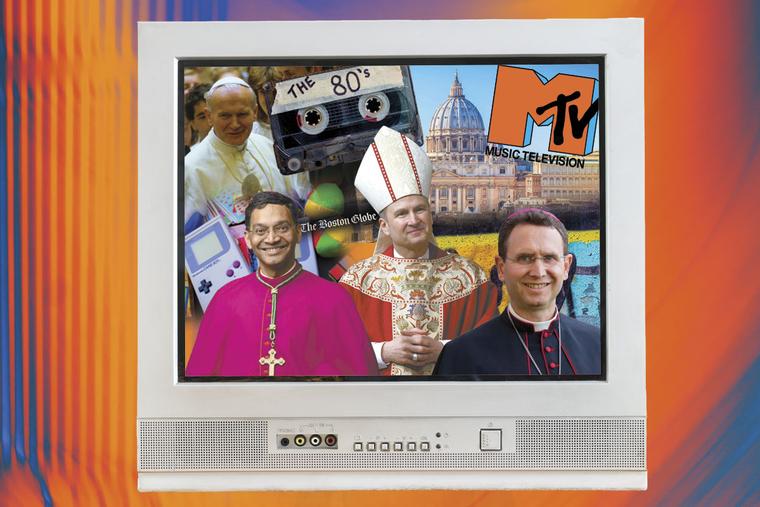
At a recent Fourth of July cookout in New Jersey, one East Coast bishop asked another what kind of playlist he wanted to listen to while they grilled. The response was “’80s music.” And instantly, a connection was made.
“I laughed and I said, ‘Oh yeah, we must both be Gen X,’” recalled Bishop Joseph Williams of Camden, New Jersey, of his exchange with Bishop Erik Pohlmeier of St. Augustine, Florida.
But as the two bishops talked, they realized their generational connection went deeper than shared adolescent memories of Bruce Springsteen on the radio or Cheers on TV. More deeply, they shared a common set of formative factors, from the same papal hero to a similar focus on catechesis while in seminary in the 1990s.
It’s a generational profile that’s becoming increasingly common among the ranks of America’s bishops. And it suggests a new era of Church leadership could soon be upon us.
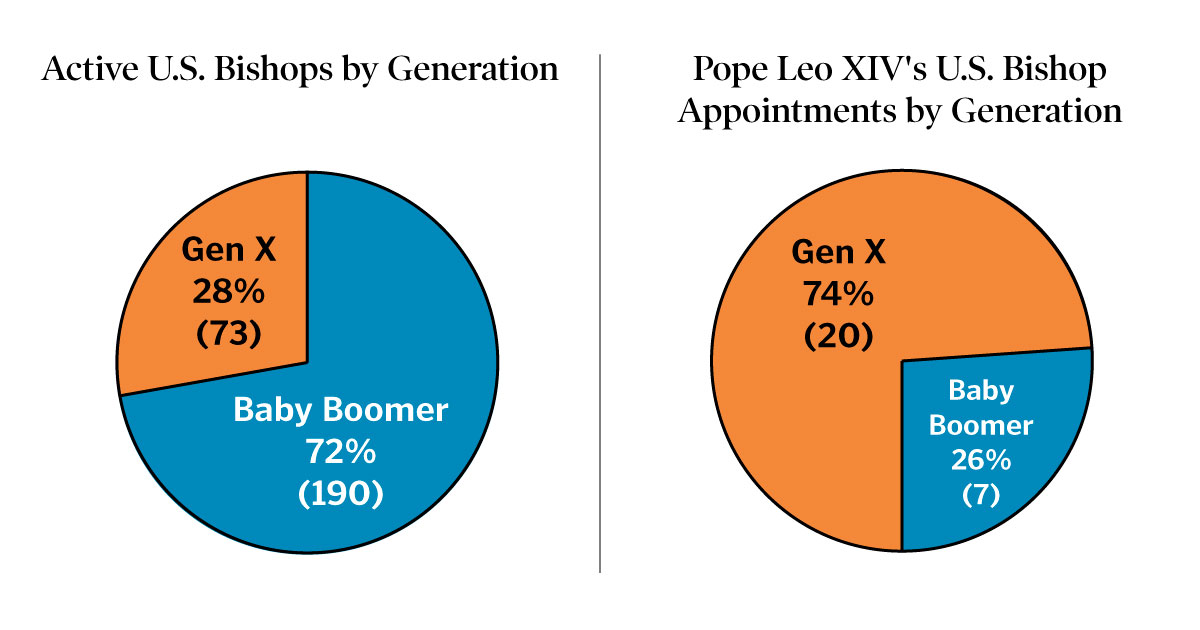
With increasing frequency, men from Generation X are being called to the American episcopate, stepping up as their baby boomer predecessors reach retirement. Born between 1965 and 1980 (46-61 years old by the end of 2026), Gen X bishops already account for one-quarter of all U.S. ordinaries, the term for bishops who lead dioceses or eparchies. The figure goes up to 28% when factoring in auxiliary bishops.
Since Pope Leo XIV’s election in May 2025, 20 of his 27 U.S. bishop appointments have been Gen Xers (74%). The rate is even higher for leaders of archdioceses. Of the four new American archbishops Leo has named, three are Gen X: Archbishop James Checchio of New Orleans, 60; Archbishop James Golka of Denver, 59; and Archbishop Ronald Hicks of New York, 58.
“I think it’s an outward sign that the baton is being passed on,” Archbishop Hicks said of the generational transition in an interview with EWTN News in Rome shortly after participating in the annual pallium Mass.
Generational turnover is nothing new. Nor can an individual prelate’s priorities or worldview be generalized based on the year in which he was born. Nonetheless, several Gen X bishops who spoke with the Register highlighted similar formative experiences, which they said will make a difference in how their generation leads the Church going forward.
“It’s the culture you lived in, it’s the age of the Church you lived in, it’s the influential voices that shaped you, and it’s the peers that you were with,” said Bishop Pohlmeier, who turned 56 on July 20. “Since you were shaped by that, those are huge factors. And they do change generationally.”
A Post-Vatican II Upbringing
Perhaps the biggest difference between Gen X bishops and their baby boomer brethren is each generation’s respective relationship to Vatican II.
Baby boomers were alive during the council and were largely formed in the somewhat chaotic years after its conclusion, when what had changed and hadn’t changed was still hotly contested. On the other hand, even the oldest Gen X bishops have no living memory of Vatican II; the council ended in 1965, the same year the eldest members of their generation were born.
“We didn’t live through it ourselves,” explained Bishop Earl Fernandes of Columbus, Ohio, who will turn 54 in September. “We learned about it as an event and have had an experience of the life of the Church after the council, with some challenges but many more blessings.”
As Stephen White, a Catholic commentator and executive director of the Saint John Paul II National Shrine in Washington, D.C., put it, Gen X bishops experienced the council less as a “radical change” and more as “just the Church they knew.”
As a result, several bishops said it was the default for their generation to understand Vatican II as in continuity with what had come before. In the words of one bishop, this has also translated into an “open-mindedness” to aspects of Catholic life that predated Vatican II, such as the pre-conciliar liturgy, known as the traditional Latin Mass.
“I never experienced it,” explained Bishop Andrew Cozzens of Crookston, Minnesota, who turns 58 on Aug. 3. “And so I don’t have any negative associations with it.”
At the same time, several Gen X bishops said their experience of Catholicism growing up was marked by a disconnect between what the Church taught and what was being lived out in the typical parish. Several used words like “watered down” or “deficient” to describe their general perception of Catholic formation during the 1980s.
This experience of lack was especially acute given the rapid cultural changes that defined their upbringing. Unlike the tight-knit, ethnic Catholic neighborhoods that were standard during the baby boomers’ youth, it was more common for Gen X bishops to come of age in the suburbs. MTV was a major cultural influence, and social practices like cohabitation, divorce and declining levels of religious practice were increasingly the norm.
“We were already beginning to experience the distance between our faith and the culture,” said Bishop Cozzens. “And that if you were going to be a faithful Catholic, you were going to have to stand in the midst of the culture, which was changing dramatically around us.”
JP2 Priests
Given Gen X’s sense of the need for something different than what an increasingly secularized culture and lukewarm parochial life had to offer, it’s unsurprising that every bishop who spoke with the Register cited the same primary influence: St. John Paul II.
As Pope from 1978 to 2005, St. John Paul II’s papacy overlapped almost perfectly with the period when Gen Xers would’ve been young adults, seminarians and newly ordained priests. And his call for young people to reject mediocrity and become saints was received as a profoundly countercultural message for a generation whose trademark phrase was an indifferent “whatever.”
“He was preaching something radical,” recalled Bishop Williams, 52. “And he was doing it with a lot of charisma.”
Gen X bishops were moved not just by John Paul II’s call to personal holiness, but his invitation to transform the culture around them. As Bishop Fernandes put it, the Pope’s “call for the New Evangelization really resonated with us.”
For several Gen X bishops, that call translated into their pursuit of a priestly vocation. World Youth Day (WYD), St. John Paul II’s signature initiative for young people, was mentioned as a particularly impactful catalyst for vocations. Bishop Williams said he attended six WYD events, while Bishop Cozzens wondered aloud how many Gen X bishops had attended WYD 1993 in Denver and encountered John Paul II in person.
If anything, St. John Paul II’s influence only increased when Gen Xers got to seminary. Bishops fondly remembered the impact the Pope’s teachings had on them during their theological formation, from Veritatis Splendor, his encyclical on moral theology, to his catechesis on marriage, family and human sexuality.
“The day they would come out, we were reading them,” said Bishop Pohlmeier, whose time as a seminarian at the North American College in Rome overlapped with John Paul II’s pontificate. “And then you’re looking out the window at the papal audience and there he is. So there was a very direct connection.”
The Polish Pope’s influence wasn’t just personal, but also institutional. Under his watch, an effort to reform U.S. seminaries after decades of post-Vatican II experimentation was carried out from the late 1980s into the 2000s. His influence is likely part of the reason why priests ordained during this period, which includes most Gen X bishops, are more likely to identify as theologically “orthodox” than their baby boomer predecessors, according to a 2023 study by The Catholic Project.
St. John Paul II’s vision for the priesthood, communicated via texts like Pastores Dabo Vobis and Ordinatio Sacerdotalis, was also cited as an inspiring portrayal of what priestly service could look like as the Church headed into the 21st century.
“In my mind, what’s so beautiful?” asked Bishop Cozzens. “He did it with such a holistic vision. He helped us understand the priest as a man of God who is meant to lead people to God. But he’s also meant to be a bridge to the human.”
Forged by Crisis
But while John Paul II provided an inspiring model for Church leadership, what unfolded in the early 2000s defined Gen X bishops in a different way.
In January 2002, The Boston Globe published its investigation into clergy sex abuse and Church leaders’ cover-up. The revelations triggered a national controversy, which engulfed the Church at the same time that Gen X bishops were either in seminary or in the early years of their priesthood.
Both Bishop Fernandes and Bishop Williams were ordained that same year. And both described the sex-abuse crisis as a “shadow” that hung over the Church.
Gen X bishops experienced the impact of the sex-abuse crisis on parishes and evangelization firsthand, as they lived through it not as bishops, but as junior priests. White called it their generation’s “before-and-after movement,” as it profoundly shaped the way they understand their ministry and the needs of the Church.
For one, Gen X bishops told the Register that the crisis underscored the need for transparency and vigilance, for the sake of both protecting innocent people and also ensuring the credibility of the proclamation of the Gospel.
“It’s become clear that one of the great failures of the Church was not listening to people who had suffered,” said Bishop Pohlmeier.
At the same time, Gen X bishops also seem to take seriously the impact that the Dallas Charter, a 2002 framework for handling abuse allegations, had on priest morale, in large part because they saw the results firsthand.
Perhaps unsurprisingly, it was two Gen X bishops who asked for more time before the U.S. Conference of Catholic Bishops accepted revisions to the Dallas Charter this past June, on the grounds that the process had not adequately consulted priests and laypeople: Bishop Fernandes and Archbishop Shawn McKnight, 58, of Kansas City, Kansas. The measure passed 176 to 22, with six bishops abstaining.
More broadly, Gen X bishops told the Register the impact of the sex-abuse crisis combined with the Church’s already-waning social standing helped to clarify for them what their vocation was all about.
“We were ordained to serve,” said Bishop Williams, who described clergy from his generation as having a working-class mentality.
Bishop Cozzens agreed, adding that his time as a bishop has not been marked by the social status that might have been present in previous generations.
“I have never experienced as a bishop the idea that I’m living a privileged life,” said Bishop Cozzens. “My experience has very much been of being present to the people, not separated from them by protocol or office.”
Dan Cellucci, the CEO of a nonprofit that has provided leadership formation to hundreds of bishops, says that he has been struck by Gen X bishops’ “hands-on approach” to everything from evangelization to pastoral ministry.
“They aren’t afraid to get their hands dirty and roll up their sleeves,” said Cellucci, who also described Gen X bishops as full of zeal and adaptable, given the significant periods of transition in the Church and society they have experienced.
Francis Bishops
As much as St. John Paul II was the primary papal influence for Gen X bishops, it’s also true that another pope played a pivotal role in their path to the episcopacy: Pope Francis.
Most Gen X bishops were made bishops by the Argentine Pope. Bishop Cozzens, for instance, was the first American called to the episcopacy by Pope Francis in 2013.
But the connection goes deeper than mere overlap. During his pontificate, Francis also changed the criteria for bishop selection, prioritizing pastoral experience over academic or administrative credentials, with direct results on who from Gen X is in the episcopacy today.
“You’re looking around the room, and you’re like, ‘These are not the usual suspects,’” said Bishop Williams. “Suddenly, someone who has gone out to the peripheries looking for the lost sheep became a candidate once again for this high office of bishop.”
Bishop Williams himself may be an example of this dynamic. Prior to being made an auxiliary bishop of the Archdiocese of St. Paul and Minneapolis in 2022, he was known mostly for his ministry to inner-city Latinos — not a typical résumé for the episcopacy. Other Gen X bishops who were appointed under Pope Francis without having the traditional prerequisites, such as a terminal degree, include 61-year-old Bishop Don DeGrood of Sioux Falls, South Dakota, and Bishop James Ruggieri, 58, of Portland, Maine.
Gen X bishops also told the Register their experience of serving through three pontificates has helped them connect St. John Paul II and Pope Benedict XVI’s emphasis on catechesis and sound teaching with Francis’ focus on encounter.
“I came to appreciate more not just the instruction about what we believe, but the witness and even people sharing their faith in small groups,” said Bishop Pohlmeier.
Bishop Fernandes made a similar point, saying that the Church cannot simply become “the Church of rules.”
“We need to propose the faith that attracts, without falling into the culture wars,” he said. “We proclaim the Gospel and its fullness with integrity.”
Because of this experience, Bishop Williams believes Gen X bishops can help the Church synthesize the visions of recent popes and overcome divisions, which has been a priority for Pope Leo XIV.
“And now we’re trying to say, boy, we’ve loved every one of these pontiffs,” said the New Jersey bishop. “How do we live the reality together?”
‘We Have an Opportunity’
Gen Xers are still the minority of U.S. bishops. But how quickly could men from this generation make up the majority of diocesan leaders?
It will depend on how quickly Pope Leo appoints them. But there will be plenty of opportunities to do so. At present, 20 U.S. ordinaries have reached the retirement age of 75, with another 17 set to join them over the next two years. If Pope Leo XIV were to appoint Generation X bishops to fill each of those sees, Gen Xers would become the majority of U.S. ordinaries as soon as August 2028.
What would that mean for the future of the Church?
Joe Capizzi, the new director of the McGrath Institute for Church Life at the University Notre Dame, downplayed the significance of reading too much into a bishop’s generation, emphasizing that every person is a “free agent.”
Still, he said that the younger crop of bishops he’s gotten to know seem well-suited to face the current era.
“I think most people sense we’re in a thrilling ecclesial moment, filled with hope and expectation,” said Capizzi, pointing to a recent rise in convert numbers and liturgical renewal against a backdrop of overall religious decline. “And the younger bishops I’ve encountered strike me as men of great probity, seriousness and capacity to meet that moment.”
Gen X bishops who were interviewed for this story were clear that they don’t see their ascendancy as a break from the baby boomer generation so much as building upon a foundation that has already been laid.
At the same time, Gen X bishops were not hesitant to highlight what they think they bring to the table. And several suggested that the conventional wisdom that the Church needs to “move from maintenance to mission” is a natural fit for them, given how central outreach and discipleship has been throughout their formation and ministry.
“You have younger bishops with a real vision and heart for vocations, evangelization and sound catechesis,” said Bishop Fernandes, describing Gen X’s ascendancy as “a sign of hope.” “We are unafraid to take risks.”
Archbishop Hicks framed the generational transition as one of new possibilities, as men from his generation are now being invited to be "Christ in the moment."
“My brother bishops and I who are the same age, we just kind of look at each other and say, ‘We have an opportunity here,’” said Archbishop Hicks in his EWTN News interview. “It’s our beginning.”
- Keywords:
- generation benedict
- bishops