If Leo XIV Were a New CEO, He’d Be Crushing It, Say Leadership Experts
Qualities of humility, clarity and servant leadership are early signs that Pope Leo is charting a unifying path.

It’s been less than two weeks since Pope Leo XIV was elected the 267th pope, and in that short time, he seems to have pulled off the incredible feat of winning over most Catholics at a time of deep division within the Church.
The Catholic Church is a global “corporation” — not in the modern business sense, but in the original meaning of the word: a corpus, a body, the Body of Christ.
And just as all eyes are on a new CEO, the world is looking at Pope Leo for signs that he is the right man for the job of St. Peter’s successor — a role that the Catechism teaches is “the perpetual and visible source and foundation of the unity both of the bishops and of the whole company of the faithful.”
The early reviews from corporate management experts? The Holy Father is crushing it, offering a “master class,” as it were, on how to move into the top job.
The leadership pros that the Register consulted for this story pointed to several specific reasons why Pope Leo is off to such a strong start.
He’s embracing the role of a “servant leader.” The term “servant leadership,” coined in 1970 by Robert Greenleaf, an AT&T executive and management researcher, describes a leadership philosophy that prioritizes the needs and well-being of others within the organization.
In the business world, servant leadership can translate to higher pay and benefits for workers, investing in training and career development, and treating workers like collaborators in a common enterprise.
Experts like Andreas Widmer — a former Swiss Guard under Pope St. John Paul II and later a tech CEO — say the new pope is the epitome of that leadership approach.
“He’s surveying the landscape and finding the common ground with everybody. And that’s exactly what I would advise somebody who gets into a management position to do first,” explained Widmer, director of the Arthur & Carlyse Ciocca Center for Principled Entrepreneurship at The Catholic University of America’s Busch School of Business.
“It’s the tell-tale sign of servant leadership when you’re doing that,” he said.
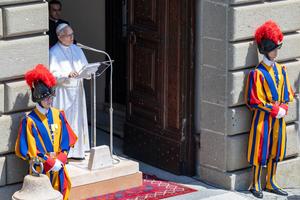
At his inaugural Mass on Sunday, he explicitly stressed that the Vicar of Christ should be a “servant” rather than an “autocrat.” Pope Leo said:
The Apostle Peter himself tells us that Jesus ‘is the stone that was rejected by you, the builders, and has become the cornerstone’ (Acts 4:11). Moreover, if the rock is Christ, Peter must shepherd the flock without ever yielding to the temptation to be an autocrat, lording it over those entrusted to him (cf. 1 Peter 5:3).
On the contrary, he is called to serve the faith of his brothers and sisters and to walk alongside them, for all of us are “living stones” (1 Peter 2:5), called through our baptism to build God’s house in fraternal communion, in the harmony of the Spirit, in the coexistence of diversity.
He’s being humble and authentic. Rob Neal, a real estate executive and chairman of the board of trustees at The Catholic University of America, believes these two qualities are essential for effective leadership.
“I think these twin points of authenticity and humility radiate easily from him, and that’s very important,” Neal told the Register. “You can’t fake authenticity. People can smell inauthentic authenticity, if you will.”
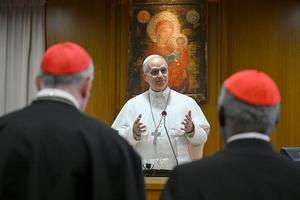
Pope Leo’s humility, Neal said, was evident during his first papal Mass on May 9 when he spoke directly to the College of Cardinals and acknowledged his need for their support.
“You have called me to carry that cross and to carry out that mission. I know I can rely on each and every one of you to walk with me, as we continue as a Church, as a community of friends of Jesus, as believers, to announce the good news, to announce the Gospel,” the Pope said.
“That was a beautiful, humble acknowledgment that you cannot lead alone. You can only lead by engaging,” Neal observed.
Pope Leo’s humble demeanor also helps communicate this frame of mind, according to Stephen Henley, president of Legatus, a network of Catholic leaders.
“Most cardinals that become pope,” he said, “did not seek out this role. Regardless, they accepted God’s will humbly.”
“Pope Leo has personified this through what is already evident as servant leadership. A humble leader is always the best and most respected leader.”
He’s sending smart “early signals.” Henry Kutarna, a former Canadian government minister and businessman who advises Catholic executives, said Pope Leo, like successful new CEOs, is sending “early signals” to reassure those who might be anxious about the change in leadership.
“When a new CEO arrives on the scene, customers want to know if the CEO will be sensitive to their needs, whether the product will change, and what will happen to the price. Staff want to know if the mission and business plan will change. In other words, how much drama and change will I have to endure?” he explained.
“The new CEO will visit various regional offices and the big customers. He may even practice ‘management by walking around,’ an old and still fashionable model,” added Kutarna, who mentors Catholic CEOs through his consulting business, The Catholic CEO.
When Pope Leo was elected, for example, he sent a reassuring signal to traditionalists the moment he appeared on the central loggia of St. Peter’s. Dressed in the ornate papal vestments that Pope Francis had opted not to wear — a red mozzetta and stole — Pope Leo instantly communicated that this pontificate would be restoring some traditions that had been abandoned.
However, by paying his respects at Pope Francis’ tomb at the Basilica of Santa Maria Maggiore on his first trip outside the Vatican after becoming Pope, he also telegraphed his intention to maintain continuity with certain aspects of his predecessor’s pontificate.
“Savvy observers saw that he carefully sent soothing messages to all the various factions within the Church. Every ‘group’ eagerly noted something they wanted to hear,” Kutarna said.
Tim Busch, CEO of Pacific Hospitality Group, and chairman of the board of the Napa Institute, pointed out that the Pope seems to be staking out a middle ground.
Leo, he said, is “very steeped in the teachings of the Church” and frequently cites the Church Fathers and saints, sending a message that he wants to defend the Magisterium.
On May 16, for example, Pope Leo made headlines for declaring that the family is based on “a stable union between a man and women” and defending the dignity of the unborn.
In other ways, Busch said, he has echoed the themes of Pope Francis. On May 19, for instance, he assured faith leaders of his support for synodality, promising to promote “the synodal nature of the Catholic Church and developing new and concrete forms for an ever stronger synodality in ecumenical relations.”
He’s focusing on the “main thing.” Neal learned this trade secret from Rex Tillerson, who was CEO of ExxonMobil at the time.
“I asked him, ‘How is it that you were running so exceptionally an organization with 400,000 people?’” and he said, ‘Rob, we focus on the main thing,” he recalled. For ExxonMobil, the main thing was not gas or oil, but energy. And, Tillerson told Neal, all of the company’s efforts from senior management to each individual in the organization needed to be focused on the main thing.
“He saw that as the role of management, starting at the top, to remind and keep people focused on the main thing,” Neal said.
“It just seems to me that His Holiness is already focusing people on the main thing,” he added.
“It is Jesus’ instruction to ‘Love one another as I have loved you.’ That’s the main thing,” he said. “He made that clear with his very first words, ‘Peace be with you.’ It was just such a beautiful opening.”
He’s rising above partisanship. In his first days, the Pope has received acclaim from all corners of the Church, partly because he has refused to say or do anything that might sow division.
Luke Burgis, author and professor at The Catholic University’s Busch School of Business, said this is a valuable lesson for any leader.
“One mark of a great leader is his or her ability to resist easy categorization. In the early days of their leadership, they don’t ‘signal’ things to various factions, even when people really want them to. In the way that he communicates, our new Pope seems to understand the importance of his office as one that must transcend partisanship,” Burgis said.
He’s being prudent and listening to others. So far, Pope Leo has not come out with any bold statements or initiatives that could alienate people. Cristofer Pereyra, CEO of Tepeyac Leadership, Inc. (TLI), a non-profit that trains lay Catholic professionals to take leadership roles, said this is an excellent strategy for a new leader.
While he notes that it is premature to make assessments about Pope Leo’s pontificate, he is impressed that the pontiff seems to be spending these early days listening.
“When somebody comes in as part of a new leadership in any type of organization — this includes the Catholic Church — they can’t come in, waving a flag of revolution, announcing changes or major disruptions to the way things are done,” Pereyra said.
“So, it seems to me, he’s coming in and showing us that he is ready to listen to the Holy Spirit and listen to the needs of the Church as he encounters them in his new role.
“Even when he speaks, he doesn’t rush,” he said. “He isn’t one to just burst out with something that seems to be a sudden thought that comes to him. He seems to be somebody who really thinks about what he does and what he says.”
The prudence Pope Leo has shown follows the same strategy Kutarna would advise any new CEO to follow.
“He’s checking in on the major customers — Ukraine, Russia, the U.S.A., the Middle East. He’s saying ordinary Catholic things. He’s not taking strong definitive positions. He’s avoiding talk about the China deal or the state of donations in the U.S.A.,” he said.
“He is seen as interested, engaged and concerned. He’s keeping it ‘light’ at the moment, which is what a savvy CEO would do. He’s being careful.”
He’s clearly demonstrating why he was picked. Just as a corporate board seeks to find a chief executive best equipped to meet the needs of the company, each member of the College of Cardinals goes through a process of discernment and exercises his own judgment when selecting a new pope.
The difference (in most cases) is that cardinals pray for guidance from the Holy Spirit that they are selecting a man to participate in God’s plan for the Church and the world. For Widmer, the Holy Spirit was clearly at work in the selection of Cardinal Robert Prevost.
As a former technology executive, Widmer’s academic work explores the ethical questions raised by engagement in the marketplace, within companies and with one’s customers. He was thrilled to hear Pope Leo say that he chose his papal name because of Pope Leo XIII’s teachings on the dignity of the worker in this new era of artificial intelligence.
“The Holy Spirit is bringing a man here who has what it takes to address this new age of the Church,” Widmer said. “I think this is now the pontificate where we’re moving into the next century.”
- Keywords:
- pope leo xiv
- leadership