Spain’s Hit Film ‘Sundays’ Takes Religious Vocation Mainstream
In the award-winning Spanish film, an unbeliever’s camera provokes audiences to take seriously the possibility that God still calls.
Warning: Minor spoilers ahead.
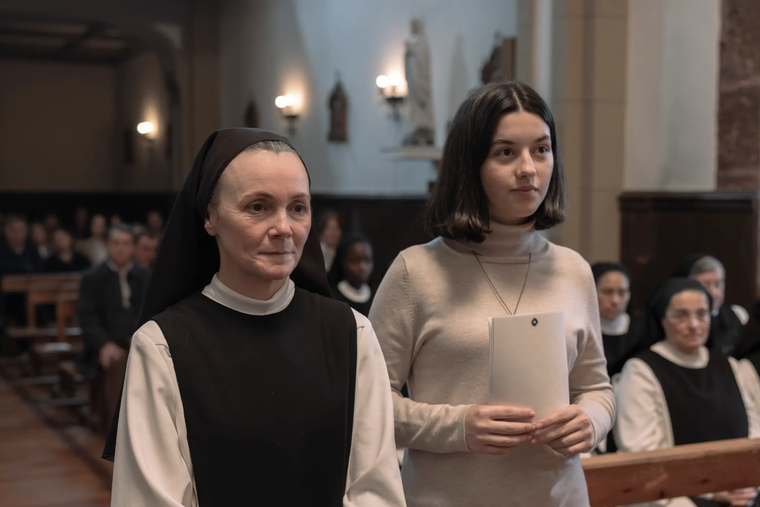
That one of Spain’s most acclaimed recent films centers on a 17-year-old girl discerning cloistered religious life is remarkable. Alauda Ruiz de Azúa’s Sundays (Los Domingos in the original Spanish) swept the Goya Awards, Spain’s Oscars, taking “Best Film,” “Best Director” and “Best Original Screenplay,” after winning the top prize at the San Sebastián Film Festival. More than 650,000 Spaniards saw it in theaters before streaming, a notable feat for a religious-themed film in the largely secularized country.
While Sundays’ success does not prove that Spain is returning to the Church, it does suggest something subtler. Modern audiences are still willing to be troubled by questions that secular culture often treats as settled — namely, those related to faith, family, obedience, freedom and the possibility that God still calls.
Sundays is not a pious film. But neither is it an anti-clerical exposé. Its achievement lies in refusing to lean towards one extreme or the other. When one considers that Ruiz de Azúa is an atheist, the film’s balance is even more impressive. As the director herself has said, her goal was neither to lecture nor to evangelize, but to present the phenomenon of religious vocation on its own terms.
The Possibility of God
The story centers on Ainara, played with luminous reserve by Blanca Soroa. A gifted teenager in the Basque country, she lives with her widowed father, Iñaki, and two younger sisters. Every week, the wider family gathers around her grandmother’s Sunday table. At the center of the family stands Aunt Maite, Iñaki's sister.
The Church enters Ainara’s life chiefly through Father Txema, her spiritual director at school, and Mother Isabel, the prioress of the cloister she hopes to enter. When Ainara tells the family she wants to become a cloistered nun, Iñaki is bewildered but not hostile. In contrast, Maite is horrified. To her, Ainara’s vocational aspirations can only be the product of manipulation, immaturity, grief or escape.
Maite’s response represents the perspective of many viewers who will search for the psychological key to explain the girl’s radical intention: the death of her mother, an absent father, a failed romance, or the influence of priests and nuns. The film gives us all these elements, and none should be dismissed. Ainara is wounded. She is young. She longs to be loved. She is not a plaster saint.
But to reduce her vocation to her wounds is to miss the film’s openness to a more Catholic possibility.
Faith rarely appears in a soul like lightning in a clear sky. Grace often works slowly, through practice: Sunday Mass, confession, prayer — the steady education of desire. While Sundays does not show us enough of Ainara’s sacramental history — one of the film’s limitations — it does give us traces.
One scene is especially revealing. During a retreat, after staying up late talking with her friends, Ainara is faced with a choice the following morning. She could sleep in. Instead, she rises early, walks alone through the empty town in the first light of day, and enters the cloister church for morning prayer. She is the only layperson present with the nuns behind the grille of the enclosure — her first real sense of the hidden life drawing her.
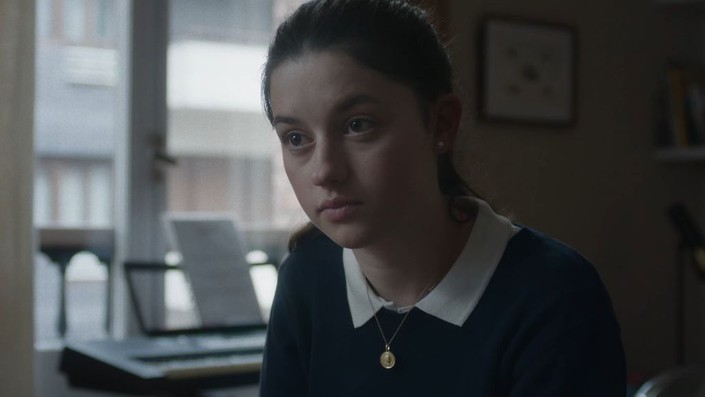
This is not decorative piety but evidence of a soul already under discipline — a faith cultivated through sacrifice. Before anyone applauds or condemns her, she is choosing to order her body and time toward God.
Faith and Freedom
The title of the film — Sundays — carries a double-edged meaning, according to Ruiz de Azúa. As the director has explained, Sunday is, for Catholics, the Lord’s Day, while for many families it is also the day of reunion, obligation and conflict. In the film, those two meanings collide: the family Sunday of meals, arguments and inherited wounds; and the ecclesial Sunday toward which Ainara’s life is being drawn.
But the central conflict of Sundays is not simply between belief and unbelief. It is the tension between two accounts of freedom.
For Ainara, freedom is receptive. It can answer a call because the One who calls is trustworthy. In Catholic tradition, a vow is not the negation of freedom but its consecration. One gives oneself not because life is empty but because love has become sufficiently real to command everything.
For Ainara’s aunt Maite, freedom is possessive. It means keeping all options open and resisting any claim that limits self-determination. At first, her objections are understandable: Adults must protect minors from coercion and premature decisions. Authentic vocation requires discernment, freedom and the Church’s careful confirmation.
But Maite’s concern hardens into control. She does not merely ask Ainara to wait; she mobilizes the family, presses friends and relatives into service, and even lies to the prioress in an effort to stop her niece from believing God is calling her.
Ainara and Maite move in opposite directions. The girl whom others regard as captive becomes the character moving toward integration. The aunt who speaks most forcefully in the name of freedom becomes increasingly coercive.
The ending makes this unmistakable. Maite does not simply fail to prevent Ainara’s vocation. She expels her brother and his family from the grandmother’s apartment. She removes Ainara and Iñaki from the will. Her marriage, corroded by her own coldness and self-absorption, strains toward breaking. She wins nothing and loses nearly everything.
That is the film’s most devastating irony. Maite believes the Church is taking Ainara away. Yet it is she who severs housing, inheritance, kinship and trust. The freedom she invoked against the convent becomes, in her hands, an instrument of her own dispossession.
The Final Message
Ruiz de Azúa’s direction is exceptionally restrained. She does not caricature Maite as a secular monster — and, as remarkably, she does not caricature the Church. The nuns are serene and sincere; Father Txema listens patiently and never manipulates. Mother Isabel puts it in a line fit for any catechism: Faith is a gift, either received or not.
Not every Catholic viewer will be reassured — some may fault the priest for accompanying without instructing, for instance — but crucially, the film never portrays a vocation as a product of manipulation.
And in a culture that treats vocation as pathology, repression or propaganda, Sundays does something rarer. It does not merely permit the possibility that Ainara’s call is real — it shows us where that call is sealed.
After her grandmother’s funeral, the decisive interior moment comes in prayer. The young woman prays St. Charles de Foucauld’s “Prayer of Abandonment,” repeating its words — “because you are my Father” — until she breaks into a cry of pain: “Please, say something. I can’t go on.” She collapses, and only afterward does the light come. Then she rises and embraces her own father. Her vocation crystallizes not under pressure but in surrender.
The film then follows that “Yes” to its visible conclusion: Ainara prostrate on the chapel floor, in the habit, passing into the enclosure as the withheld choral score finally swells.
Sundays itself declines to say whether Ainara’s call to the religious life is the result of grace or woundedness. But it refuses to explain the vocation away and rather lets her say “Yes” with her whole self. I will not pretend to have watched the film with the filmmaker’s neutrality, however. That final ceremony moved me to tears — and to the eyes of faith, the scene reads as a soul arriving home.
The success of Sundays does not mean that secular Spanish audiences have embraced Catholic doctrine. But it may mean they are no longer satisfied with a culture that explains faith only as a result of trauma or manipulation. The film asks them to sit, uncomfortably, with a different possibility. What looks like renunciation may be love. What looks like enclosure may be an opening. What looks like obedience may be the beginning of freedom.
The scandal of Ainara’s vocation is not that it has no explanation. It is that her reasons have been formed in a grammar many modern adults no longer speak. And perhaps the unexpected triumph of Sundays suggests that, even now, many are still willing to listen.
Viewer Caveat
Recommended for ages 15-plus, due to thematic elements, including intense family arguments and brief suggestive content.
- Keywords:
- movies
- vocational discernment
- spain
- religious vocations