The Napa Way: Before We Debate, Let’s Have Dinner Together
COMMENTARY: As Catholics, we must look beyond our disagreements to search for common ground.
America is experiencing a period of profound polarization. Researchers have documented a growing ideological divide over the past several decades, while surveys show that many Americans feel exhausted by the constant conflict that surrounds public life. Social media has amplified this trend.
Many of us increasingly receive our information from sources that reinforce what we already believe rather than challenge us to understand those who think differently.
Yet polarization is not merely a political phenomenon. It is deeply human, so it has also found its way into the Catholic Church. There is, alas, a broad divide between “conservative” and “progressive” Catholics. While it cannot tear the Church apart, given the Church’s divine founding and purpose, this division nonetheless wounds the Body of Christ.
Three years ago, my wife Steph and I decided to try and find a path to healing.
Under the umbrella of the Napa Institute, we began hosting what we call “salon dinners” — intimate gatherings in a residential setting where people come together to discuss substantive issues and build meaningful relationships. From the start, we invited Catholics representing a broad range of viewpoints, both at our New York apartment and our home in Orange County.
We have now hosted more than 15 salon dinners and welcomed more than 200 participants. They have included leaders within the Church, priests, religious sisters, scholars, journalists, lay leaders and even a cardinal — and from all colors of the theological and liturgical spectrum.
As Catholics, we can and should look beyond our disagreements to search for common ground. I am convinced that we can always find it.
The salon dinners have deepened my conviction. There are certainly disagreements on important theological, social and political questions. Yet after spending an evening together in prayer, conversation and friendship, it becomes clear that nearly everyone in the room loves Christ, loves the Church, and desires human flourishing.
The point of the dinners is not to change anyone’s beliefs. Rather, the purpose is to cultivate friendship. Friendship creates trust. Trust creates dialogue. Dialogue creates understanding. And understanding allows us to see the image of God in one another, even when disagreements remain.
Mother Teresa often reminded us that we belong to one another. We need one another. In a polarized world, that reminder may be more important than ever.
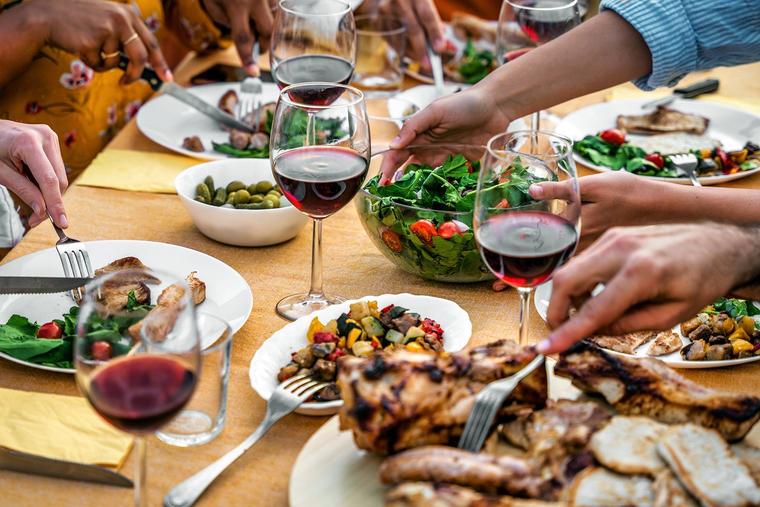
The dinners are structured to foster friendship, with an intentionally simple and non-combative format. We invite a balanced group of approximately 12 to 14 participants representing different perspectives. We always begin with Mass, followed by the Rosary, to ask our Mother Mary for intercession. We adjourn to a reception. Then we sit down for dinner. Over a beautiful meal, guests introduce themselves and share their favorite Bible verses, explaining why those passages hold special meaning in their lives.
That simple exercise changes everything.
Rather than seeing someone as a label or ideological opponent, participants begin seeing each other as fellow Catholics, fellow Christians and fellow human beings. Conversations naturally emerge. Trust develops. Friendships begin.
One participant recently told me that he had entered the evening expecting to encounter hostility from people whose views differed sharply from his own. Instead, he left having exchanged contact information with several people he previously would have avoided.
Another attendee remarked that he had spent years reading articles written by individuals on the “other side” of various Catholic debates. After sharing a meal and praying together, he found it impossible to caricature those individuals in the same way.
Following each dinner, we send a letter thanking participants and providing everyone’s contact information so that relationships can continue beyond the event itself.
We are now planning to launch a newsletter to share stories from these gatherings. We also encourage dioceses, parishes, schools and Catholic organizations to host similar events. Hosting your own salon dinner is deceptively easy, and if you’re interested, here’s a quick 10-point plan for you to get started:
- Invite 12-14 Catholics representing a balance of viewpoints and experiences.
- Collect brief biographies and distribute them in advance.
- Begin with Mass. If Mass is unavailable, begin with the Rosary or another form of communal prayer.
- Hold the gathering in a home to encourage an informal, hospitable setting.
- Share a meal together around a single table. It can be potluck.
- Ask each participant to introduce himself or herself and share a favorite Scripture passage and why it is meaningful.
- Avoid structured debates or attempts to persuade.
- Focus on listening, understanding and relationship building.
- Conclude by sharing contact information and encouraging future conversations.
- Pray for one another and for the unity of the Church.
In the days ahead, the Napa Institute will publish a standard operating procedure to provide more detail and guidance, especially for salon dinners at the parish level.
While polarization is a major challenge, bridging divides isn’t as challenging as it often seems. As Catholics, we already worship together every week. We share the sacraments. We participate in parish life. Given this shared foundation, we can surely come to appreciate one another as brothers and sisters in Christ, and not as enemies in some theological or social war.
Jesus himself modeled this approach. He was criticized by the Pharisees for spending time with tax collectors and prostitutes. He sought out those whom society rejected. The lesson remains relevant today. The Evil One desires division. As Catholics, we must follow Christ in pursuing unity.
In a world increasingly defined by division, Catholics can offer a model that’s profoundly different. We can create a place where people can disagree without becoming enemies. A place where truth and charity walk together. A place where friendship comes first.
No doubt, polarization will always be with us. But so is our duty to look beyond that polarization, through the lens of Christian faith and in light of Christian friendship.
- Keywords:
- debate
- polarization
- unity
- dinner
- charity
- napa institute