How the ‘No Contact’ Phenomenon May Point to a Broader Societal Breakdown
In her latest book, Noelle Mering argues that the surge of young adults cutting ties with family points to the prevalence of individualism in today’s culture.

“No contact.” It’s a short phrase signifying a painful process wherein people completely cut themselves off from loved ones who they believe have hurt them. It’s also the subject of best-selling author Noelle Mering’s upcoming book, No Contact: How a Seductive Ideology Broke Families and Friendships and How We Can Repair Them.
In No Contact, Mering explores the increasing number of people who have stopped speaking with parents, family members and friends, often over politics or religion. While the exact number of “no contact” cases is difficult to measure, Google searches for the related term “family estrangement” have surged since 2021, indicating the practice’s growing prevalence.
Mering’s book isn’t the only Catholic treatment of the phenomenon. Psychologists like Greg Bottaro have provided guidance for discerning when one should and shouldn’t cut off ties with family, while catechetical platforms like Catholic Answers have assessed how the practice relates to — and can sometimes be consistent with — Church teaching on honoring ones parents.
But in No Contact, Mering is less focused on individual cases of family estrangement than she is on the role politics and ideology are playing in the broader phenomenon — and what it says about American society.
“My thesis is that this [wider phenomenon] is not so much mimicking an immune system’s defense response as it is an autoimmune disorder, where we no longer can differentiate between normal familial conflict and friction and severe abuse and manipulation,” said Mering, a fellow at the Washington-based think tank Ethics and Public Policy Center.
No Contact comes out Sept. 8 and is currently available for pre-order at all major booksellers. A 48-year-old wife and mother of six, Mering’s previous books include the Theology of Home series, coauthored with Carrie Gress, and Awake, Not Woke: A Christian Response to the Cult of Progressive Ideology. Her writing has also appeared in the Register.
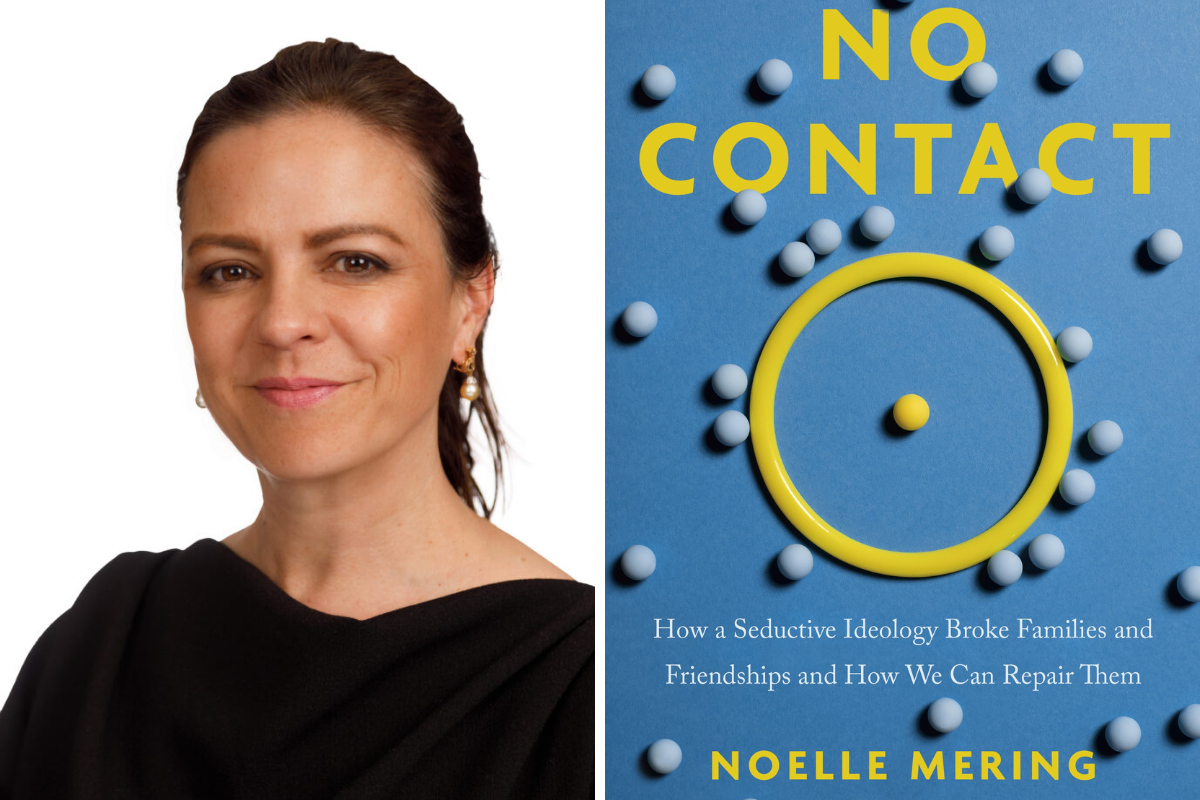
Mering spoke to the Register from her home in Southern California about what led her to write the book and the impact of “no contact” culture on the American family today. The interview has been edited for clarity and length.
Why did you choose this topic?
I was going around the country talking about the woke movement — mostly to Catholic audiences, some Protestant, some secular — but I started to see a common dynamic during Q&A [sessions]. People would increasingly stand up, and their question would be something very personal. They would say, “My adult children went to college, got woke, left the faith. Now our relationship is really on rocky grounds. It’s very fragile, if not entirely fractured.”
And, increasingly, that question, that personal story, turned into one of estrangement. They all seemed very shocked, like it had come out of nowhere. And, of course, I can’t dive that deeply into their personal stories in Q&A, but it really stayed with me and on my heart.
It seemed like something new and worthy of exploration was happening. Because it became very clear that the Church is going to lose its youth and vitality very quickly if we keep losing the next generation. And that would be really heartbreaking on multiple levels. For all those reasons, I wanted to address it.
And what was your research like in your writing process?
I read a number of books (like Rules of Estrangement by Joshua Coleman and Fault Lines by Karl Pillemer) and found various experts that I could both interview but also read their body of work. And then I had a ton of families that I interviewed, families I didn’t know. I reached out to every group of people that I know that have channels into various communities that I don’t have access to, just to put out feelers. It was a difficult privilege, I would say. You’re not often invited into the intimacy of a stranger’s familial breakdown.
But I am so grateful that people were willing to be vulnerable with me. Most of them unanimously felt like, “I want to put light on this. I want other people to feel like they’re not alone in this. I want to share my story.”
And in your conversation with experts and families on the topic, what were some of the trends you noticed when families are going through this period of “no contact”?
Before I say that, I should make it clear that there are people who go no contact for entirely healthy reasons. I analogize it to an immune system. It’s good for people to have proper immune systems that can protect them when needed and pull away from things that are harmful.
But my thesis is that this [wider phenomenon] is not so much mimicking an immune system’s defense response as it is an autoimmune disorder, where we no longer can differentiate between normal familial conflict and friction and severe abuse and manipulation.
The three most common causes that adult children would cite are COVID disagreements, voting for Donald Trump, and not affirming their gender. Or sometimes the child was an ally and they had friends who were living alternative lifestyles, and they could no longer reconcile what they believe were their parents’ hateful beliefs with the people in their sort of chosen family. Those are the three most common reasons.
Another commonality that I’m seeing is the hyper-therapeutic speak or “therapy speak”: very casually using words like “narcissism,” “toxic parents,” “toxic environment,” “protect my boundaries.” I think “boundaries” is a fascinating example because boundaries properly understood are for the sake of protecting a relationship. But I think the term has been circumscribed to be about just protecting the individual self, which is another reflection of rising individualism.
How, if at all, has social media impacted this trend of going no contact?
There’s this rise in “no-contact influencers.” I’m not on TikTok, but I did a lot of research into this phenomenon as it’s being portrayed on TikTok. There are a whole host of pop psychologists that are there strictly to talk about exposing childhood trauma and your “toxic parents.”
This is a very online phenomenon, and a lot of these influencers will do a video where the title is something like, “How to know if you should go ‘no contact’ with your parents.” I highlighted one prominent case in my book, where the only criterion is “If you feel like you should, then do it because you will feel freed, liberated.” There really is no other criterion given.
And I think that plays into what I call an infallibility narrative of the victim class. If adult kids feel like they are oppressed by their parents, then there’s not really any question or pushback you can put on their experience. Their personal narrative is unimpeachable. And so that assurance that the kids are getting online creates in them a hypervigilance to see where in their relationships they might be experiencing some toxicity.
What do you think the surge in “no contact” cases says about our society today?
I think it says a lot. We have set up a convergence of conditions that are coming to a head, as reflected by the “no contact” movement. And oftentimes the fault is not even with the young kids themselves. We have a divorce culture, for one thing, that has taught generations of kids that family members are replaceable: “You can be replaced. My parents can replace one another. Who’s to say I can’t replace them?”
It also speaks into what I call in the book the “empowerment delusion.” It is this understanding that we can control things in a God-like way, that we have power over things that are not within our control: “I can determine the meaning of my life, the meaning of sex, the meaning of marriage, the meaning of my body.” And then we’ve coupled that with this radical victimhood, where the things that are actually within my control — whether I grow in life, whether I flourish in my personal life — are ascribed to either systemic forces that are outside of myself or to wounds that have affected me throughout my life and that have now calcified into an identity of woundedness that I can’t possibly be expected to overcome.
That combination of autonomy over things we can’t control and helplessness over things that we can is going to inevitably lead to an anxious self-conception.
Was there anything that surprised you in your research?
I was wonderfully surprised by so many of the parents I interviewed that had real, hard-won wisdom and increased faith throughout this. They would say things like, “There’s not really a public forum for my grief.” If someone’s child dies, as horrible as that is, the community knows what to do. They know that you’re grieving. They know to come support you. They know to bring you dinners. They know to check in on you. But this is a different sort of grief, although it feels a lot like your child dying. You have the hope that they haven’t died and there can be reconciliation.
Abandonment and betrayal are incredibly destabilizing experiences. I was surprised and inspired in my own spiritual life to see their journeys through all of those different stages of grief and the remarkable ability that they had to find Our Lord in that pain and recenter Him in their lives in a way that could only be explained by the supernatural grace of God.
What would you say to someone whose family member has decided to go no contact with them?
My general advice is, first, don’t panic, and don’t act out of emotion. I think there’s an understandable tendency to become reactionary and to react or respond to them out of a place of your own woundedness. But in many ways, seeing the pain of the parent can make the adult child pull away even more. And so the parent has to assume a role of nobility, regardless of whether that nobility is acknowledged by the adult child.
Second, be curious. If you’re still in conversation with the family member, and they’re just threatening no contact or you feel that the relationship’s gotten really difficult over politics and ideology, then adopt a posture of curiosity: “Why do you think what you think? I want to understand.” Sometimes there might be a deeper root of why they feel so strongly about something. It’s not just that they are irrational or that they have been affected by the culture; sometimes there’s some wound there that may be good for them to uncover and to even examine for themselves.
Finally, what would you say to someone who is considering going no contact with their family?
I would want them to seek out some sort of trusted authority figure that they respect — someone who might be a little older but whom they trust to share their story, give them their reasons, and try to be as objective as they can be.
Because I don’t think that we can arrive at such a decision objectively if the only people we’re talking to are people who are cheerleading that decision to go “no contact,” people who are cheerleading all of our personal positions on politics, ideology; people who don’t have to pay a cost if we make that decision.