LA Archdiocese Rebuilds, Finds Strength From Eucharist After Fires
The 2025 National Eucharistic Pilgrimage draws closer to the fire-ravaged region just ahead of Corpus Christi Sunday.

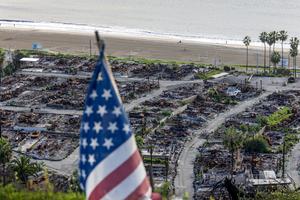
Less than six months have passed since wildfires devastated portions of the Archdiocese of Los Angeles, resulting in as many as 30 fatalities and 18,000 structures destroyed, causing hundreds of thousands to flee and billions in economic losses.
Entire neighborhoods in the Pacific Palisades and Altadena were destroyed, power and water were shut off to many, and pollutants left by the fires delayed the return of many residents to homes that did survive.
Multiple properties owned by the archdiocese and religious communities in the fire zones suffered varying degrees of damage; the most notable loss was Corpus Christi Church in Pacific Palisades, which was destroyed, along with the homes of 80% of its parishioners.
A glimmer of hope was felt when Capt. Bryan Nassour of the Los Angeles Fire Department discovered the church's 300-pound tabernacle unscathed amid the wreckage.
Repairs and rebuilding are still underway and many sites have reopened to the faithful.
As the archdiocese prepares to welcome visitors from throughout the U.S. for a series of National Eucharistic Pilgrimage events throughout the Southland culminating just ahead of Corpus Christi Sunday, the Register spoke to several people in the region about their process of recovery.
Palisades Fire
On Jan. 7, the Palisades Fire destroyed Corpus Christi parish’s church, rectory and convent and damaged its school.
Longtime pastor Msgr. Liam Kidney was shocked to see the extent of the destruction upon his return to the site, but along with parishioners vowed to rebuild.
Rebuilding has gone slow, admitted Msgr. Kidney, as the parish staff has to navigate various levels of “bureaucracy” as well as have discussions with parishioners about how the church should be rebuilt.
And, while the lots around the parish have been cleared, construction has yet to begin on a significant scale.
One thing he’s observed, however, is that “our elderly people will not be coming back. They are selling their lots and moving closer to their grandchildren.”
Hence, he expects not only the look of the neighborhood to be entirely different in the upcoming years, but the residents will be different, including a younger demographic. “That means we’ll become an entirely new parish. But whatever happens, Corpus Christi parish will be there to serve.”
Currently, the parish is celebrating Mass and holding other functions at a site in Brentwood that previously served as a house of formation for the Sisters of St. Joseph.
The parish will also have a small role in the Eucharistic pilgrimage, as a handful of parishioners will gather for prayer on the parish site on Saturday, June 21, at 8 a.m. Additionally, some will participate in Mass at Our Lady of the Angels Cathedral the following day.
Corpus Christi School, which is located alongside the parish, saw its gymnasium destroyed, middle school building severely damaged and administration/elementary school building left intact, but in need of major cleaning. The debris is still being cleared from the site.
The school is planning to reopen in fall 2026, reported Principal Paola Sessarego, but she is uncertain who will be returning for classes.
“Many of our families lost homes and have moved out of the area,” she explained. “Some will return to rebuild; others will not. But regardless, we will reopen in 2026, even if it is with just a single class.”
Neither Msgr. Kidney nor Sessarego had an idea what the cost to rebuild would be, nor what portion insurance would pay. But the total cost, Monsignor surmised, would run into the many millions.
Eaton Fire Damage
The Mater Dolorosa Passionist Retreat Center in Sierra Madre, on an 83-acre campus that backs to the Angeles National Forest, had extensive damage on Jan. 7 from the Eaton Fire. Its employee apartments, hermitage and a garage burned down, its administrative buildings were damaged, and its formerly beautiful gardens with winding pathways were severely burned.
The center has reopened to about 90% capacity, and repairs and rebuilding are ongoing.
Passionist Father Febin Barose, the director, estimates the total loss from the fire to be $4.3 million, which is being paid for by a mix of insurance and private donations (donate at MaterDolorosa.org/donate/).
The months since the fire have been a time of “listening to each other’s stories, as the fire has affected each person differently,” Father Barose said, adding: “People here experience the fire every day; it is not just a memory. As you listen to victims, they express their shock, anxiety and fear. They don’t want anything like this to happen again.”
Replanting of the gardens has been ongoing, Father Barose said, with a preference for trees and plants that are fire-resistant. Some severely burned areas have been fenced off for safety. Repair of the surviving buildings has been fraught with problems such as leaks and malfunctioning air conditioning, and additional problems related to the fire are being regularly discovered. He expects repair and rebuilding to continue for the next two years or more. Hampering rebuilding is the high cost of complying with building codes and regulations not in existence at the time the original buildings were constructed.
The center plans to offer a nondenominational healing retreat for those in the community still in distress by the fire, and its grounds have also offered to local fire departments for training.
Sacred Heart parish in Altadena survived the Eaton Fire with only modest damage, thanks to the efforts of parish Deacon Jose Luis Diaz, who spent an hour dousing flames with a garden hose. Many of the homes on the east side of the parish did burn down, however, and about 60% of parishioners lost their homes.
Sacred Heart needed $300,000 in repairs, including to the roof, a door and paint, the majority of which was covered by insurance. The parish has been reopened since March; attendance today is down a third. Many of those not turning out for Mass are Spanish-speaking parishioners, noted pastor Father Gilbert Guzman, perhaps because a large portion of their homes have burned down and they have left the area, he speculates.
Sacred Heart has been a hub for emergency relief, Father Guzman explained, as Catholic Charities has come on site to distribute gift cards, and the archdiocese has offered grants to victims funneled through the parish. Rebuilding of homes is still in the debris-removal stage.
Parishioners have kept up their spirits, Father Guzman observed, realizing what was lost “was just stuff. The important thing is that they have survived and have come together in solidarity amidst much suffering and loss. I am edified by the love and compassion I have seen.”
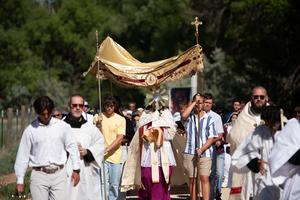
Sacred Heart was selected by the archdiocese to be the site of a June 20 Mass and Eucharistic procession through the destroyed neighborhoods and time of adoration, “as a way to show solidarity, caring and blessing to this blighted area.” Among the special guests, the pastor noted, will be papal nuncio Cardinal Christophe Pierre.
Father Guzman anticipated that the Eucharistic procession will bring “massive healing” to Altadena. When he first shared the news of the event coming to the parish, he recalled, “The people responded with tears of gratitude. It should be a real faith booster.”
- Keywords:
- california wildfires
- catholic parish life