The Narcissus Trap: AI Wearables and the Risk of Self-Obsession
COMMENTARY: Is it possible that users of wearable AI devices could, like Narcissus, become unable to tear themselves away from their own data?
As Christians, we seek to know ourselves — especially the state of our souls.
But the proliferation of wearable devices powered by artificial intelligence, which offer constant streams of data or even the voice of an AI “companion,” may tempt us to obsess over our physical, mental and emotional selves, rather than our identity in Christ.
Even before Christ, the ancient Greeks considered self-knowledge a virtue, but they also warned of its danger.
When he was a boy, the ancient mythological figure of Narcissus was told in a seer’s prophecy that he would have a long life if he did not seek to “know himself.”
It wasn’t clear if that meant the handsome youth was being advised to avoid looking at himself or that he not become prideful about his appearance. When Narcissus saw his reflection in a pool one day while hunting, both of those admonitions may have been his downfall.
By one account, he was so enamored of his own reflection that he couldn’t tear himself away from it. Suffering from unrequited love (of himself), Narcissus fell on his own sword and died.
Today, our phones command our attention, almost like portable versions of Narcissus’ pool. We can now wear that “digital pool” on our bodies in the form of devices that probably provide more health data than an intensive-care hospital room.
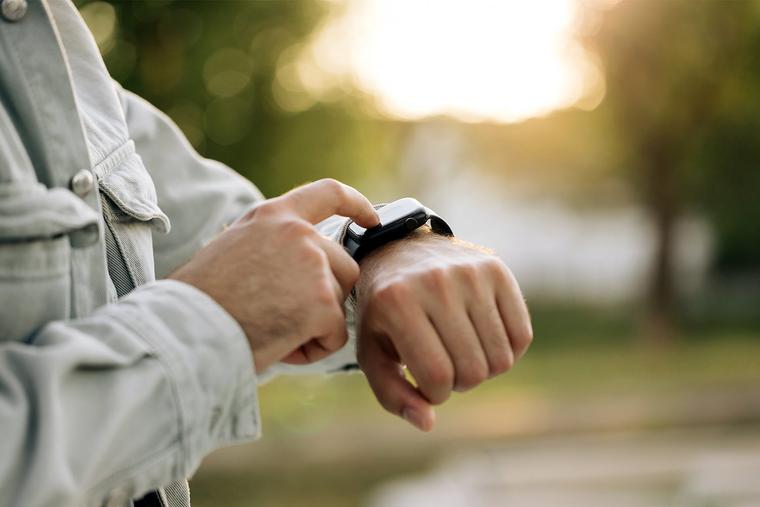
Smartwatches have been on the market for more than a decade and have become increasingly affordable. Along with facilitating communications and internet functions, they gather health and fitness data. Other devices made as jewelry are expanding the collection and analysis of physical and mental-health data, which the wearer often accesses through a corresponding phone app or through direct interaction with the device.
Like smartwatches, the Oura Ring also was launched in 2015 and claims to continuously collect “deeply personal health metrics and insights.” It tracks more than 20 biometrics through red, green and infrared LEDs. Among the data Oura gathers are heart rate and heart rate variability, blood oxygen during sleep, calories burned, step count, movement and activity, and fertility indicators.
Another titanium pendant called Nirva promises to monitor the wearer’s life, track moods, map social relationships, and offer “truly useful” guidance. It also claims to improve self-understanding, to listen and respond in real time. The device gathers data through audio, motion and light exposure to journal daily activity, track emotional patterns and map social interactions, according to Forbes.
The Nuna Emotion Tracking Pendant is a wearable device that markets itself as “a calm, caring mirror for your inner state powered by AI.” Also in the form of a pendant, the device tracks emotions, logs reflections and uses color to analyze mood. It identifies emotional patterns through the wearer’s vocal biomarker.
Nuna tracks environmental sounds to provide insights into how your atmosphere affects your emotional well-being. Using a proprietary multimodal AI model, it fuses voice tone and biometric signals such as heart rate variability to help the wearer “better understand their body and mind.”
Is it possible that users of wearable AI devices could find themselves, like Narcissus, unable to tear themselves away from their own data? Narcissus’ obsession with his appearance led him to despair; could so much ever-accessible personal data potentially also lead wearers to distraction and fear?
These devices are probably helping some users to manage their health and emotions, and they could guide them in seeking help, but it’s not clear if they lead them to hear God’s voice — or ponder God’s design for humanity.
In his message for the 60th World Day of Social Communications, which will be observed May 17, Pope Leo XIV warns that “digital technologies, especially artificial intelligence systems capable of simulating voices, faces, and emotions, risk altering essential dimensions of human communication.”
“The challenge,” the Pope stresses in the message for the upcoming World Day, Vatican News reports, “is not primarily technological but anthropological; it is a matter of protecting human identity and authentic relationships.”
Our most authentic relationship should not be with a device but with God, who is well aware of our vital data and emotions, but is more likely to speak in the quiet of our hearts and calls us to offer an “indelible reflection of God’s love” to the world.
As Leo reminds us ahead of next month’s World Day:
Faces and voices are sacred. God, who created us in his image and likeness, gave them to us when he called us to life through the Word he addressed to us. This Word resounded down the centuries through the voices of the prophets, and then became flesh in the fullness of time.
We too have heard and seen this Word — in which God communicates his very self to us — because it has been made known to us in the voice and face of Jesus, the Son of God.
From the moment of creation, God wanted man and woman to be his interlocutors, and, as St. Gregory of Nyssa explained, he imprinted on our faces a reflection of divine love, so that we may fully live our humanity through love. Preserving human faces and voices, therefore, means preserving this mark, this indelible reflection of God’s love.
We are not a species composed of predefined biochemical formulas. Each of us possesses an irreplaceable and inimitable vocation, that originates from our own lived experience and becomes manifest through interaction with others.
We can’t ignore “the trends that reduce the body to biological material to be enhanced, transformed, and remodeled at will,” according to a recent document released by the Vatican’s International Theological Commission on the 60th anniversary of the Vatican II document Gaudium et Spes.
We can’t ignore the technology, but we shouldn’t let it distract us from seeking after the self-knowledge that Narcissus missed: of ourselves in relation to our Creator.
- Keywords:
- artificial intelligence
- ai
- narcissism
- technology