Here Comes the Bride — and the Groom: Why Catholic Couples Are Walking Into Their Wedding Mass Together
Although it may be seen as a new trend, a growing number of Catholic couples are opting for this more liturgically rooted procession.
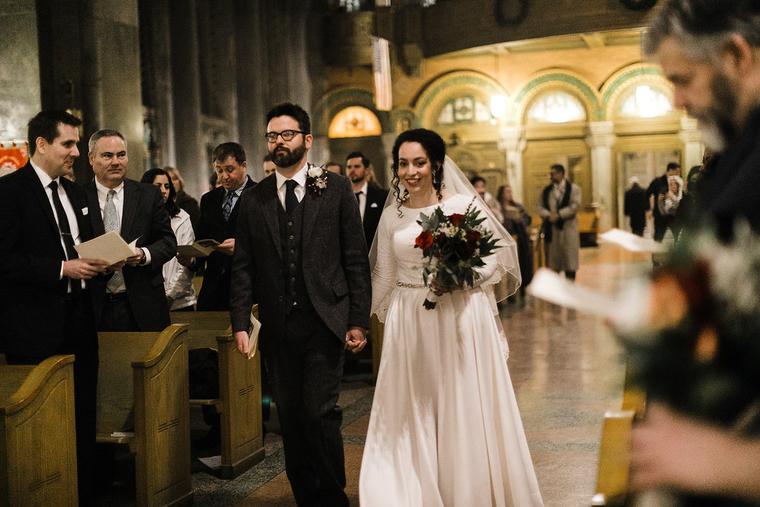
At the start of an Aug. 23 Catholic wedding in St. Paul, Minnesota, all eyes turned to the back of the church for that iconic moment: the bride’s procession down the aisle with her father, before he hands her off to her husband-to-be.
Except when the back doors of St. Mary’s Church opened for the big reveal, Liz Holman wasn’t standing with her dad; he was already seated in his pew, next to her mother.
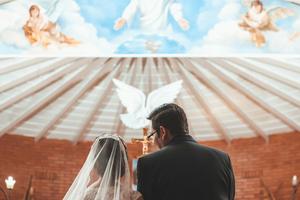
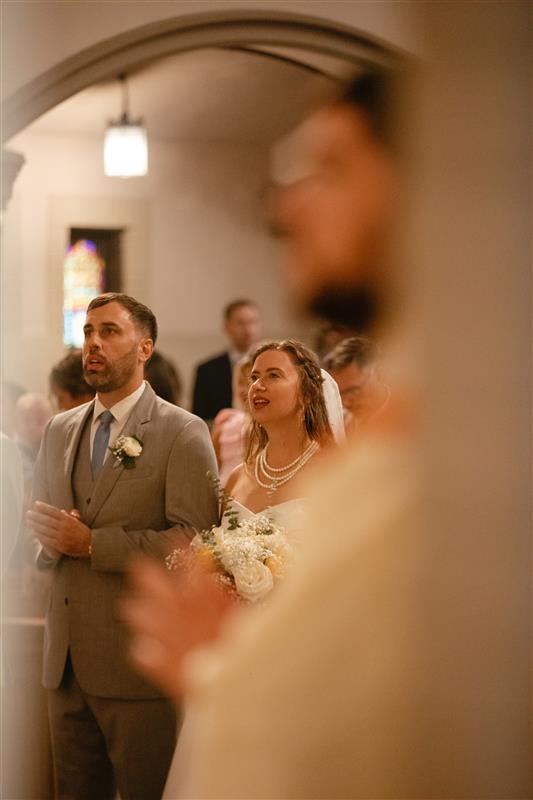
Instead, the bride was locked arm-in-arm with her groom, Greg Westerhaus. And together, as the choir sang Come Thou Fount of Every Blessing, the couple walked to the altar.
The move might strike some as a modernity-motivated break from religious tradition. But contrary to popular belief, the father-of-the-bride escorting and then “giving away” his daughter at the altar is not called for by the Catholic Church — it’s merely an American cultural convention.
And a growing number of Catholic couples like the Westerhauses are bypassing the custom in favor of what they see as an entrance procession that’s truer to the Church’s vision of matrimony.
“We wanted to enter marriage together,” explained Liz, who had seen the practice at a friend’s wedding and was drawn to its deep symbolism.
Symbolic Significance
The Catholic Church teaches that marriage is a sacrament, a visible and grace-giving sign. But unlike reconciliation or the Eucharist, the priest isn’t the minister of the sacrament — the bride and the groom are. As the Catechism of the Catholic Church states, the spouses “mutually confer the sacrament upon one another by giving consent before the Church,” an image of Christ’s love for his people.
“We marry each other, and so live as signs of God’s covenant,” explained Terence Sweeney, a Villanova University theologian who processed up the aisle with his wife Jess at their 2019 wedding.
The bride and groom’s status as the ministers of the sacrament is meant to be reflected in the wedding liturgy, including the procession. In fact, the liturgical guide for weddings that was in use until 2016 explicitly states that “if there is a procession to the altar,” the bride and bridegroom enter last, behind the servers and priest. The text adds that the couple may be escorted by “at least” their parents and “the two witnesses”— the maid of honor and best man — “according to the local custom.”
While this language is retained in the official Latin version of the updated “Order of Celebrating Matrimony,” the English version simplifies things and gives two options: the priest meeting the couple at their place or a procession “in the customary manner.”
What’s absent in each of these liturgical texts is any mention of the father alone escorting the bride or giving her away at the altar.
In fact, for most Catholics around the world, from Germany to Vietnam, the bride and groom processing together is the norm.
So why is the father-and-the-bride custom so common among Catholics in America?
“It was something introduced by Protestant culture,” explained Dominican Father Gabriel Mosher, pastor of St. Catherine of Siena Catholic Newman Center at the University of Utah.
When Catholic immigrants arrived in the U.S. in the late 1800s and early 1900s, they encountered the father-and-the-bride custom, which had become a formal part of Protestant wedding ceremonies. And out of either an attraction to the custom, a desire to fit in with a mostly Protestant country, or a mix of both, American Catholics incorporated it into their wedding Masses.
By the mid-20th century, the father escorting the bride was presented by non-official Catholic wedding literature as the norm in the United States.
“The bride comes up the aisle on her father’s right arm,” reads one such guide, American Catholic Etiquette, published in 1961. “At the gates of the altar, her father takes her right hand and places it gently on the left arm of her bridegroom.”
A Growing Trend?
The Church gives wide latitude to incorporating cultural customs into the celebration of marriage.
However, upon learning of the more liturgically rooted procession — as well as the Protestant roots of the father-daughter custom — a growing number of Catholic couples seem to be going in the opposite direction.
Father Mosher told the Register that the practice of bride and groom processing in together, although far from widespread, is becoming more popular, especially among converts and those with a formal education in theology or liturgy.
The general trend was confirmed by Jacqueline Eckert, a wedding photographer who shot the Westerhauses’ wedding. Eckert said she has seen an uptick in the practice over the past two years, with the bride and groom processing in together for four of the 10 Catholic weddings she has photographed thus far in 2025.
In fact, Eckert and her husband decided to process down the aisle together when they got married two years ago because the practice had stronger Catholic roots and “more clearly signifies coming to the sacrament freely and without coercion,” she said.
Like the Westerhauses and Sweeneys, the Eckerts didn’t know about the custom until discovering it at another couple’s wedding, a sign that the practice is spreading organically.
But awareness is also spreading in other, more far-reaching ways. For instance, on a recent episode of the FOCUS spirituality podcast discussing the theology of marriage, liturgical theologian Christopher Carstens described the bride and groom processing together as the Church’s preferred practice.
“The Church is trying to offer something normative and canonical, while at the same time allowing for some local differences,” said Carstens, director of the Diocese of La Crosse, Wisconsin’s liturgy office and director of Adoremus, a group that promotes the “rich liturgical tradition” of the Catholic Church. “But, in any case, this is what’s at least on the books, trying to sacramentalize this reality.”
Sweeney thinks that the practice could be especially appealing to younger practicing Catholics.
“The biggest thing is that so few people know about it,” he said. “I think there is growing interest, but that interest would grow a lot more if couples knew.”
Differing Views
For some Catholics, making the practice of the bride and the groom processing together the norm in America isn’t just about getting back on more solidly Catholic footing. It’s also moving away from a custom that they see as symbolically problematic.
Father Mosher, for instance, argues that the father giving away his daughter to her new husband conveys the idea that marriage is “a form of property exchange.” This view was common in the Roman Empire, he said, but the early Church rejected it, emphasizing that “there is an equality to the exchange between the couple themselves.”
“I don’t think that it’s consistent with Catholic theology to speak or act in such a way that implies that the bride is being given to the groom by her father,” he said.
Some parishes even explicitly ban the practice, such as St. Mary’s in Grand Rapids, Michigan.
However, not every Catholic priest is ready to discard the custom.
Jesuit Father Tony Lusvardi acknowledges that the custom of “giving away” the bride may have a problematic past, but its expression appears to have been “purified by Christian usage.”
“I think it reflects the special bond between father and daughter, the uniqueness of that relationship and even the complementarity of the sexes,” said Father Lusvardi, a sacramental theologian at the Pontifical Gregorian University in Rome. “So I don’t object to the father escorting the bride if that’s what the couple prefers.”
In fact, Father Lusvardi notes that the Church allows for cultural adaptation with marriage “more than any of the other sacraments.” At different times and places, this has included everything from a coronation of the bride and groom to blessings of the nuptial chamber.
“The Church is very insistent on the importance of the consent of both members of the couple, but is a bit more flexible when it comes to the ceremony,” said the Jesuit theologian.
Discerning the Decision
Given the strong expectations that some fathers might have of walking their daughters down the aisle, some Catholic couples drawn to the more liturgically minded procession have nonetheless found a way to do both.
For instance, on the Sweeneys’ wedding day, the couple started with a “pre-liturgical procession” that included Terence walking down the aisle with his mother and Jess being escorted by her father. After they met in the middle of the church, however, Jess and Terence returned to the back of the nave to follow the priests to the altar while a hymn was sung.
“It was a kind of family procession to honor our families and then the actual liturgical procession,” explained Terence.
Other Catholics have noted that, in addition to the sacramental symbolism, the bride and groom jointly progressing in may have some practical benefits.
Jessica Bohaty, for instance, wrote in a post for Life-Giving Wounds, a ministry for children of divorce, that processing to the altar with her now-husband felt appropriate, given that her father had left her family after her parents split.
“I loved my father and respected him and his continued desire to be a part of my life, but that did not include wanting him to give me away in marriage,” wrote Bohaty, now a wife and mother in Nebraska.
Whatever a couple decides for their wedding procession, Father Lusvardi encourages those preparing for marriage to spend time with prayers and gestures of the rite, to ensure that they’re conforming to the Church’s vision of marriage rather than one of their own creation.
“The meaning of marriage is God-given, not an invention of the couple,” he said.
For Greg and Liz Westerhaus, reflecting more deeply on the wedding liturgy and the sacrament of marriage led them to process to the altar together. It was a walk that Greg said was symbolic of how he wants to live with his wife going forward.
“She is my ezer,” he said of Liz, referring to the Hebrew word for “helper,” which is used in Genesis’ description of Eve. “So taking those steps together was important.”
And it’s a walk that more Catholic couples getting married will likely be taking.
- Keywords:
- catholic marriages