Are the Minneapolis Church Shooting Victims Martyrs?
The Church mourns the loss of Harper Moyski and Fletcher Merkel as Catholics reflect on the tradition of recognizing the many forms of bearing witness to Jesus Christ.
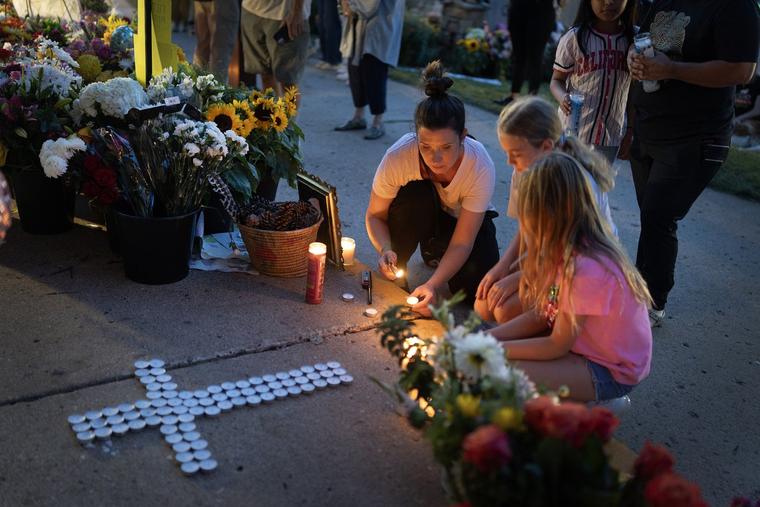
Among the unanswered questions in the aftermath of the mass shooting at a Catholic church in Minneapolis earlier this week is whether the two children who died are martyrs.
Like St. Óscar Romero in 1980 and St. Thomas Becket in 1170, they died while praying in church.
But does that make Harper Moyski, 10, and Fletcher Merkel, 8, martyrs as the Catholic Church defines the term?
The answer isn’t clear-cut, partly because not all the facts are known and partly because the Church’s concept of martyrdom has been expanding in recent decades.
The Register contacted several Catholic scholars who study martyrdom to ask the question and received varying answers.
Harper and Fletcher, pupils at Annunciation Catholic School in the Windom neighborhood of Minneapolis, were attending an all-school 8:15 a.m. Mass on Wednesday at Annunciation Church when a man outside the building fired dozens of rounds with a .223-caliber (5.56-millimeter) rifle, as well as a handgun and a shotgun, through narrow stained-glass windows on one side, authorities have said. The two children died. Eighteen other people were wounded, most of them students at the pre-kindergarten-through-eighth-grade school.
The shooter, Robert (Robin) Westman, 23, a male who identified as a female, fatally shot himself shortly after he shot up the church.
Westman, who attended the school and had attended Mass at the church, “had some deranged fascination with previous mass shootings and very disturbing writings that demonstrate hatred towards many individuals and different groups of people,” Minneapolis Police Chief Brian O’Hara said during a press conference Thursday.
Published descriptions of the shooter’s videos and writings include anti-Catholic statements and a target with a picture of Jesus, but also animus against Jews, Zionists, Blacks, Mexicans and President Donald Trump, among others. He also “wanted to watch children suffer,” said Joseph Thompson, acting U.S. attorney for the District of Minnesota, during the press conference Thursday.
What Is Catholic Martyrdom?
All Christians have a duty “to act as witnesses of the Gospel and of the obligations that flow from it,” states the Catechism of the Catholic Church (2472), which says such witness “is an act of justice that establishes the truth or makes it known.”
“Martyrdom is the supreme witness given to the truth of the faith: It means bearing witness even unto death,” the Catechism says (2473). “The martyr bears witness to Christ who died and rose, to whom he is united by charity. He bears witness to the truth of the faith and of Christian doctrine. He endures death through an act of fortitude.”
Popes have been issuing decrees of martyrdom since at least 1627, when Pope Urban VIII declared that 26 Japanese Catholics crucified in Nagasaki in 1597 because of their faith were martyrs.
The current standards of the Church for determining martyrdom are violent death at the hands of a persecutor acting in odium fidei (“in hatred of the faith”) “and of its acceptance by the victim,” according to an apostolic letter Pope Benedict XVI wrote to the Congregation for the Causes of Saints in April 2006.
“There is an intention of consciously reproducing the passion of Christ. One is actively testifying to Christ’s sovereignty,” said Jesuit Father Peter Nguyen, associate professor of religious studies and adviser of Catholic studies at the College of the Holy Cross in Worcester, Massachusetts, who studies 20th-century Christian martyrdom.
A formal declaration of martyrdom by the Church automatically qualifies a person for beatification, without the usual requirement of a miracle.
Did the Shooter Hate the Catholic Faith?
In the case of the Minneapolis children, there is no question about violent death. But did the shooter act in hatred of the Catholic faith?
Some think this incident is more about mental illness than persecution.
“At first, I thought it was martyrdom. But then you read the manifesto. It’s a goulash of nonsense,” said John Dempsey, a professor of history at Westfield State University in Massachusetts and author of Bonizo of Sutri: Portrait in a Landscape, a 2023 book about an 11th-century Italian bishop who suffered for his attempts to reform the Church.
“This is just nihilistic violence — someone who says, ‘I’m ill, and I know that I’m ill, and I just want to bring someone with me,’” Dempsey said.
“He just looked out at what was closest and what he knew, and I’m not sure you could simply say he was motivated by hatred of the faith,” Dempsey continued.
Carmelite Father Steven Payne, professor of practice in historical and systematic theology at The Catholic University of America in Washington D.C., said it’s hard to say the shooter acted out of hatred of the faith based on the current uncertainty about his motives, which undermines the case for formally declaring the Minneapolis children martyrs.
“That is not to deny that their deaths were tragic and that we rightly mourn them, nor does it take away from the pious hope that they are now in heaven,” Father Payne told the Register by email. “But at least based on what we know so far, they don’t seem to qualify as ‘martyrs’ in the technical sense that would be required for beatification and canonization, even though one might call them ‘martyrs’ in the broader popular sense. (The word ‘martyr’ means ‘witness,’ and there are many forms of ‘witnessing’ to the faith.)”
But some think the circumstances of the shooting — during Mass, targeting participants — prove hatred of the faith.
Anthony Clark, professor of Catholic Chinese history at Whitworth University in Spokane, Washington, who has studied the deaths of 119 Chinese Catholics whom the Church has declared to be martyrs and saints, told the Register the Minneapolis children are victims of persecution of Catholicism.
“It would be easy to argue that someone shooting into a church to massacre children of that faith certainly acted in odium fidei,” said Clark, author of the 2011 book China’s Saints: Catholic Martyrdom During the Qing (1644-1911).
“Were the children witnesses? I think we could arguably say that by dying in this way, they are,” he said.
That leaves the third standard — voluntarily accepting death — which would be harder to show in the Minneapolis church shooting.
“Typically, martyrs have a chance to choose their life or their faith. Rome would probably say about the third part of the question, that the question mark is too large,” Clark said.
But that’s not a definite “No.”
“One never knows, because one never decides these things without prayer,” Clark said. “The Church has its rules, but it approaches a matter like this with a great deal of prayer and discernment.”
“If you put me in a corner — were they martyrs? My answer would be in odium fidei, Yes. I would say as witnesses, Yes,” Clark said. “And I’d say about the third part, voluntary acceptance of death, that’s negotiable. That’s a more nebulous field of inquiry.”
“Were these children martyrs? At the end of the day, that’s the decision of the Church. But we as laypeople who are members of the Body of Christ can weigh in,” Clark said.
The Liturgical Case for Martyrdom
It’s not clear from publicly available facts whether the pupils attending Mass at Annunciation Church on Wednesday chose to do so or had any intention to lay down their lives for Christ, the Church, or its teachings, and it seems the children had no reason to think they would soon be under attack.
“That said, liturgically speaking, on Dec. 28, we celebrate the feast of the Holy Innocents,” Father Nguyen noted, referring to the incident described in Matthew 2:16-18 in which King Herod the Great ordered every boy 2 years old and younger slaughtered in an attempt to kill the Baby Jesus, who unknown to Herod had already been taken by Joseph and Mary to Egypt.
“They were not aware. And they were not Christian,” Father Nguyen said of the Holy Innocents. “But in the Church’s liturgical tradition, we honor these young boys as martyrs.”
Katherine Milco, associate professor of classics and early Christian studies at Sacred Heart Seminary and School of Theology near Milwaukee, noted that the Church typically declares as martyrs only baptized Catholics killed out of hatred for the faith and usually those who “have freely chosen to act in conformity with their Christian convictions regardless of the personal cost.”
She cited as examples St. Óscar Romero, the archbishop of San Salvador who was shot to death while celebrating Mass because he spoke out against government-sanctioned death squads; and St. Maria Goretti, an 11-year-old girl from central Italy who was stabbed to death in 1902 rather than give in to the sexual advances of a 20-year-old male neighbor.
“Is there any indication that the children in Minneapolis freely chose to go to Mass and were prepared to die as a result?” Milco said, by email.
She acknowledged the unusual situation of the young boys slaughtered by Herod described in the Gospel of Matthew.
“In fairness, I should mention that the Church has long venerated as martyrs a group of children who were neither Christian nor capable of acting freely, namely, the Holy Innocents. The argument could be made, however, that they are an anomalous case given their unique role in salvation history,” Milco said.
Polish Martyrs Expand Church’s Understanding of Martyrdom
A more recent case provides an example of how the Catholic Church has expanded its understanding of martyrdom in recent years.
In October 1971, St. Paul VI described St. Maximilian Kolbe, a Polish priest who gave his life at Auschwitz in 1941 in exchange for the life of a family man condemned by the Nazi deputy prison camp commander, as a “martyr” during his beatification Mass — something Pope St. John Paul II also proclaimed during Kolbe’s canonization Mass in 1982, even though many believe Father Kolbe gave his life for charity and not strictly speaking because of the Nazi commander’s hatred for the faith.
In September 2023, with Pope Francis’ authorization, the Church beatified the nine members of the Ulma family, who were killed by the Nazis in Poland in 1944 for sheltering Jews. Each member of the family now has the title “Blessed,” which is one step away from canonization.
The family included a father and mother and six young children — ages 1 to 7 — plus a baby of unknown sex apparently born just before the mother was killed.
Cardinal Marcello Semeraro, prefect of the Dicastery for the Causes of Saints, who celebrated the beatification Mass in Poland almost two years ago, said during a press conference the day before the beatification that the adult parents had given their lives in witness to Jesus’ Parable of the Good Samaritan.
He also said the six older children were beatified because they “were baptized in their parents’ faith and raised in that faith” and were therefore “included thanks to their parents’ faith in their martyrdom.”
As for the newborn child who was not baptized with water, “we are saying here that this child received baptism of blood. It was immersed in its mother’s blood, who suffered a martyr’s death,” Cardinal Semeraro said, according to a report from the Polish Bishops’ Conference published on the website of the Ulma family’s canonization cause.
In a telephone interview Thursday, Father Nguyen said that “the passion of Christ takes up all causes,” and he suggested that the Minneapolis church-shooting victims bear resemblance to young martyrs the Church has already proclaimed.
“You can connect these young children in Minnesota with the Holy Innocents, as well as the Polish family Ulma, because the Church’s tradition has given room for God’s grace to sanctify persons without their cooperation,” Father Nguyen said.
Robert Royal, president of the Faith and Reason Institute in Washington, D.C., and author of The Catholic Martyrs of the Twentieth Century: A Comprehensive World History (2006) and The Martyrs of the New Millennium: The Global Persecution of Christians in the Twenty-First Century (April 2025), also sees parallels between the Minneapolis church-shooting victims and the Holy Innocents.
“The Church, of course, would have to pronounce whether they could be considered martyrs in some sense. They certainly were killed in odium fidei, the traditional category, even if that was carried out by a deranged or possibly spiritually corrupted individual,” Royal told the Register by email.
He noted that the Church has been flexible in how it defines martyrdom, pointing to the case of St. Edith Stein, whom the Nazis sent to Auschwitz primarily because she was ethnically Jewish, though she was also a convert to Catholicism and a Carmelite nun. St. John Paul II nevertheless declared her a martyr, saying during her beatification Mass in May 1987 that “she gave her life for ‘true peace’ and ‘for her people’” and noting that her deportation from Holland occurred after the Dutch Catholic bishops publicly condemned the deportation of Jews to death camps.
John Paul II also used the phrase “martyrs of justice” to refer to a priest and a government magistrate killed by the mafia in Italy.
“Can that be stretched all the way to young children simply attending Mass in a nation that once had a proud Christian heritage? I don’t know,” Royal said.
“What I do know — and I’ve encouraged my own pastor about this — is that churches unfortunately now need to take steps to protect parishioners at Mass and church properties from everything from random vandalism to outright demonic hatred in our troubled culture,” Royal said. “All that may force us to further develop notions of martyrdom.”
- Keywords:
- school shooting
- minneapolis
- martyrdom
- catholic martyrs