Gratitude: A ‘Miracle’ We Don’t Talk About Enough — but This French Priest Is
Gratitude has a ‘spectacular’ impact on the body, the mind, relationships with others, and with God, says Father Lionel Dalle.
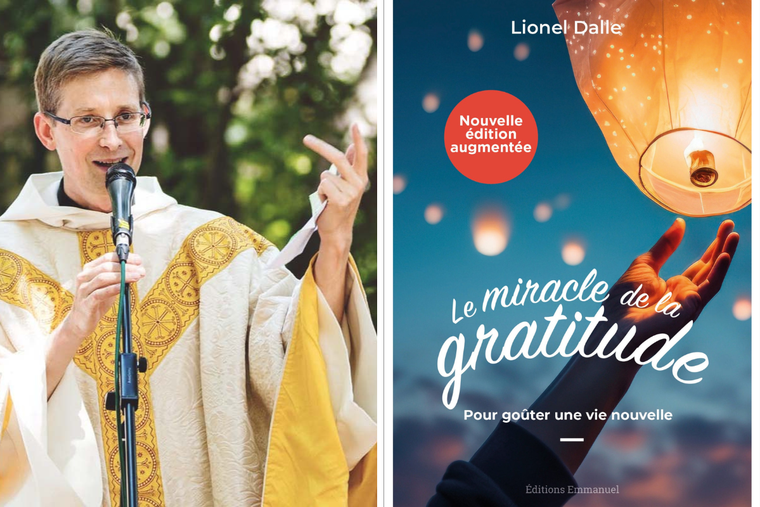
Seven years ago, French priest Father Lionel Dalle wanted to find ways to help people place gratitude at the heart of their daily lives and to establish it permanently so that it would become “like a second nature.”
This priest from the Emmanuel Community drew inspiration from the work of Father Pascal Ide — who holds doctorates in both medicine and theology — to develop a practical tool that includes exercises to help people “move into action.”
“Gratitude is free, simple, and very impactful … it is nothing short of a miracle,” Father Dalle explained to the Register. .
His book in French, The Miracle of Gratitude, along with the program he launched in his parish, has met with great success. Why such enthusiasm?
“Today, scientific studies have proven it: The effects of gratitude are quite spectacular. It has a somatic impact, a psychological impact, a relational impact and a spiritual impact,” the author told the Register. “The effects of gratitude are well-documented, long-lasting and profound— if one adopts an attitude that is actually quite easy to learn,” he added.
Throughout his instructional work, the priest lays out the theoretical underpinnings and provides a road map for embodying gratitude across every area of life. He highlights opposing forces — such as ingratitude, comparison, regrets, impatience, fears — and cautions against pitfalls like voluntarism (the universe is subject to the will alone) and a laissez‑faire attitude.
The path of gratitude, Father Lionel insists, rests on three steps: Recognize, feel and thank. “Recognizing belongs to awareness, feeling to the realm of emotion, and thanking to the domain of the will.”
Thanks to these clearly defined stages, gratitude is revealed as a powerful remedy for many illnesses, is defined as “the gateway to the virtues,” and is described as the ideal way to get free of our age’s greatest failings — the logic of hyperconsumption.
By publishing this work, Father Dalle has become the “priest of gratitude,” as he good‑humoredly calls himself. His intention was to prevent gratitude from becoming the sole province of personal‑development gurus and life coaches — overlooking that its true source lies in “the Christian faith,” he underscored. “Our principal prayer is the Mass — that is, the Eucharist, which literally means ‘action of thanksgiving’… and therefore gratitude. In the Bible, the word ‘thanksgiving’ and the attitude of giving thanks are everywhere,” he explained.
Beneath an overly horizontal view of gratitude, the French priest discerns several dangers. The first flaw of these “pagan” methods, he argues in his book, is their Pelagianism. In other words, because they fail to acknowledge the transcendent, they tend to assert that everything depends on human effort — forgetting “the grace of God.” Their second flaw is narcissism: They revolve around the “self” as the ultimate center and end.
Father Dalle, for his part, intends to help his readers turn toward others and toward God, framing his approach within humanity’s calling “to give and to serve.” To that end, he follows the fairly classic schema of Christian anthropology, unfolding gratitude as lived in four “relationships”: with creation, with oneself, with others, and with God.
Just as a master guides his apprentices, the priest of gratitude seeks to lead his flock gradually from Level 0 — an absence of gratitude — to Level 4. This final rung is by far the most demanding and the most delicate: the heroic choice to live out gratitude in times of trial. It can be quite simple to live out gratitude in everyday frustrations, with attitudes such as “It’s interesting!”; “It’s not a big deal!”; “It’s useful!”; “It’s funny!”. But what about real hardships? “It is the theme of God’s mysterious omnipotence, drawing good out of evil,” Father Dalle emphasized. For him, the person who best embodies this reality is Etty Hillesum, the young Dutch Jewish woman who died at Auschwitz during World War II. “In her diary, we clearly see that the deeper she sinks into the darkness around her, the deeper her inner peace becomes. She speaks of tears of gratitude running down her cheeks while she is imprisoned at the Nazi camp in Westerbork, standing in the antechamber of death. It is miraculous to feel gratitude under such extreme circumstances.” But Father Lionel clarified: “It is about experiencing joy in suffering, not taking joy in suffering.”
The book, which has won many followers, has been translated into other languages, including Slovenian and Chinese. On a personal level, deepening his grasp of gratitude has enabled Father Dalle to anchor himself in the present. “When I went through the program, my main struggle was living in impatience and always looking to the future. I learned to appreciate what I already had. Then later, when I faced pastoral trials, gratitude became a spiritual weapon to remain at peace.”
In any case, gratitude is “not at all something you live by snapping your fingers,” he warned. As he writes in the book, “God aims for a higher goal for us. He does not wish for men a life of petty pleasures, but integral, complete happiness — which is eternal life. He does not want our comfort, but our conversion; not (or not only) our health, but our holiness.”
Emma Silvestri is a freelance writer in Europe.
- Keywords:
- gratitude
![‘The Holy See has made clear that the clergy of the Society [of St. Pius X] are now to be regarded as schismatic,’ Bishop Frank Caggiano said in a statement.](https://publisher-ncreg.s3.us-east-2.amazonaws.com/pb-ncregister/swp/hv9hms/media/2026070617078_0ab6902d-8c02-4eac-aba4-1ec174e52618.png "‘The Holy See has made clear that the clergy of the Society [of St. Pius X] are now to be regarded as schismatic,’ Bishop Frank Caggiano said in a statement.")