Making Reparation in England’s Lost Catholic Churches
Members of the Society of St. Justin Martyr are reclaiming England’s Catholic history through prayer.
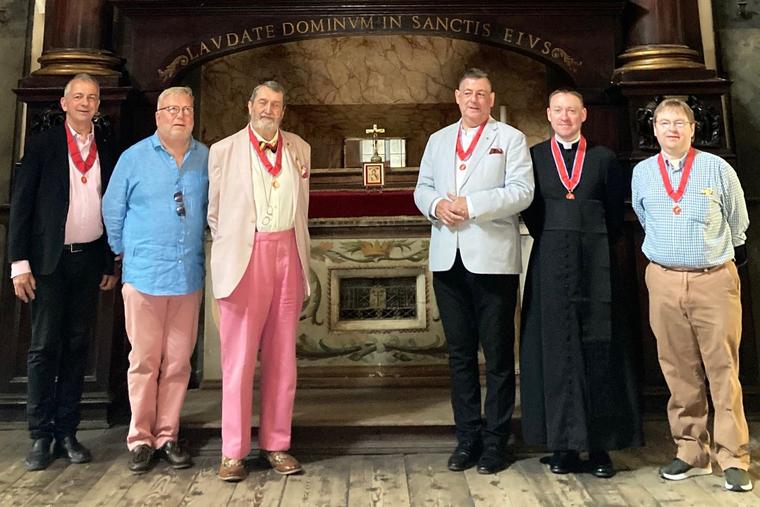
The Society of St. Justin Martyr has a simple yet profound three-fold spiritual purpose: to pray in pre-Reformation former places of Catholic worship as an act of reparation for past wrongs, to pray for the souls of those who worshipped there, and to pray for the unity of the Church.
Founded in 2005 as a confraternity of English Catholics, the Society’s apostolate focuses on these spiritual works of mercy aimed at honoring the memories of those who worshipped in cathedrals, churches and monasteries of the United Kingdom prior to, and during, the Reformation. When entering these sacred places, members of the Society are asked simply to recite, in Latin, a Pater Noster, Ave Maria and Gloria Patri with these intentions.
In this Jan. 30 email interview with the Register, founders Graeme Jolly, Master of the Society, and Antony Pinchin, the Society Chamberlain, explain more about their apostolate, which has grown over the past two decades and now has members internationally, especially in places where their own sense of Catholic history resonates with the Society’s purpose.
Their overriding goal, they stress, is to help bring “the intercessory power of the entire Church to the particular place and the particular situation” and simply to pray, “Thy will be done.”
The Society welcomes new members, who can apply via their website.
What were your motivations for starting the Society of St. Justin Martyr and in what ways do you see the Society as participating in the Church’s mission to repair the spiritual damage caused by the Reformation?
We were originally a small group of Catholic friends, priests and laity, who had all previously been Anglicans. The question arose as to how we should proceed as Catholics if we found ourselves in a church building of our former communion and particularly one which had originally been built as a Catholic place of worship, a place where the Catholic Mass had been celebrated.
We came to the conclusion that visiting such places could be turned into an opportunity for prayer, including praying for Christian unity and an opportunity to turn that visit and that prayer into an act of reparation, for example for the desecration which occurred during the dissolution of the monasteries and the Reformation as well as praying for those who had worshipped there through the generations.
Could you explain in more detail how your charism relates to the communion of saints and to the enduring bond between the faithful who died in full communion with the Church and us who still belong to that same visible Church?
If one thinks of some places, especially those places which were set apart by the Church for liturgical worship, it’s easy to understand how they become a locus where the Church Militant on earth, the Church Expectant in Purgatory and the Church Triumphant in heaven are in a mystical sense present, most especially during the celebration of Mass.
Even in those places where the building has been lost to another purpose, perhaps there are echoes of the entire Mystical Body of Christ being attached to that place. Our visits, little pilgrimages, can tap into that mystical reality and bring, perhaps, the intercessory power of the entire Church to the particular place and the particular situation.
In those places where the buildings are used by communities of other baptized Christians who haven’t perceived a personal call to full Christian unity (union with the See of Peter), we hope our private intentions in that place will not only affirm them in their baptismal dignity but also help to open the doors to allow a little of the light that guides us all towards full visible unity.
Our apostolate, however, is not to resolve at its core the fractured nature of the Church, but simply to pray and all prayer leads to utter the Dominical phrase, ‘Thy will be done.’
Neither do we think these places are “magical” but neither can they be reduced merely to tourist attractions. Faith leaves its mark and the enduring holiness in those places comes from repeated prayer, often over centuries, lived faith; prayer and faith which came at a price.
The following hymn from the Anglican tradition in a way sums it up:
In our day of thanksgiving one psalm let us offer
for the saints who before us have found their reward;
when the shadow of death fell upon them, we sorrowed,
but now we rejoice that they rest in the Lord.
In the morning of life, and at noon, and at evening,
he called them away from our worship below,
but not till his love, at the font and the altar,
had clothed them with grace for the way they should go.
These stones that have echoed their praises are holy,
and dear is the ground where their feet have once trod;
yet here they confessed they were strangers and pilgrims,
and still they were seeking the city of God.
Sing praise, then, for all who here sought and here found him,
whose journey is ended, whose perils are past;
they believed in the light; and its glory is round them,
where the clouds of earth’s sorrows are lifted at last.
T.S. Eliot’s lines in Little Gidding also seem appropriate:
“You are not here to verify … or inform curiosity”
“You are here to kneel
Where prayer has been valid.”
What criteria do you use when selecting sites?
Members of the Society are encouraged to pray in former Catholic churches, wherever they find them. Such places might be the great cathedrals, village churches, ruins of medieval monasteries or even former Catholic buildings which have been given over to secular usage. The balance varies from country to country. Our experience has been that such places can be found in many different parts of the world and it’s surely a good thing to respect a former Catholic church building whatever it is used for now and wherever it may be, by saying a Pater, Ave and Gloria Patri.
At the sacred places now used by other ecclesial communities, how do you unite the truth that the Catholic Church alone possesses the fullness of the means of salvation with genuine charity and intercession for those separated brethren who worship there?
Really our apostolate is rooted in the spiritual work of mercy “to pray for the living and the dead.” What our members do represents an opportunity to mark out, with prayer, places that had once been hallowed by the celebration of the sacraments.
As has been alluded to earlier, not all of those places have a worshipping community in another denomination and in any case our visits generally represent moments of private prayer. The founding members of SSIM are aware from their own experience just how effective formation outside the confines of communion with the Catholic Church can be in showing the path to full communion, as St. John Henry Newman’s epitaph puts it:
“Ex umbris et imaginibus in veritatem.”
Prayer changes things. In what way God uses our visits we leave to him.
What have been the spiritual fruits of your apostolate over the past 20 years?
Some members have found that their use of the society prayers in ex-Catholic churches has helped them spiritually integrate their past journeys and experiences with their current membership of the Catholic Church. As to other spiritual fruits we leave this to God.
Do you see this process of healing as central to the reconversion of England — something increasing numbers of people believe could be underway?
We don’t think we have such a grand view of what we do. Very simply we want to promote visiting former Catholic churches as an opportunity for prayer and reparation. If God uses our simple efforts, then we are happy.
Quite a large number of these pre-Reformation churches have been the venue for controversial secular events such as silent discos, with Canterbury Cathedral to host its second such disco in early February. From April, these historic pre-Reformation churches will also have to pay tax on any repairs of these sacred sites. What are your views on these trends and how is the SSIM perhaps helping to counter them?
Collectively, our response to the things you mention is limited to the spiritual domain. As mentioned earlier, prayer changes things. Individual members of course may well be “politically” active in trying to combat some of the ways in which faith is attacked by growing secularism and a lack of respect for sacred spaces, even by some who are responsible for their care.
What are your hopes and plans for the future of the Society?
We have no particular ambition beyond providing a spiritual association for those who think the task we have set ourselves is of value. In this sense we see ourselves in the tradition of very many confraternities in the Church’s tradition, perhaps most particularly like those established to pray for the Holy Souls. Our membership, across a number of countries, has grown mostly by word of mouth amongst those whose own sense of Catholic history resonates with our purpose.

Edward Pentin Edward Pentin is the Register’s Senior Contributor and EWTN News Vatican Analyst. He began reporting on the Pope and the Vatican with Vatican Radio before moving on to become the Rome correspondent for EWTN's National Catholic Register. He has also reported on the Holy See and the Catholic Church for a number of other publications including Newsweek, Newsmax, Zenit, The Catholic Herald, and The Holy Land Review, a Franciscan publication specializing in the Church and the Middle East. Edward is the author of The Next Pope: The Leading Cardinal Candidates (Sophia Institute Press, 2020) and The Rigging of a Vatican Synod? An Investigation into Alleged Manipulation at the Extraordinary Synod on the Family (Ignatius Press, 2015). Follow him on Twitter at @edwardpentin.