Notre Dame Football Chaplain Father Nate Wills on How to ‘Pray Like a Champion’
The football chaplain reflects on faith-filled moments that bind Notre Dame football together.
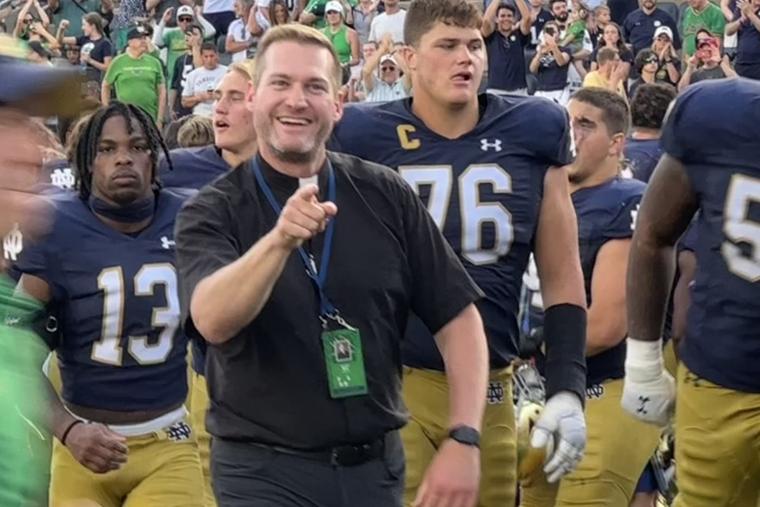
Fans of Notre Dame’s storied football team are used to seeing a man with a Roman collar standing along the sidelines with the players and coaches. For the past eight seasons, that priest has been Holy Cross Father Nate Wills, who has chronicled his experiences as the team’s chaplain in a new book, Pray Like A Champion Today: Sacred Stories from the Sidelines of Notre Dame Football, published by Ave Maria Press.
In the book, Father Nate recounts the faith-filled moments that bind Notre Dame football together — including Bible studies, the century-old tradition of distributing a medal of a different saint to the players before every game, and the gameday team Mass, a ritual revived by current Notre Dame head coach Marcus Freeman, a Catholic convert. In addition to sharing these behind-the-scenes details with readers, Father Nate imparts practical spiritual wisdom that everyone can benefit from, whether they root for the Fighting Irish or not.
You assumed the role of Notre Dame football chaplain in 2018, succeeding Holy Cross Father Mark Thesing. How enjoyable is it for the two of you to share your mutual experiences in this role?
He gave me some really great advice saying, “Eat every time they feed you but don’t eat everything they feed you,” and little things like that, which are great. I look at my older brothers in the Congregation of Holy Cross as mentors who taught me how to preach and how to administer to people with love and compassion in the name of Jesus. Father Mark still texts me after every game, which is really cool.
How has Marcus Freeman’s work ethic and faith impacted your ministry?
Coach Freeman’s work sayings and his inspiration are all over the book. I’m just telling the stories of God’s grace working in people’s lives, and it’s the case with Coach Freeman and his simple sayings like “Choose Hard,” “One Life” and “Team Glory.” He will take individual responsibility for losses and collective responsibility for wins, which is the sign of a really great leader.
What has the feedback been like on your Instagram account, @praylikeachampiontoday, which documents the 102-year-old Notre Dame tradition of honoring a different saint by passing out a medal to the team before every game?
There’s been some really nice feedback. People have reached out from all over the place to talk about the saints and how they have impacted their life. It has exceeded my expectations in terms of how much people have connected with the lives of the saints. I shouldn’t be surprised, though, because to tell the story of a saint is to tell a story of grace; and we all recognize how Christ moves in our lives, which we also see in certain saints.
Chapter 2, entitled “Choose Hard,” focuses a lot on a particular position group on the team. Can you describe some of their Christlike qualities and how they personify “Choose Hard”?
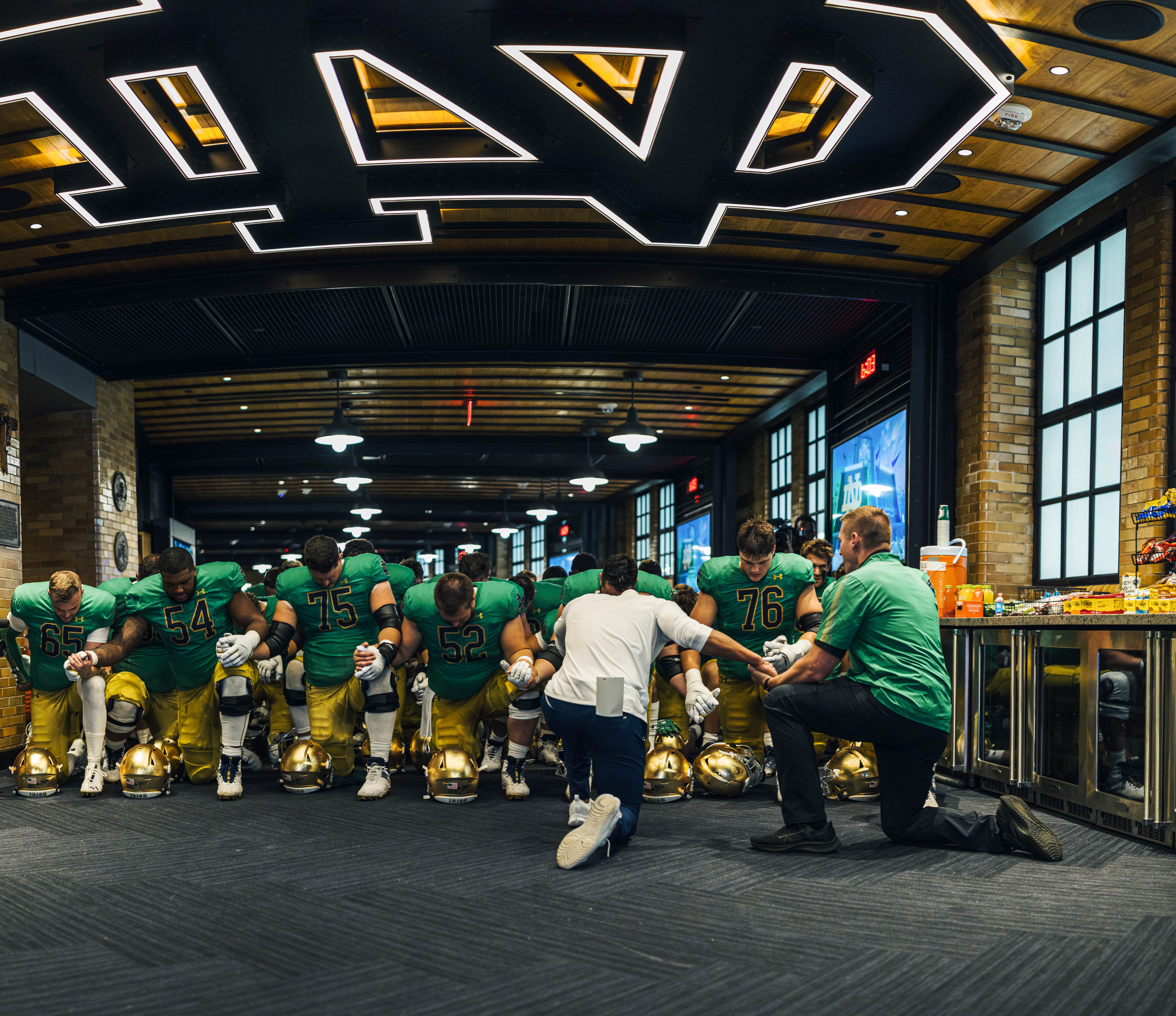
I have come to learn that our offensive linemen are some of the smartest, most interesting, and most interested people on the team, asking great questions and not taking simple answers. Notre Dame has a wonderful track record of wonderful people being O-linemen who come to our program because they want to play hard, get a great education and grow spiritually. That’s all Notre Dame football players, but in particular, I am inspired by the O-linemen, who just keep going.
How do you compose yourself to be a spiritual guide for the players after a loss?
Part of my role as chaplain is to remind the guys and myself that we are all more than our wins and losses. Before and after football, each one of them is a beloved child of God, and that’s their truest identity.
How do you minister to the non-Catholic players?
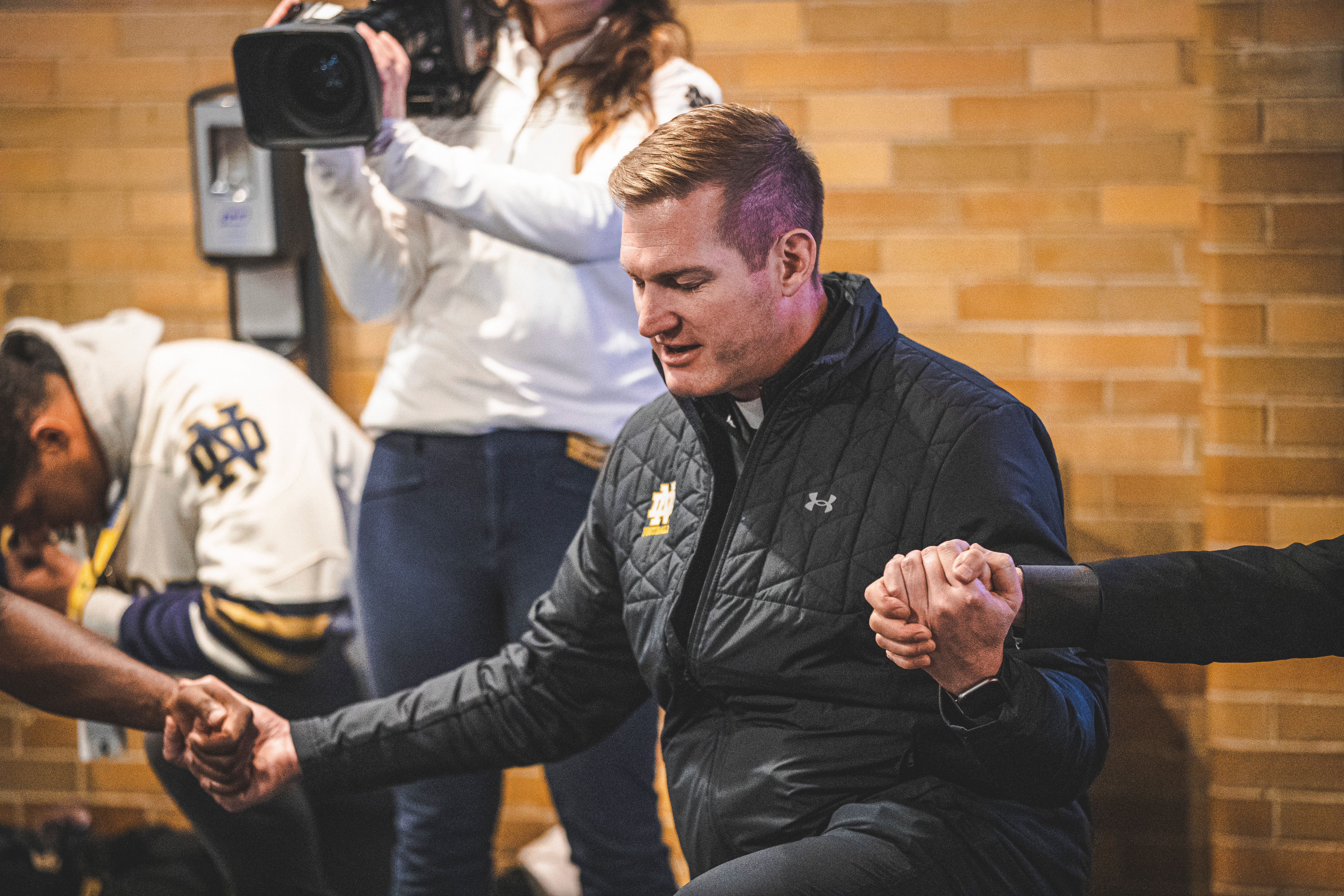
About half our team is not Catholic; and, for me, it’s a lot of just listening and showing up. There’s a story in the book about a player getting an X-ray and I went in to pray with his parents and they said, “You know we’re not Catholic.” In that moment, I reminded them I am here for everybody and want to be with everybody. The beauty of being at Notre Dame, as well, is that many of our student-athletes have chosen Notre Dame, in particular, whether they’re Catholic or not, because they know they can grow in their faith.
How important is it for someone attending a game at Notre Dame Stadium to fully experience the university’s Catholic environment and its traditions?
In many ways, Notre Dame has always been America’s Catholic university. We got on trains and traveled around the country in the 1920s and ended up beating Army (West Point) and getting notoriety for that. That became a huge source of pride for American Catholics. I do think there is something very special about coming to this campus and experiencing the beauty and the prayer we do. The presence of the Holy Spirit and the legacy of those who have come before us has been really transformative.
How much has writing the book allowed you to reflect on your journey in South Bend, Indiana, and God’s call to lead this group of young men at Notre Dame?
The process of writing and reflecting on the experiences I’ve had has allowed me to step back a little bit and to see even more profoundly how God has worked in those moments. Writing refines our thinking and challenges us to make our stories understandable to other people. Writing the book was a spiritual experience for me and challenged me to find what the deeper meaning is. It’s been a really cool journey, and it was not something I really thought about when I was taking notes and writing the ideas down throughout the years. It’s been humbling and a joy.
- Keywords:
- notre dame football
- faith and football