Priest Offers Catholic Parenting Manual for ‘Forming Families, Forming Saints’
Father Carter Griffin, a seminary rector, offers sage, timely advice — from ways to foster children’s spiritual development to why gathering around the dinner table is vital to the domestic church.
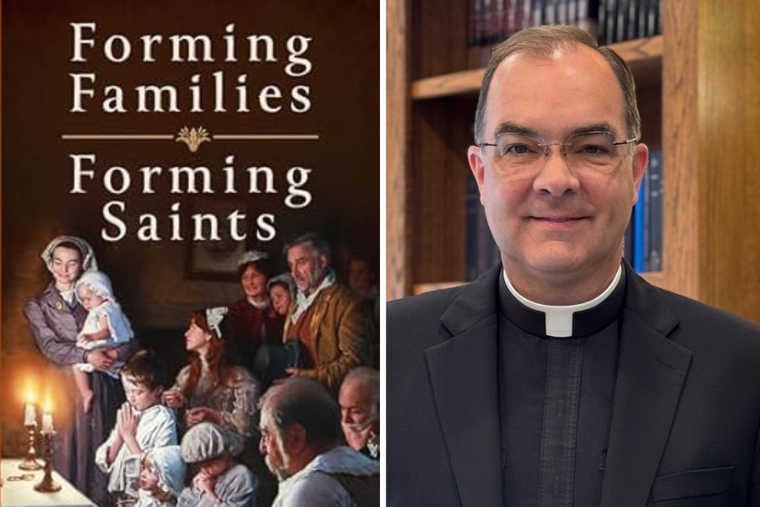
“I know what you might be thinking. What is a celibate priest doing giving advice to parents,” writes Father Carter Griffin in the introduction of his book Forming Families, Forming Saints, published last year by Emmaus Road Publishing.
Father Griffin is the rector of Saint John Paul II Seminary in Washington. He is a graduate of Princeton University and a former naval officer.
By passing on the wisdom of the Church, he writes, priests have much to offer parents who wish to raise their children to become saints. The result is a Catholic parenting manual that draws on the priest’s experiences accompanying seminarians, as well as a deep grounding in the Church’s teaching on the human and spiritual formation.
The lavishly illustrated book abounds with practical advice on how to teach children to develop a “spiritual outlook,” how to prepare the family for Mass, how to cultivate chastity (“avoid superficial compliments about appearance”), as well as tidiness (with admonitions aimed at both children and their parents).
The dinner table, he writes, is the “single most important place” in the home — it’s where the family comes together and it’s where children learn the interpersonal skills necessarily for their development. And he makes suggestions for ways to make the most of family meals: Children should help prepare the meal and clean up afterwards, he says. The TV should be off and phones put away, and everyone should say something during the meal, whether it be a highlight from their day or a poem they’ve memorized for the occasion, to name just a few.
Forming Families, Forming Saints is not just for parents who are themselves on a path to sanctification. There’s a tacit understanding between the author and reader that to raise a family well the parents need to work on themselves. Each chapter concludes with a list of questions to spur an examination of conscience. For the chapter on sincerity, Father Griffin suggests, “Reflect on how your family of origin encouraged or did not encourage sincerity.”
Parents may want to read this rich book in one go and then keep it on their nightstand, dipping into Father Griffin’s recommending reading list, “Ten Scripture Verses to Memorize,” or wisdom from the saints, or the chapter on fostering an appreciation for beauty, depending on what the latest challenges of raising of family require.
The Register interviewed Father Griffin about his book and about the challenges facing Catholic parents today.
Is it possible as parents to “form saints” if we aren’t saints ourselves?
Absolutely! This side of eternity, we are all a work in progress. But that’s the point: We are hopefully progressing towards sanctity. By the grace of God — with all the ups and downs, successes and failures, joys and sorrows of life — we can grow into the flourishing human beings that God has made us to be. Every parent (and every priest) is imperfect, and yet we are called by God not only to grow in holiness ourselves, but also to promote holiness in the people entrusted to our care. God has placed a lot of trust in us, and I think we can see in that charge a beautiful invitation to enter in to an adventure that starts afresh every day. Every morning we have an opportunity to begin again.
Why do you think so many young people drift away from the faith, and how do you think this book will prevent that?
There are many reasons. Some have had poor (or no) catechesis and are completely unprepared for the challenges of a rapidly secularizing culture. They might have come to the erroneous conclusion, for instance, that the Church and her teachings are somehow in opposition to the conclusions of science, or outdated, or narrow-minded. Others have had experiences that turned them off from the faith — grumpy priests, parents who were a bit heavy-handed with religious obligations, or persuasive atheist friends, for instance. I think many find the moral teachings of the Church to be difficult and unpersuasive in the way they are presented. Still others simply cease practicing because they don’t find religious questions pressing or important. Someone once said that many formerly religious people have “stormed off, drifted off, been driven off, or dozed off.” I think that’s unfortunately true.
There is a real need for renewal — a renewal, I believe, that is happening in many corners of the Church. That renewal needs to happen most of all at the heart of our Catholic families. A lot is hitting parents right now: growing ideologies that are deeply anti-religious, schools that have become bastions of those progressive ideologies, galloping technological change, and a general lack of support for families and children. I think it’s “all hands on deck” to support our heroic parents who are striving — and often succeeding brilliantly — to raise kids who are committed to Christ and to his Church. This book, which seeks to offer parents lessons gleaned from seminary formation, is one attempt to support them. It offers a blueprint for forming children humanly, spiritually, intellectually and apostolically and so better equip them for the pitfalls that have led so many to drift away from the faith.
As the rector of the Saint John Paul II Seminary, you’ve met a lot of young people whose parents must be doing something right. Can you share anything you’ve learned from them about how their upbringing helped foster their vocations? Is there one factor that they all have in common?
I have been blessed to meet some really exceptional parents. I am deeply edified by them. The common elements of their family cultures probably will not surprise anyone. Among many, I’ll just point out a few. First, in their families, there is an atmosphere of trust. Children who grow up in an environment where sincerity and openness are the norm tend to be much more integrated and ready to grow than those who don’t.
Second, there is a commitment to the Lord and to the Church, which is rooted not primarily in obligation but in love. Parents who love God, truly love God, the very best of Fathers, who trust him and commit their lives to him, transmit that love to their children. If someone wants to be a better mom or dad, my first suggestion is to examine his or her own interior life and see how to grow in prayer and virtue.
Third, the best families I’ve encountered have all had an outward focus. There can be a tendency, I think, for families in this tumultuous age to turn inward and circle the wagons. But Catholic children need to know that the great formation they are receiving is meant not only for them, but also for others. That can be done in many ways, ideally in practical service to people in need; for instance, the poor, the unborn, the sick, or the elderly.
Finally, I would say that the best parents I’ve met have created an environment in which there is excitement about the vocation God has prepared for each child. There is a sense of discovery that is shared by everyone, encouragement for children to explore different possibilities, and joy as vocations start to unfold in their lives.
I think it’s fair to say that parents today are not as strict as they once were a generation or so ago. What effect do you think this has on children’s human and spiritual development?
Sometimes in the past parents were strict with children in ways that were not conducive to their real human growth and maturity, or even in ways that were outright harmful. In contrast to that, the gentler form of parenting common today is a great corrective. Some, however, have taken gentleness to such an extreme that they are reluctant to correct children, which can leave children immature and poorly formed.
When it comes to religious matters, in particular, some parents have decided to leave children “free” to make their own decisions about religion when they grow up. That, however, is a great mistake. No good parent would leave children “free” to eat whatever they want or learn whatever they want. Such freedom would leave them unhealthy and uneducated; they would not be “free” to be healthy or educated. Catholic parents can foster the spiritual development of their children in many ways, for example by bringing them to the sacraments, forming them in the faith, giving them spiritual nourishment, setting a good example for them, and praying and sacrificing for them. In doing so, they are freeing them to know God and to resist the allure of the many unhealthy “religions” out there, especially the religion of self-indulgent individualism that is so rampant today. They are freeing them from the slavery of disordered self-love and for the flourishing life that God wants for us.
Can this book help parents with older children, who have perhaps reached their teen years without the benefit of the human and spiritual formation you recommend?
It is never too late to take a more intentional approach to family formation. Every parent, no matter how good, has made mistakes and must often ask forgiveness from God (and sometimes from the children). However, God loves your children even more than you do, and we know that he desires their good and their salvation. Whatever happened in the past, we entrust our children to him today and resolve to move forward, starting where they are right now.
My encouragement for parents of older children is to try to take some time apart (maybe a weekend without the kids?) and prayerfully take stock of the family as a whole and each child in particular. Try to set some clear, attainable goals to grow or improve in each of the areas of formation. Slow progress is still progress. The idea is to know where you are going so that, whatever the pace, you are at least moving in the right direction. This book is intended to help give parents that vision and to encourage them to discover for themselves where they hope to lead their children in all the different dimensions of a thriving life.