‘The Story of All Stories’: New Story Bible Is the First of Its Kind for Young Catholics
How a new story Bible uses typology and Church Fathers to explain Scripture.
As Bible sales surge, there is a new book about the Good Book for young readers.
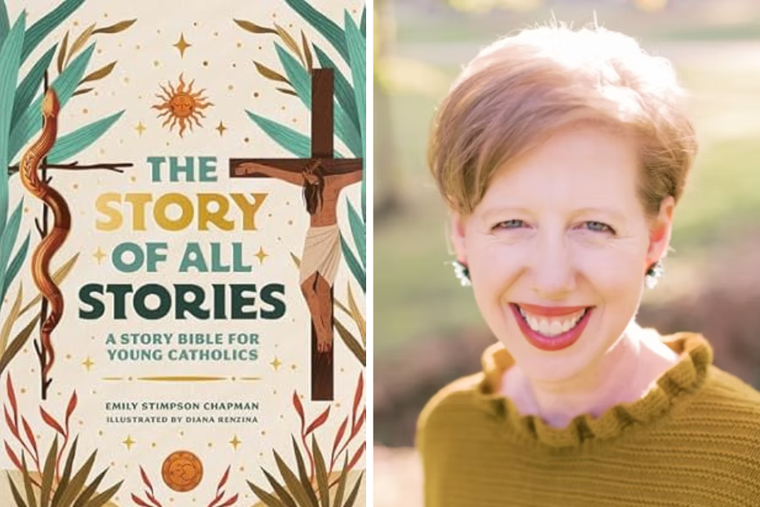
“Know the story of the Bible. We can’t know the parts if we don’t know the whole,” encourages Emily Stimpson Chapman, author of Story of All Stories: A Story Bible for Young Catholics (Word on Fire Publishing).
Chapman, author and mother of three, spoke with the Register about her latest project, the importance of learning the overarching story of salvation history, and fielding children’s tough questions about faith.
What inspired you to write The Story of All Stories?
Word on Fire asked me to do it: The idea was Haley Stewart’s, editor of Votive [imprint], and she recognized that there were no Catholic story Bibles; they were all Protestant. I actually said “No” twice before I finally said “Yes.” I finally said “Yes” because I saw their vision for the project and the art they wanted to use, and I knew that I wanted that Bible in my house. I said “Yes” for my kids!
What sets this Bible storybook apart from others, and what age would you recommend it for?
Picture Bibles are for little kids, a collection of stories from the Bible told in very simple language. Children’s Bibles are usually for age first Communion and up, but while they are illustrated, they are typically a condensed, paraphrased biblical narrative to make it easier for kids to read sacred Scripture.
This is a story Bible, which is a story about the Bible. It is like a chapter book, which goes from the beginning of salvation history to the end, and shows children how all the books of the Bible are connected: part of the same unified plan of a loving God who wants to call us to himself. It’s also Catholic and includes stories you won’t find in Protestant Bibles: the Maccabean heroes, the Bread of Life discourse, and quotes from the Church Fathers and doctors to show how the Church has been reading these stories for the past 2,000 years.
The ideal age range for The Story of All Stories is 7 to 13. It’s targeted for an audience that is starting to live a sacramental life, starting to have some bigger questions, and is capable of reading a story. We also planned it so that you could read it to your younger child of 5 or 6 — a child that is old enough to have a chapter book read to them. It’s written in layers, so they’ll get more out of it as they grow. But even adults are buying it, wanting a story Bible to help them understand the plot of Scripture.
I love how this story Bible brings gems of Church tradition alongside sacred Scripture. Please share more about your inclusion of the Church Fathers, saints and popes.
The end of each story includes a quote from a Church Father or doctor that connects the story that was just read to a way that the Church has understood it. Then, there are key points and key connections. The key points summarize that story’s relevance in salvation history, and the key connection connects it to Christ. When you read Abraham and Isaac, the key connection will be: Just as Isaac carried the wood and was willing to be sacrificed because he trusted the Father, so Jesus carried the wood of the cross to Calvary and trusted the Father’s will.
Explain a little about biblical typology for any readers less familiar with it. How do you highlight biblical types for young readers in The Story of All Stories?
Typology involves understanding how the Old Testament foreshadows the New Testament and the New Testament fulfills the promises of the Old. You can see these connections in the key points and key connections [at the end of each chapter]. The book does this through the illustrations as well. You can see this right on the cover, where you have the serpent lifted up on the pole in the desert, paired with the image of Christ lifted up on the cross. There are also images like Abraham and Isaac, in which you see Abraham and the angel hovered over Isaac with the wood of the pyre, and the way Mary is hovering over Christ at the Crucifixion is very similar to that. Another example is Jesus calling the disciples, and you see them walking across a desert landscape, harkening back to the Israelites being called out of Egypt, walking through the desert to the Promised Land. The pictures often linger in children’s minds longer than the words do; [the illustrations are] so important.
What did you find to be some of the biggest challenges and greatest blessings in working on this project?
There were a lot of challenges. First, feeling free to really tell a story … because it’s the Bible! Finding the right balance between being faithful to the narrative of sacred Scripture but drawing out the humor, the excitement, the drama — and just helping to make sense of these stories for young people, that was challenging.
It was also challenging to tell some of the harder stories: how to balance God’s love with some of the harder things that happen in Scripture, because we don’t stay away from a lot of those stories.
And then the Book of Revelation. How do you talk to kids about the apocalypse and beasts and dragons? That was challenging, [but] I ended up loving it, and it became one of my favorite chapters in the whole story Bible. Our greatest challenges can become the things we are the most proud of.
As a theologian and mother of young children, share some of your best tips for Catholic families who want to lay a foundation for a lifetime of learning and loving sacred Scripture.
The first is to know the story of the Bible. We can’t know the parts if we don’t know the whole. A lot of times, Catholics hear stories in Mass, or we have some verses we really love, but when we understand how they fit into the context of salvation history, we come to a much deeper understanding: that overarching narrative of God’s fatherly plan can carry us through a great deal.
I think it’s important to not worry that you don’t know or understand everything. You’re not failing as a parent if you don’t automatically have the perfect answer to your child’s tough question! The great thing about being Catholic is that there are answers out there. Learn how to say humbly, “That is such a great question. I have not thought about that. Let’s see if we can find out the answer together.”
- Keywords:
- emily stimpson chapman
- word on fire

Katie Warner Katie Warner is a wife, mom of five, home-schooler and children’s book author. She writes from Georgia. Her website is KatieWarner.com.