Former Head of Influential Anglican Seminary Received Into Catholic Church
Robin Ward, a patristics scholar who formed generations of clergy at St. Stephen’s House in Oxford, says he now ‘rejoices without regret or hesitation’ in the Catholic Church.
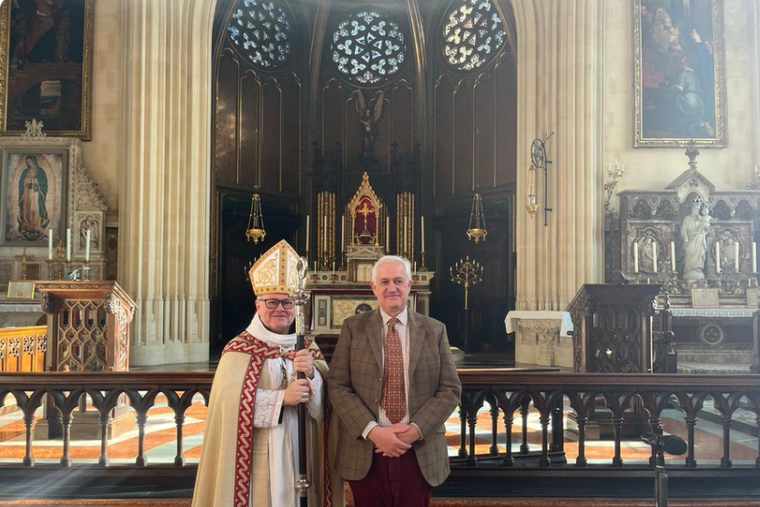
OXFORD, England — An Anglican canon who until recently headed one of the Church of England’s main theological colleges has become the latest high-profile member of the Church of England to be received into the Catholic Church.
Canon Robin Ward, who served as principal of St. Stephen’s House in Oxford for 19 years until stepping down last year, announced on social media Feb. 14 that he had been received into the Church at St. Michael’s Benedictine Abbey, Farnborough, by its abbot, Benedictine Dom Cuthbert Brogan.
“Signo te signo crucis, et confirmo te chrismate salutis — with nine words, I received the seal of the Holy Spirit in the sacrament of confirmation and the seal to complete a journey I began some 40 years ago in the city of Oxford, where I have spent most of my adult life,” Ward told the Register Feb. 18.
“I have been tremendously encouraged by the kindness of so many,” he said, “not least those who for many years have been praying for me, and I rejoice without regret or hesitation to find myself in this place.”
A prominent Anglo-Catholic clergyman and scholar, Ward, 60, studied medieval English at Magdalen College, Oxford, before training to be a vicar at St. Stephen’s House between 1988 and 1991. He later earned a doctorate from King’s College London with a dissertation on “The Schism at Antioch in the Fourth Century.”
A married father of two, Ward is an “accomplished academic in patristics and Church history, lecturing and writing extensively on early Christianity, liturgy and Anglican identity,” said Gavin Ashenden, also a prominent former Anglican who was received into the Church in 2019. “His roots in the intellectual and pastoral life of Anglo-Catholicism make his journey to Rome particularly poignant,” Ashenden added.
Ward was ordained in the Church of England in 1992 and served in various parishes as an assistant curate, parish vicar, and chaplain of a health service trust. In 2004 he was made an honorary canon of Rochester Cathedral and represented that diocese in the General Synod, the governing body of the Church of England. He was appointed principal of St. Stephen’s House in 2006.
Colloquially known as “Staggers,” St. Stephen's House has played a significant role in the history of the Church of England. Founded in 1876, Ashenden said it is “the last remaining theological college to represent the aspirations of the 19th-century Oxford Movement.” That association, also called the Tractarian Movement, sought to recover continuity between Anglicanism and the Catholic Church, helped shape “Anglo‑Catholic” worship and spirituality, and prompted some prominent conversions to the Catholic Church, one of the most famous being St. John Henry Newman.
Reflecting on his path to the Catholic Church, Ward told the Register that he had been raised “in the habits of low-church Anglicanism that barely exists anymore: using the Book of Common Prayer, liturgical without ceremony, earnest and lengthy in its preaching, sacramental but Protestant.”
It was not until he studied at Oxford, at the same college that C.S. Lewis had taught, that he “discovered the rarified and recondite world of Anglo-Catholicism” and was captivated and inspired by this “surviving fusion of 19th-century theology and romantic ritualism” that, he said, “cannot but appear eccentric and marginal” to those outside it “and especially perhaps to Catholics.”
But during his time teaching at St. Stephen’s House, passing on the theology that had most inspired him, he said a “variety of developments seemed to occlude what I held most dear.” Noting that to run a seminary means in simple terms to propose to students three questions — “Who is Jesus Christ? What is a priest? What is the church?” — he said he found the answer to the last question was becoming “less and less satisfactory and that this was becoming more apparent not only to me but to my students, past and present.”
A further influence came from being in “close proximity with the energy and charity of Catholic life in Oxford: the Dominicans at Blackfriars, the Jesuits at Campion Hall, the Oratorians at St. Aloysius.”
Ward was also conscious of the “constant presence of John Henry Newman.” When Newman began to be rediscovered in the 1980s, he said he was still “someone to whom justice had not been done,” but he is now widely acknowledged — just as the 20th‑century Jesuit theologian Erich Przywara had foreseen — as a “teacher of our age, as Augustine was for antiquity and Aquinas for the Middle Ages.”
“As we have learned to understand him better, so I have learned to see through his distinctive charism, so close to the Oxford I have known and loved for so long, the way into the One Fold of the Redeemer,” said Ward, adding that he took John Henry as his confirmation name at his reception last week.
Looking to the future, Ward said, citing from Newman’s hymn Lead, Kindly Light: “I now need to learn how to live within the household and to trust in God’s providence for the work and vocation he intends for me: ‘One step enough for me.’”
Ward’s reception follows several other high-profile Anglican conversions over the past five years. They include former Church of England bishops Msgr. Michael Nazir‑Ali, Jonathan Goodall, John Goddard, Peter Forster, Richard Pain and John Ford. Since 1992, some 700 Anglican clergy and religious in Britain have been received into the Church.
Lay converts also appear to be showing an uptick in numbers in England. Last week, the Oxford Oratory at the parish of St. Aloysius, which Ward named as significant in his own journey to the faith, said it had witnessed a wave of conversions, receiving more people into the Church in the first two months of 2026 than throughout last year.
According to The Catholic Herald, the oratory’s sacramental life is reportedly thriving: Priests hear about 1,200 confessions monthly and offer daily Masses in both the new and older forms of the Roman Rite. Known for reverent liturgy and clear preaching, the community has become a vibrant center of faith since the Oratorians took charge in 1990.
Reflecting on Ward’s reception into the Church, Ashenden observed a “weightier symbolism” behind it, in that Ward “represents the last generation of Anglo-Catholics surviving within the progressive transformation of Anglicanism.”
His becoming Catholic, he added, “will undoubtedly be taken as a signal for many that this is the only way of expressing a Catholic spirituality and ecclesial commitment, now that the modernist and feminist revolution within Anglicanism has shown it is no longer willing to compromise in any meaningful way with those who sought to retain an element of Catholic identity and loyalty.”
- Keywords:
- anglican converts
- catholic converts
- oxford movement
- oxford
- st. john henry newman
- anglo-catholics

Edward Pentin Edward Pentin is the Register’s Senior Contributor and EWTN News Vatican Analyst. He began reporting on the Pope and the Vatican with Vatican Radio before moving on to become the Rome correspondent for EWTN's National Catholic Register. He has also reported on the Holy See and the Catholic Church for a number of other publications including Newsweek, Newsmax, Zenit, The Catholic Herald, and The Holy Land Review, a Franciscan publication specializing in the Church and the Middle East. Edward is the author of The Next Pope: The Leading Cardinal Candidates (Sophia Institute Press, 2020) and The Rigging of a Vatican Synod? An Investigation into Alleged Manipulation at the Extraordinary Synod on the Family (Ignatius Press, 2015). Follow him on Twitter at @edwardpentin.