Papal Nuncio Urges U.S. Bishops to Deepen Communion
Archbishop Gabriele Caccia highlighted continuity between Francis and Leo in his first speech to U.S. bishops.
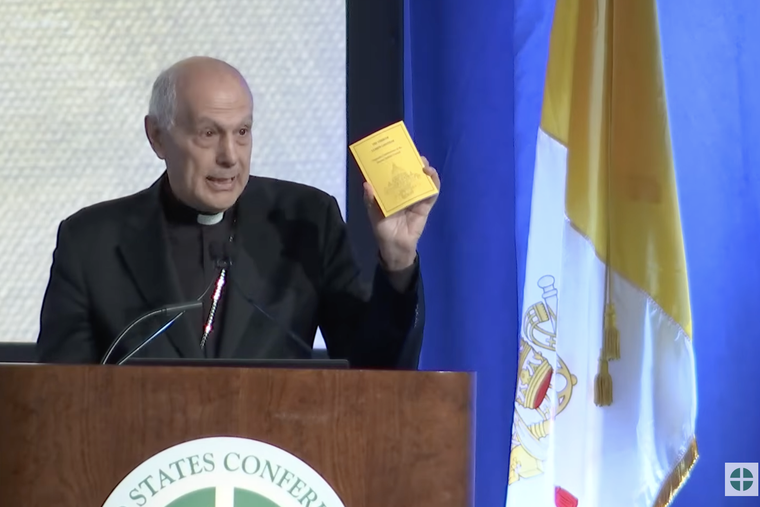
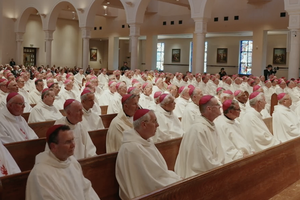
ORLANDO, Florida — In his first address to the U.S. bishops since becoming apostolic nuncio to the United States, Archbishop Gabriele Caccia called for deeper communion within the Church and presented Pope Leo XIV’s pontificate as a moment of renewal rooted in continuity with the vision of Pope Francis.
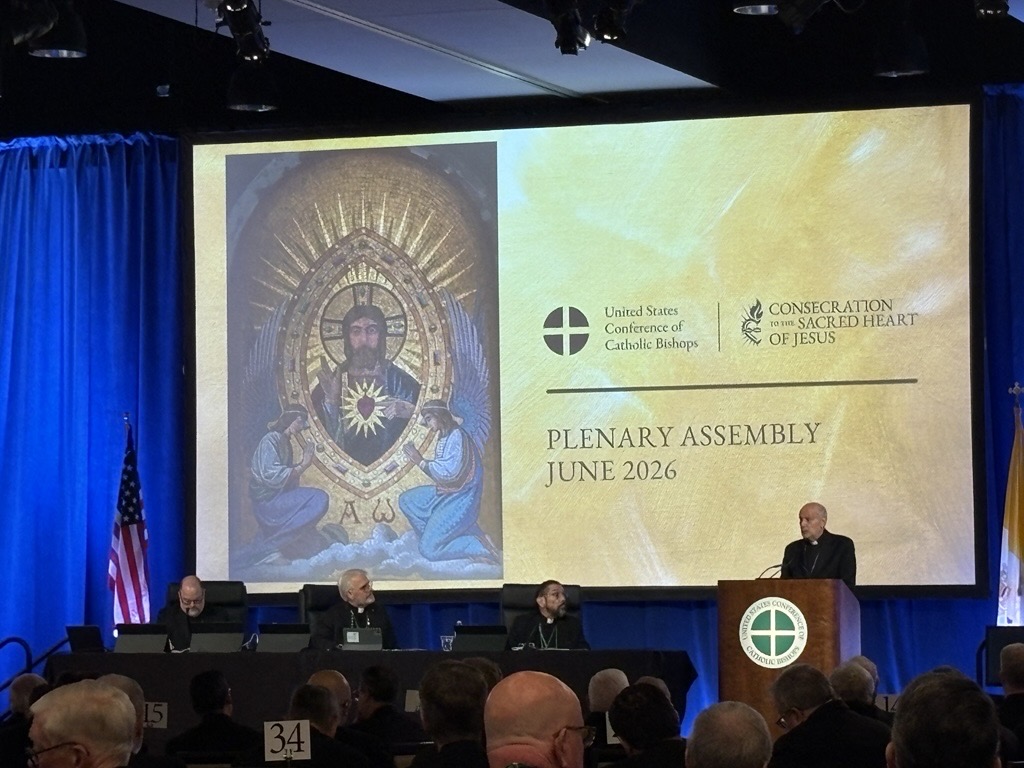
Speaking June 10 at the U.S. Conference of Catholic Bishops’ spring plenary assembly in Orlando, Florida, Caccia emphasized themes of peace, communion, and mission, describing them as essential both to the Church’s public witness and to the ministry of bishops themselves.
“I wish to be present among you as a brother bishop who journeys with you,” Archbishop Caccia told the assembly. “My service here is one of listening, trust, and shared discernment within the Church that we are all serving together.”
The address marked Caccia’s first appearance before the full body of U.S. bishops since Pope Leo appointed him nuncio in March, succeeding Cardinal Christophe Pierre, who retired after reaching the Vatican’s age limit.
Archbishop Caccia began by conveying greetings and a blessing from Pope Leo, telling the bishops that the Holy Father remains close to them in their ministry and prays that the Lord will strengthen them in their vocation.
The nuncio also paid tribute to Cardinal Pierre, thanking his predecessor for years of service to the Church in the United States and noting his efforts to travel widely throughout the country to better understand local Churches.
Throughout his remarks, Archbishop Caccia repeatedly returned to the theme of communion, portraying it as a defining characteristic of the Church’s mission and of the new pontificate.
“I see the election of Pope Leo as a gift of the Holy Spirit,” he said, encouraging the Church in the United States to foster what is best in its tradition while continuing to confront difficult chapters in its recent history, particularly the abuse crisis.
The archbishop emphasized that the United States has contributed significantly to the life of the universal Church and now has given the Church its first pope born and raised in the country. Recalling observations by French political thinker Alexis de Tocqueville during his travels in America in the 1830s, Archbishop Caccia noted that one priest had suggested the United States could someday become the center of Catholicism.
“Perhaps he was very optimistic,” Archbishop Caccia joked, drawing laughter from the bishops. “But I wonder what Tocqueville would think today, seeing that the successor of Peter has come from this land.”
At the same time, he cautioned that esteem for the Church in America must not obscure the need for continued renewal and purification.
“The Church is at once holy and always in need of being purified,” he said, quoting the Second Vatican Council.
‘We are called to build together’
Another focus of the speech was the bishops’ planned consecration of the nation to the Sacred Heart of Jesus, scheduled for June 11. Archbishop Caccia described the act as providing a “spiritual center” for the assembly and linked devotion to the Sacred Heart directly to the Church’s efforts to foster unity and peace.
“Rooted in our own communion with Jesus, we can become builders of peace and communion among ourselves and with others,” he said.
Communion, Archbishop Caccia emphasized, naturally leads to mission. While noting the Churchʼs history as both a recipient and sender of missionaries, he said the missionary vocation is lived not only by going out to others but also by welcoming those who come to us.
“To meet them with the charity of Christ, to recognize their dignity, and to help them find a place in the life of the community is also part of a missionary Church,” he said. The theme was later echoed by Archbishop Paul Coakley, USCCB president, in remarks following the nuncioʼs address.
The nuncio also highlighted what he described as a strong continuity between Pope Francis and Pope Leo.
Referencing Francis’ encyclical Dilexit Nos and Leo’s recent encyclical Magnifica Humanitas, which addresses the ethical implications of artificial intelligence, Caccia said both pontiffs have emphasized the dignity of the human person in the face of modern challenges and technological advancements.
“Here we can see the continuity between Pope Francis and Pope Leo,” he said.
According to Archbishop Caccia, Francis stressed that no technology can fully capture the depth of the human heart, while Leo is asking how the Church can safeguard human dignity amid rapidly developing technological systems.
“Such a humanism allows the Church to meet new realities without naive enthusiasm or anxious fear,” he said. “It also reminds us that the Church’s response is built in communion, not in isolation.”
Drawing on an image used by Pope Leo in Magnifica Humanitas, Archbishop Caccia pointed to the biblical figure Nehemiah rebuilding Jerusalem alongside the people.
The emphasis on unity reflected themes that have marked Archbishop Caccia’s own diplomatic ministry. Before arriving in Washington, the Milan-born prelate served as the Holy See’s permanent observer to the United Nations in New York from 2019 until his appointment as nuncio, representing the Vatican on issues ranging from migration to nuclear disarmament.
Ordained a priest in 1983, Archbishop Caccia entered the Holy See’s diplomatic service in 1991 and later served as apostolic nuncio to Lebanon and the Philippines before his assignment to the United States.
As apostolic nuncio, he serves both as the Holy See’s ambassador to the United States and as the pope’s representative to the Catholic Church in the country, maintaining relations with the U.S. government while also playing a key role in communication between the Vatican and the nation’s bishops.
A ‘living tradition’
Near the conclusion of his remarks, Archbishop Caccia presented each bishop with a pocket-sized volume containing Lumen Gentium and Dei Verbum, the Second Vatican Council’s dogmatic constitutions.
The gesture underscored another theme of the speech: continuity with the Church’s living tradition.
“This continuity is important,” Archbishop Caccia said. “We are not beginning again from zero. We receive a living tradition; and above all, we receive the love of Christ, poured out from his heart for the life of the world."
As the bishops gather for their first plenary assembly since Pope Leo’s election and under the leadership of newly elected USCCB president Coakley, Caccia’s message offered a vision of the Church centered on communion with Christ, unity among bishops, and a shared missionary purpose.
“May our renewal in the Sacred Heart of Jesus give us the grace to do this together,” the nuncio said, “for the life of the Church and the good of the world.”
- Keywords:
- usccb