Archbishop Shevchuk Praises His Flock: ‘We Hope Because We Are Christians’
The head of the Ukrainian Greek Catholic Church discusses his country and Church after four years of war with Russia.
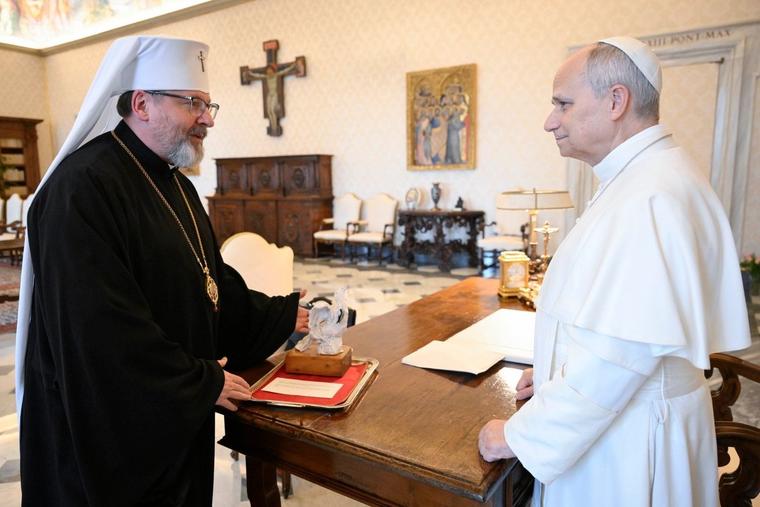
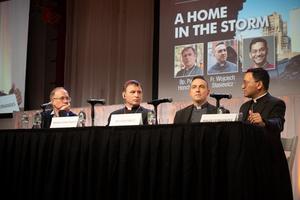
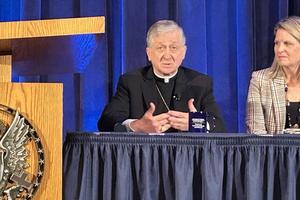
As Ukraine nears the fourth anniversary of the renewal of its conflict with Russia, His Beatitude Sviatoslav Shevchuk, major archbishop of the Ukrainian Greek-Catholic Church, met with Leo XIV on Feb. 12. During the meeting, Archbishop Shevchuk briefed the Pope with his initiatives and gave him an updated list of prisoners to be liberated.
In this interview with the Register, Archbishop Shevchuk explains that he conveyed to Leo XIV the image of a resilient Church.
But he also conveyed the suffering of a high-intensity war that has lasted longer than the Nazi-Soviet War during World War II, the sense of precariousness brought on by the nuclear threat — not only the fighting in Zaporizhzhia, but also the Chernobyl “sarcophagus,” a nuclear ground zero that requires maintenance after 40 years — and the need not to feel isolated. Because, ultimately the archbishop says, Christians in Ukraine have hope.
What did you talk about with Leo XIV?
We had a meeting I would describe as therapeutic, because for us, who bear the pain and trauma of war, it is important to be heard, to share the life of our Church and our people, and to know that we are not forgotten.
What did the Pope tell you?
Leo XIV said he cares deeply about Ukraine and is following events very closely. He asked me if there were any glimmers of hope from Ukraine. I tried to explain to him how we form the Church, how we live as a Church, how we strive to remain Christian amidst this tragedy. I had also prepared a report on the identity and structure of our Ukrainian Greek Catholic Church. I told the Holy Father that at the beginning of the last century, we were only three dioceses within the Austro-Hungarian Empire, and today we number 36, of which only 16 are within Ukrainian borders. Our presence has exploded, thanks also to the attention and concern of the Holy See.
What was the Holy Father’s reaction?
He was interested. He also commented on the war situation, noting that war changes people. It is true, in fact. The religious landscape in Ukraine has changed dramatically, even though there is religious freedom in Ukraine, while in the territories occupied by Russia, religious denominations have been eradicated. In Ukraine, religions can thrive. The cold, after all, makes no distinctions; it affects us, Latin Rite Catholics and Orthodox Christians, alike.
What does the Church do for the people in Ukraine?
One cannot speak of the Church and the people separately. We are one. But the data is interesting.
According to recent studies, the number of Orthodox Christians has declined dramatically in Ukraine. Before the war, they represented 70% of the population; now, they are 55%. Most Orthodox Christians belong to the Ukrainian Orthodox Church; there is still a 5% Orthodox faithful [contingent] linked to the Moscow Patriarchate and 18% Orthodox who call themselves Orthodox but have no visible affiliation with a Church. And this is an interesting fact. It means that the Orthodox community has experienced a significant trauma, making it impossible for them to belong to any one in their Church, or even to change confession.
What is the situation of the Ukrainian Greek Catholic Church?
We are a thriving, dynamic Church. Studies note that we have grown: We were at 8% before the war and are now at 12%. We are still trying to fully understand these data, but from an initial assessment, we can see that there is a large number of people who previously had no religious affiliation and who today join the Ukrainian Greek Catholic Church because they are searching for meaning in life, asking existential questions, and I am happy that our Church has been able to respond to this search. We are truly a Church that evangelizes in the context of war.
And in Ukraine?
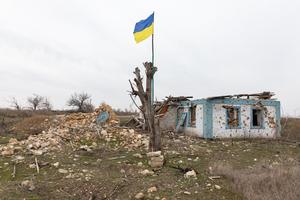
No one was prepared for a war that has now lasted four years. Some have noted that four years passed since Nazi Germany’s invasion of the Soviet Union until the end of World War II. This war is destined to last much longer. But a war is always against the civilian population. The front is largely static, despite Russian declarations of victories and conquests.
Every night, our cities, especially Kyiv, are subjected to various types of attacks aimed at making life impossible for people. The night before I left Kyiv, four types of missiles and several state-of-the-art drones were launched on the city, at a cost our military estimates at $330 million, enough to pay the salaries of an entire generation in Russia.
The Russians are systematically destroying the neighborhood’s electrical and heating systems. Kyiv, one of Europe’s largest capitals, with its 4 million inhabitants, has a power plant in every neighborhood. The area where our cathedral is located was among the hardest hit. When the power plants were hit, everything went out: water, electricity and heating, with temperatures dropping to minus 20 Celsius [minus 4 Fahrenheit]. The water in the pipes froze, and the pipes burst, affecting apartment buildings housing 3,000 families.
Tents have been set up in front of these buildings. We call them “points of resilience.” There are electric generators, fire trucks and stoves that can heat something.
But people aren’t desperate. They’re singing. I told the Holy Father that this is a gift of the Holy Spirit. The attacks have failed to achieve their goal of breaking the spirit of the Ukrainians.
Do you have hope that things will change, or is war the only solution for now?
I think war is never a solution. It’s a disgrace. Remember the Holodomor, the genocide of Ukrainians perpetuated by Stalin in the 1930s through an induced famine? We call this situation “Holodomor,” where “holod” means “cold” — because it is an attempted genocide through cold. But this is a disgrace. We spoke with the Pope about how to build peace. Our soldiers are bearers of peace because they stop the advance of the Russian army, and they must be supported. Ukraine must defend itself; it’s inevitable. However, we remain hopeful that a democratic solution will be found. We are truly grateful for the high-level meetings to propose a peace agreement.
How much does public opinion weigh in Ukraine?
It’s important; it has its own weight. This is why we need to engage with civil society, create spaces for dialogue within public opinion. There is one opportunity, the Kyiv Security Forum. It has been held annually since 2007, bringing together various experts on peace issues, with many high-level speakers. This year, it’s being held in April, and it’s interesting that part of the discussions will be dedicated to the Catholic Church. This is a sign that the Catholic Church has a very important weight and role, especially in Central and Eastern Europe. A representative of the Holy See has been invited, as well as representatives of the local Churches of neighboring countries — Poland, Slovakia and Hungary. I believe it’s extremely important for the Holy See to participate.
What would a just peace look like today?
A just peace is one that allows us to survive. Peace is not just a signed document or an abstract idea. Peace means living space. Even when we eventually discuss territories, we must make it clear that there are human beings in those territories. We are not talking about abstract entities; there are elderly people, women and children. Indeed, I would go further: There will be a just peace only when young people have the courage to start their own families.
Is there no longer the courage to create families today?
The birth rate has dropped dramatically, and it’s a sensitive issue. Birth rates are indicators of a people’s vitality. Demographers say that for a population to grow, each family needs to have an average of 2.5 children. Before the war, the average in Ukraine was lower, at 2.1 children per family. Now, the birth rate is 0.6%. The family is the part of the population most affected by the war. Women and children have fled or been displaced, men are recruited, and a child-free culture is even developing. We need to understand today where the families capable of having children are. When the war ends, the demographic issue will be one of Ukraine’s major problems.
But are you hopeful?
We hope because we are Christians — we must hope. But we also hope because we see that the Holy Father is with us. And there are many reasons to be hopeful, given the growing solidarity despite the war.
Did you also speak about this with Pope Leo?
Yes. We pointed out to him that the [Kyiv Security] Forum is dedicated to the 40th anniversary of the Chernobyl disaster [April 1986]. The Pope was shocked to realize that so much time had passed. Moreover, Chernobyl is once again a risk, because the walls of the “sarcophagus” that protected the facility until today are severely damaged. We are in a climate of constant nuclear threat, especially because of these nightly bombings. These bombings also affect our other nuclear power plants, especially because, with every blackout, electricity production must immediately be reduced to prevent them from exploding.
What messages did you receive during your visit with the Holy Father?
The Holy Father seemed very realistic to me. Two things emerged that demonstrate how much the Holy See cares about Ukraine. First, the Pope said that the war is in Europe and Europe must take responsibility; it cannot simply be a spectator, but must participate in the peace process, perhaps even proposing or seeking agreements.
Second theme: The Pope said that to make a genuine and true peace, the Ukrainian Constitution must be respected. It’s been years since the constitution was discussed. The constitution is a sign of sovereignty.
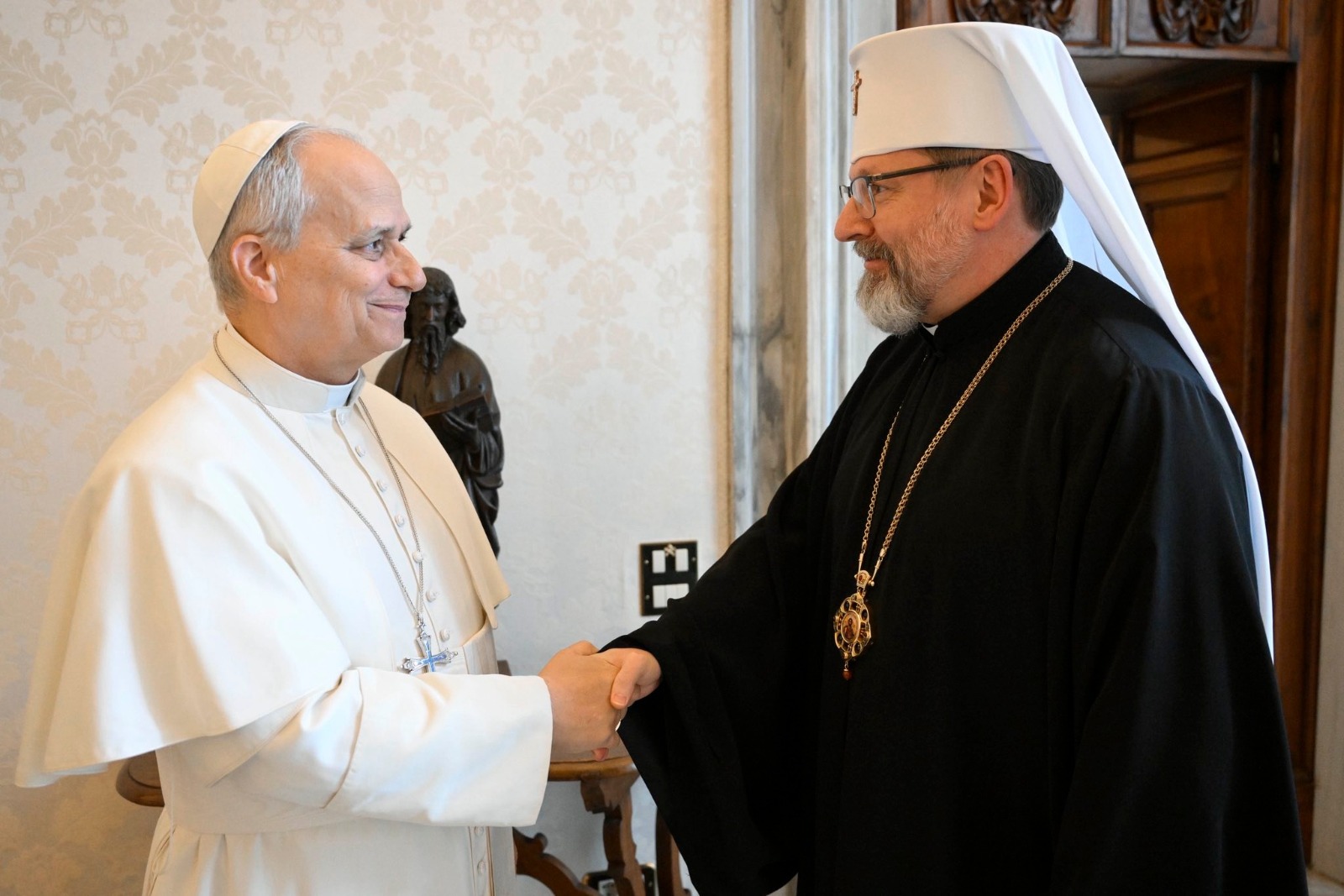
Pope Francis always said he wouldn’t go to Kyiv unless he went to Moscow first. Does Leo XIV plan to come to Kyiv?
I’ve invited him … and this year it would have a special significance: This year marks the 25th anniversary of John Paul II’s visit to Ukraine, a visit during which he beatified the Ukrainian martyrs, making them known to the world. There will be celebrations despite the war; a committee is already committed to commemorating the key messages left by John Paul II. I said to the Pope: “Holy Father, we’re expecting you, even if we respect the pace of decisions.” He made it clear he’s considering it.
- Keywords:
- ukraine war
- ukraine catholics
- 'pope leo xiv'
- russia-ukraine
- christian hope
- Major Archbishop Sviatoslav Shevchuk