Bishop Conley’s Cure For Cultural Amnesia: Get Lost in the World of Literature
COMMENTARY: Great Books and the Humanities Prompt Us to ‘Look Up’ With Wonder
Editor’s Note: This story is part of literary special content. Find related stories here.
I was led to the Catholic Church during my undergraduate years, when I was a student in the famed Integrated Humanities Program at the University of Kansas (KU). The program was a four-semester “Great Books” program for freshmen and sophomores and flourished during the 1970s and 1980s.
It was somewhat modeled after the “Great Books” programs at St. John’s University in Annapolis, Maryland, and the University of Chicago in the 1950s and 1960s. But it was different in that it was an “integrated” program where the students not only read the classics of Western civilization, from Homer’s Odyssey to Francis Parkman’s The Oregon Trail, but also memorized poetry, wrote calligraphy, went stargazing and learned to waltz.
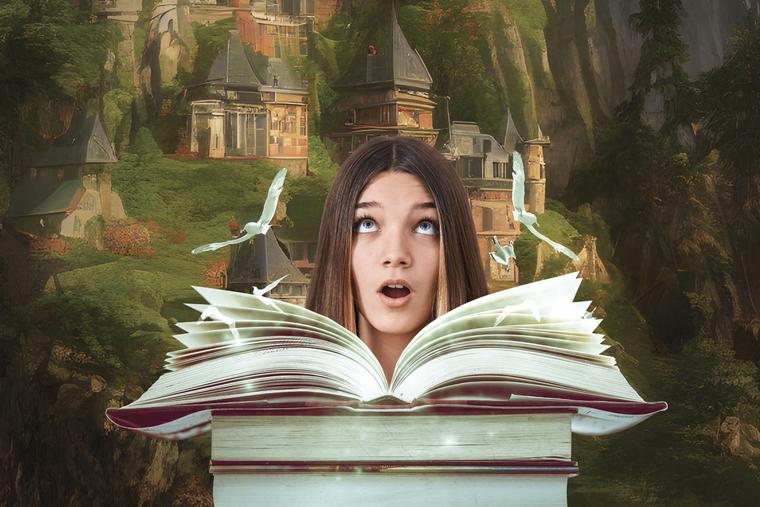
It was an attempt to get the students to “look up” and gaze at the world with fresh eyes; to try and see truth, goodness and beauty in all things.
The motto of the Integrated Humanities Program was a simple Latin phrase: Nascantur in Admiratione, which is translated: “Let them be born in wonder.” Over the course of the 15 or so years, the program flourished, hundreds of university students were reborn in wonder; and many of those students, including myself, converted to the Catholic Church. By experiencing truth, goodness and beauty through the humanities at a very large and secular state university, lives were forever changed. At the time, there wasn’t even a Catholic student center on the KU campus. But it was primarily through an introduction to the rich treasury of Western civilization that hundreds of students discovered and fell in love with the Catholic Church.
Exposure to the humanities, the “best that has been thought and said,” in the words of English poet Matthew Arnold, helps us first to know ourselves and then to know others. Friendships emerge organically, friendships built on the themes and ideals of the great works of Western civilization.
The humanities teach us about humanity — both our own humanity and the humanity of our neighbor. The humanities also teach us, in the words of scholar Joseph Pearce, “that the human person is a homo viator, a pilgrim or wayfarer who journeys through mortal life with eternal life always in mind.” And all of this opens the soul to the eternal, to the permanent things.
The pilgrim should rhyme with Mother Goose, adventure into Narnia and Middle-earth, lift his or her spirits with Bach and Mozart, explore the complexities of life with Shakespeare, and soar into the sacramental vision of Michelangelo. As much as possible, the imagination should be populated with noble characters, filled with vivid landscapes, and occupied with delightful thoughts.
Unfortunately, there has been a noticeable decline in the study of the humanities over the past 50 years.
In some ways, we, as a culture and a civilization, have forgotten from where we came.
G.K. Chesterton, the great British writer and Catholic convert of the early 20th century, recognized this in an almost prophetic way when he wrote, “modern man is more like a traveler who has forgotten the name of his destination, and has to go back from whence he came, even to find out where he is going.”
We suffer from a kind of cultural amnesia where we have forgotten the tremendous legacy of our past. It is through exposure to the humanities, whether that be great literature, poetry, music, art or even film, that we can discover our deepest purpose and meaning in life, like it did for me years ago as a young college student. It can also set us on a lifelong journey of learning.
Exposure to the humanities, the struggles and triumphs of those who have gone before us, can help us get through the ups and downs of life, the peaks and the valleys, the trials and tribulations of this world. It was no secret that the great Sir Winston Churchill suffered from depression at times during his long and illustrious life, particularly during that time between the two world wars. He called it the “black dog” that hounded him throughout his life.
It was during one of these dark times that Churchill took up the art of painting. He writes about this period of his life in a little book entitled: Painting as a Pastime. As a world leader totally immersed in the burdens of global politics, national policy and the sociocultural demands of the day, Churchill knew that it was hard to keep up with his own personal reading, study and reflection.
Pondering his vast library of books, he mused that “if the great books cannot be your friends, let them at least be your acquaintances. If they cannot enter the circle of your life, do not deny them at least a nod of recognition.” In other words, we should at least be familiar with the contributions to the humanities to be a truly educated person.
I can relate to what Churchill was saying. It was an encounter with truth, goodness and beauty — through books, poetry, music, art and film — that helped me get through a particularly difficult time in my own life. These encounters can take you out of yourself and out of your own head, reminding you that you are part of something much larger and much grander than your own thoughts and worries. In this way, exposure to the humanities can even contribute to good mental health.
As the world in which we live today becomes increasingly technologized, digitized and virtualized, let us not allow the screens to consume our best hours. Let us unplug and disengage from time to time and allow ourselves the freedom to get lost in the world of literature.
Each day, I try to read a few verses of poetry, listen to a little music and get in a few pages of reading from a real book I can hold in my hands. Each day I try to commit to an early morning walk around the block, or a conversation with a friend over a cup of coffee, or a step outside into my backyard to look at the moon and the stars.
I don’t always achieve all of these goals every day, but I try. And when I do, my life seems better.
- Keywords:
- good literature
- jane austen