From ‘Night of the Soul’ to Abundant Grace: The Profound Hope of St. Thérèse’s Little Way
To live by this abundance of grace is to live by love, and living by love is the Little Way.

The “Little Way” of St. Thérèse casts light on how to live out the hope we have in Christ. In fact, one of the foremost scholars of her work, the late Bishop Guy Gaucher, proposed that the very heart of her Little Way is nothing other than hope. He means, of course, a hope in Christ lived out in the daily exigencies of life. In this way, even the most mundane affairs can be animated with mysteries too great for this present world to hold.
The Church sees the need to ponder this mystery of hope. Pope Benedict XVI attempted to turn the attention of the Church to this mystery when he declared that hope must be more than informative, but performative, that is, put into action: “The dark door of time, of the future, has been thrown open. The one who has hope lives differently; the one who hopes has been granted the gift of a new life” (Spe Salvi, Saved in Hope). Pope Francis confirmed this when he proposed this Holy Year as a year of hope in Spes Non Confundit, (Our Hope Does Not Disappoint). Those who would seek to deepen their own hope during this Holy Year may well benefit by considering the Little Way that St. Therese proposed.
The Source of Her Wisdom
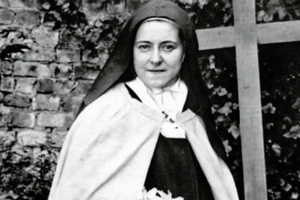
Her Little Way was born of radical hope. That is, Thérèse embraced an approach to a whole discipline of life rooted in the love that Christ has for us even before she became a nun. She developed her ideas further while serving as an assistant mistress of novices. Her job in the convent was to form novices in the Carmelite way of life, and her Little Way proposed how to live out the Gospel as fully as possible moment by moment. Though the spiritual discipline of the Little Way was originally intended for young Carmelite novices, when St. Thérèse was declared a doctor of the Church, this body of doctrine passed into the universal patrimony of the Church.
The hope that animates her Little Way did not come from a book, but from Christ himself. One could say that it was Christ’s own hope in her. When it comes to mystical prayer and her own appropriation of the mystery of Carmel, St. Thérèse admits that very few books ever really helped her very much. Even recourse to the Imitation of Christ and St. John of the Cross were not as encouraging as the Gospels. When this too failed her, she proposes that Jesus himself is the book to whom she turned. He is the reason for her hope. The Gospels and her other spiritual reading helped her to see this mystery that Christ was teaching her himself. Living out the Little Way is rooted in this first hope, the hope of Jesus Christ himself.
We see an example of this in Chapter 5 of her spiritual autobiography, Story of a Soul: The Gospel beatitude of poverty of spirit and the doctrine of night of St. John of the Cross converge on her life-changing devotion to the Infant Jesus. Having reflected on the happiness of her early childhood and then her psychological agony after her mother’s death, she unpacks how the grace of spiritual poverty prepared her to enter Carmel. Specifically, she describes a moment of conversion she received at the top of a stairwell on Christmas Eve. The moment comes in the form of a night of light, “On that night of light began the third period of my life, the most beautiful and most filled with graces from heaven.”
This illumination occurred after midnight Mass, after a reckless word from her father spoken in exhaustion. Not in any prayerful state of consciousness but deeply wounded, given to emotional breakdowns since the death of her mother, her eyes already glistened with tears. Into these unlikely circumstances, the Infant Jesus intervened in a singular manner. The Little Flower recalled: “The work that I was unable to do for ten years was done by Jesus in one instant, contenting himself with my goodwill that was never lacking.”
Rather than explode in tears, Christ gave her a new self-possession. What happened exactly? She does not describe hearing a voice, or a qualm of conscience; instead, simply a moment of silence, the total absence of anything except her own goodwill. In other words, it was an action of Christ in her without her understanding or knowing how, and it is this kind of grace that St. John of the Cross describes as a night for the soul. In this case, it was the night of Christmas.
The Night of the Soul
For her, the grace that she received on the physical night of Christmas Eve coincides with those spiritual nights that St. John of the Cross celebrates in his poem Dark Night. She calls this night “illuminating” in reference to his teaching that what we do not understand about God’s illuminating action far exceeds anything we do understand about him. This is not because God is obscure. Rather, our intellects are too weak to grasp his mysterious ways. We place our hope in what we do not understand, confident that his love is accomplishing something wonderful.
How did St. Thérèse come to associate that graced Christmas Eve with the teachings of St. John of the Cross? Years after her conversion but before she would write about it, 1891 marked the 300th anniversary of the Carmelite spiritual father’s death. The whole convent read his works in celebration. At 17, she found his teaching on the spiritual night illuminating her own conversion. What happened after midnight Mass on the stairwell was the very ray of darkness that he explains every soul must welcome on its way to union with God. It is a mystical grace that God can give only after a soul has been prepared through difficult trials. Her trials included the inconsolable and even pathological grief of losing her mother and feeling insecure in the world. God used these trials to prepare her for the poverty of spirit that would allow him to infuse her with his own self-possession in her — and with this great gift she would help form other souls in a deeper love of him.
Suggesting that God can make meaningful the gratuitous suffering of a child is admittedly strange. Yet the Christian faith is rooted in the scandal of suffering, and in the scandal of her own suffering, St. Thérèse discovered the truth that St. John of the Cross celebrates as a “happy night.” Namely, only those who God draws into the night with him know the hope of his meaningful presence, the secret victory of love hidden under the distress of weakness and limitation.
A Divine Logic
St. Thérèse’s Little Way is rooted in the logic of meaningful suffering in meaningless situations. This is a divine rather than human logic, a light that shines with the darkness of night. The night describes a certain kind of grace Christ yearns to give but very few want to receive. Specifically, we are dealing with mystical grace in which the soul is under the impetus of the Holy Spirit rather than acting from its own power of reason. The Little Way, as the effort to live by love when and where love seems impossible, is rooted in this very impetus.
This means that “night” in the light of Carmel is not simply desolation. Desolation is a state of soul that St. Ignatius of Loyola addresses in his own Rules of Discernment. Desolation is a felt absence of God in which it is difficult to be virtuous and devout. Rather than being moved by the Holy Spirit, the soul feels the movements of other spirits that it must choose to resist and endure.
Night, contrary to desolation, only feels as if God is absent and often thinks that he is so. One also feels and thinks even more that one is not virtuous or devout. The facts are otherwise. God is closer and his power is being revealed even if it is unseen. Others see the devotion and the virtue, and a good spiritual director leads such a soul not to trust its feeling or understanding, but only God. What seems dark is really the overwhelming new light of God shining on the soul in a way the soul has never known before.
The night, rather than a trial from which Christ delivers a soul, is a gift into which he leads. If it is not convenient, comfortable or familiar, this night is not that of a horror movie. As the Bridegroom leads the believer into this difficult but beautiful darkness, he prompts the heart to embrace what it does not understand or it feels, especially if it is uncomfortable, inconvenient and unfamiliar. These are the conditions of love — for love remains small so far as it is only comfortable, convenient or familiar. In the night, enlarged by what is uncomfortable, inconvenient and unfamilar, God communicates into the soul a greater outpouring of his love in a deeper and more transforming way.
An Abundance of Graces
To live by this abundance of grace is to live by love, and living by love is the Little Way. Not by sensational acts that get noticed. Not a preoccupation with optics. The Little Way chooses to love in the night into which God has placed the soul because God has chosen to love in the inconvenient, uncomfortable and unfamiliar. Seemingly weak and ineffective, little acts of faith, little “nothings” that are known only to God, are hidden efforts to love just as God loves. Each act is offered with full confidence that God has chosen to give birth to it in this particular set of circumstances, at this particular place and time, for this particular person. This unnoticed and secret love is filled with the gravity of hope, a hope that holds firm when all else seems lost. This hope is Christ himself, his hope in us, even as he bears our weakness and sin so that we might know his freedom.
Where there is no love, put love and you will find love, teaches St. John of the Cross. St. Thérèse was convinced that Christ made himself subject to the veil of her own weakness to communicate himself to her. When the Son of the Father assumed our nature, he assumed our weaknesses. For her, however, everything is personal. Christ’s subjection to human weakness implicates her own weakness and infuses it with new light. This is why St. Thérèse sees the holy night of her conversion as a spiritual darkness illumined by Christ. A graced Christmas Eve is an “illuminating night” that “delights of the Holy Trinity.” Jesus, “the Light that shines in the darkness,” she says in Story of a Soul, “changed the night of my soul into rays of light.”
Even as emotions surged, she acted not as someone left to herself, but with him present in the pain of the moment while she also shared his own pain with her too; for the Incarnate Word of the Father aches with love and for love, and this ache moved her to have compassion on her father and bring peace to her household. As she matured, this ache-animated compassion became expansive to even those furthest from knowing God. It is this mutual possession of weakness between Christ and the soul that becomes a source of hope for a soul when it offers its sufferings for others. In believing in his love when love seems most absent, a soul rekindles its hope, its inner confidence that no matter what it feels, God is doing something beautiful and that, by being faithful, it can join in this beautiful work. Each sacrifice becomes the offering of a little flower to God in gratitude for the great things that he is already accomplishing for us.
- Keywords:
- the little way
- st. therese of lisieux