The Rosary Without Distraction: 4 Simple Ways to Keep Your Mind on the Mysteries
Great advice from Marian priests on praying the Rosary including tips to pray as a family with small children.
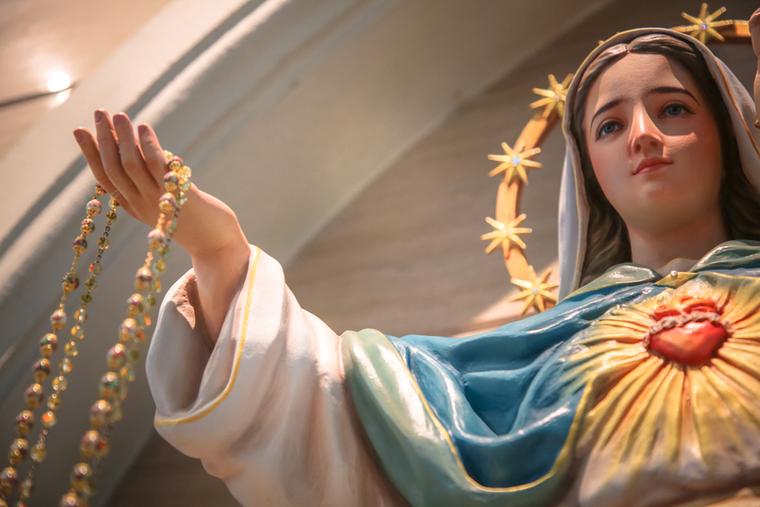
Do you find yourself distracted by thinking of dinner, work, weather or daydreams while praying the Rosary? You’re not alone. But there are proven ways, effective and popular, to keep distractions at bay.
Visualize
Marian Father Donald Calloway, of the Marians of the Immaculate Conception and author of 10 Wonders of the Rosary and Champions of the Rosary, suggests for each mystery to “focus your mind on a particular wound in Christ’s body (Heart, hands, feet)” to give your mind a “focal point and decrease distractions.” For each decade, focus on a different wound and meditate on the mystery. For example, for the First Joyful Mystery, the Annunciation, “focus on the Heart of Jesus and ponder his goodness in taking on flesh for us, and so on.”
Father Calloway also recommends using “a visual aid that depicts the Mysteries of the Rosary in art,” he told the Register. “You can even store your own visual aid on your phone.”
Dominican Father Lawrence Lew, the order’s general promoter of the Rosary and author of Mysteries Made Visible: Praying the Rosary with Sacred Art, told the Register that he often tells people — including himself — that a helpful “assist” is “having some sacred art or even just a crucifix in front of me so that when my mind starts to wander, I have something to focus on, something to look at.”
“Nowadays, with the internet, you have great resources to find the images that you find attractive or that help you to meditate,” he said. “You can find an image related to the mystery that you’re meditating on,” such as “a nice image of the Annunciation, the Visitation, and so on.” Traveling as promoter of the Rosary, he tells parents if they have older children, to “go with them online and look for great art that’s related to the Mysteries of the Rosary. There are a lot of beautiful paintings. You could start with Fra Angelico, a great Dominican painter. There are the classics as well.”
At the same time, this method is “a great way to educate your children in sacred art,” said Father Lew. “And then you use that art the way it’s meant to be used — for meditation — so the Rosary and fine-art education come together.”
Family-Friendly
In Andover, Minnesota, Eric and Alison Duffy have found this approach works for their six children, ages 2 to 13.
Every morning after breakfast before the school day begins, Alison and the children pray the Rosary together. The two youngest, ages 2 and 4, hold a rosary or sit and quietly play.
To help minimize distractions, they follow along via YouTube, she told the Register: “We tend to enjoy the ones that show us drawings of a rosary and the beads get filled in on the screen as we go, so the kids can keep track of where we are. I think this is crucial, as their little minds wander so easily (as do bigger minds, like my own). These videos also have text for the prayers, so we can follow along and read the words if some of the younger kids haven’t memorized all of the Rosary prayers just yet.”
At times, other videos have scenes depicting the mysteries. “The video clips are silently playing to match the mystery,” Alison explained. “This helps the children — and even myself — more fully understand what that particular mystery is about. It also helps us not to forget which mystery we are on. This also helped me to explain to my children that the Rosary isn’t just ‘rote prayer.’ Rather, the Hail Marys are a timekeeper for meditating on a particular mystery, and we really meditate on it when we can see it portrayed in video.”
“Other times,” she added, “we just have ‘plain’ YouTube Rosary videos, where it’s just a video of a priest praying. My 11-year-old son especially likes these. The mix of the different styles help everyone engage more fully.”
Another Fine Method
Father Lew is also a great supporter of the tried-and-tested idea of what he calls the Bavarian style of praying the Rosary — “Bavarian” way because he sees it as very popular in Bavaria and the south of Germany. “It’s not quite scriptural, but it’s almost there.”
Simply, at the end of the Hail Mary phrase “Blessed are you among women and blessed is the fruit of your womb, Jesus,” add “a little phrase that brings to mind whatever you’re meditating on,” Father Lew explained. For example, “If meditating on the Crowning With Thorns, the phrase could be ‘Jesus — who was pierced with a crown of thorns for us — Holy Mary, Mother of God, pray for us (etc.).’”
He reasoned, “You’re thinking about the Precious Blood; you’re thinking about Jesus’ suffering. It’s more intentional.”
Many people have also told him they find the scriptural Rosary very helpful. In it, a line of Scripture accompanies every Hail Mary.
This echoes what St. Louis de Montfort had in mind in The Secret of the Rosary, writing, “[T]ry to form a picture in your mind of Jesus and Mary in connection with that Mystery.”
Father Edward Looney, a priest of the Diocese of Green Bay, Wisconsin, and member of the Mariological Society of America, also recommends de Montfort’s suggestion of adding a different phrase after the name of Jesus in the Hail Mary — for example, adding “born in Bethlehem” after “Jesus.” Father Looney said he “expanded the original suggestions of de Montfort” in his book A Rosary Litany.
Teaching Without Distractions
In his travels, Father Lew often has parents ask him about assisting their younger children in regard to praying the Rosary.
“Obviously, when a child is 5, 6, they’re easily distracted,” he explained. “We shouldn’t be too stressed out over that. But I like to make the Rosary into a bit of a game.”
He uses a ball — whether a beach ball or tennis ball — to serve as a big “bead” passed to the child, “and they say the first half of the Hail Mary, and you say the second half, and then you pass that to the next person and so on.”
In a classroom setting, children can sit or stand in a circle to pass the ball.
“We move from that later on to the bead of the rosary, because I’ve often found that if you give a rosary to younger children, they get very distracted, and they don’t know how to move their fingers along the rosary necessarily.”
“Pass the ball” also works in the sense that the child gets used to leading the Rosary.
In addition, when praying with groups, Father Lew often projects an image of the mystery on a wall and asks the faithful to think about what happened as they contemplate the beautiful, artistic depiction. He then prompts with a related suggestion, such as, “Remember Mary went to visit her cousin Elizabeth, but maybe you’ve got a cousin or a relative you want to pray for.”
Such a method allows no time for the mind to be distracted. But even if your mind wanders, don’t worry.
“These are ways to engage your mind,” counseled Father Lew. “When people talk about being distracted in praying the Rosary, [what they] mean is that your mind wanders. You start to think about everything, and your mind drifts. We shouldn’t be too anxious about this.”
He turns to St. Thomas Aquinas, who tells us, “It’s natural for human beings to wander in their mind during prayer. If we were angels, then we wouldn’t. But because we are humans, then our body is distracted. We notice things, we see things, we hear things, and so on. So the mind begins to wander. But he says not to worry too much about that; as long as when we’re conscious of being distracted, we bring ourselves back to prayer.”
That is precisely what these major aids will do — on the feast of Our Lady of the Rosary, the Month of the Holy Rosary and beyond.
- Keywords:
- our lady of the rosary