Our Radiant Mother of the Southern Hemisphere
During the early
19th-century conflict between
They wanted to pray to Our Lady of Mount Carmel, asking for her intercession and promising that, if she answered their prayers, they would build a church in her honor wherever the decisive battle took place.
That ended up being the
A little more than a year later,
the supreme director of
Because of the problems in establishing the new nation, along with a great deal of poverty, construction of the church was put on hold. And a long hold it would be. It was not until 1885, when the president of the country visited Maipú and recalled the promise that had been made decades earlier, he set aside funds to construct the church.
The church was completed in 1887. On April 5, 1892, the 74th anniversary of the nation’s independence, the church was blessed and called the Chapel of Victory.
All was well until 1917, when a tremendous earthquake destroyed much of the area, including the 30-year-old church.
In 1942, during a time of great
Marian devotion, a Marian Congress was held. It coincided with the Dec. 8 feast
of the Immaculate Conception. At that time the decision was made to replace the
church that had been destroyed by the earthquake with a great sanctuary
beckoning to the whole country of
On July 16, 1943, the archbishop
of
Well, there’s that and there’s
also this: In 1987, from
Mary, Magnified
Step inside today and the first thing your eyes are drawn to is a singular presentation of Our Lady of Mount Carmel. A traditional Mary holding the Child Jesus is encircled by an angular, dramatically sweeping frame of golden bars that, one supposes, represent the radiance that emanates from her immaculate heart.
This statue, I learned, dates back
to 1785. Its colorful history culminates with its arrival here in 1956,
accompanied by the president of the
A circular walk in front of the statue allows a close view of Our Lady of Mount Carmel. In front of and below the statue is the main altar; it is set on a pedestal and is reached from the nave by five steps.
Above the altar is an enormous dome, drawing our gaze toward heaven.
To the left of the altar is a large crucifix, reminding us that every Mass is not only a celebration but also a holy (and costly) sacrifice.
On both side walls of are the flags of the nations of the world, signaling the universality of the Catholic faith.
To the right of the main sanctuary
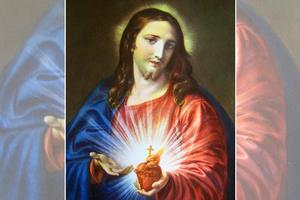
is the altar of the Most Sacred Heart of Jesus. Beyond this altar is the
entrance to the museum, which features artifacts contributed by peoples from
throughout the country of
The tabernacle, situated to the
left of the main sanctuary, was constructed by a Holy Cross Brother. It was
blessed on the feast of
On its sides are reliefs depicting the life of Christ. On the wall above the tabernacle is a polychromatic statue of Christ, attended by two angels.
Let Faith Ring
The front tower, which is topped by a plain cross, houses a 23-bell carillon. For all its traditional appearance and sound, it’s actually computerized. It plays some 65 melodies. The tower is illuminated in the evening by 329 lamps.
In front of the basilica, to the
left and right, are rows of columns similar to those seen in front of St.
Peter’s Basilica in
The tower includes a striking stained-glass window of Our Lady of Mount Carmel with the child Jesus. This window is about 90 feet high.
The themes of the basilica’s other stained-glass windows reflect the life of the Blessed Mother, the seven sacraments, Jesus’ parables and Chilean geography.
The massive main door of the basilica is 13 feet wide and 26 feet high; it weighs two tons.
Sitting in the nave, looking to the left and right, pilgrims can spend hours contemplating the Stations of the Cross. They’re depicted in paintings set in lovely alcoves.
During my attendance at a 7 p.m. Sunday Mass, I was moved by the singing in Spanish of the communicants as they proceeded up the main aisle to receive holy Communion. Their slow walk, set against the imagery of the Stations, evoked the “carrying of the cross” that every Christian must undertake if he or she is to be a disciple of Jesus.
Our Lady of
Joseph Albino writes from
- Keywords:
- July 16-22, 2006