Bishop Rhoades on Reviving Devotion to the Sacred Heart of Jesus
COMMENTARY: Beholding the Heart that loves us so greatly impels us to be witnesses of his love in the world.
Editor’s Note: The following commentary first appeared on Franciscan University of Steubenville’s Catechetical Review. It is reprinted here with permission.
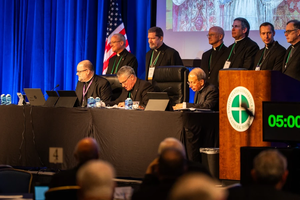
This past November at the 2025 plenary assembly of the United States Conference of Catholic Bishops in Baltimore, I presented a proposal on behalf of the USCCB Committee on Religious Liberty that we consecrate the United States to the Sacred Heart of Jesus during our June assembly in 2026, the 250th anniversary of our nation’s Declaration of Independence. My brother bishops enthusiastically endorsed this proposal.
In consecrating our nation to the Sacred Heart of Jesus during the semiquincentennial anniversary, we will be entrusting our nation to the love and care of Jesus, the Redeemer of the World. At the same time, the consecration will be a reminder to Catholics of our task to serve our nation by “perfecting the temporal order with the spirit of the Gospel,” as taught by the Second Vatican Council.
A Tradition of Consecration
In his fourth and last encyclical, Dilexit Nos (DN), Pope Francis brought devotion to the Sacred Heart to the forefront of Catholic life as the ultimate symbol of “the human and divine love” of the Heart of Jesus. And in his first apostolic exhortation, Dilexi Te, Pope Leo XIV invites us to contemplate Christ’s love, which moves us to mission in our suffering world today. Pope Leo’s predecessor and namesake, Pope Leo XIII, had taught that “there is in the Sacred Heart a symbol and a sensible image of the infinite love of Jesus Christ which moves us to love one another.” He encouraged individuals to make an act of consecration to the Sacred Heart of Jesus when he consecrated the whole world to the Sacred Heart in 1899. Leo XIII reminded all that “whatever honor, veneration and love is given to this divine Heart is really and truly given to Christ Himself.” Drawing on the teaching of Pope Leo XIII, Pope Pius XI referred to the “pious custom” of consecrating the nation to the Sacred Heart of Jesus as a way to recognize the kingship of Christ.
The consecration of our nation to the Sacred Heart of Jesus in 2026 is an opportunity to promote devotion to the Sacred Heart in our families, parishes, schools, and other institutions. This devotion has profound spiritual and theological depth. The Heart of Jesus expresses the very core of Christianity, the Good News of God’s passionate love for humanity revealed in the Incarnation of his Son and in his redemption of humanity by loving us “to the end” (John 13:1). The Heart of Jesus, pierced by the soldier’s spear, became the fountain of life and holiness communicated to us in baptism and the Eucharist, “the two fundamental sacraments by which the Church lives.” In Dilexit Nos, Pope Francis proposed to the whole Church “renewed reflection on the love of Christ represented in his Sacred Heart. For there we find the whole Gospel, a synthesis of the truths of our faith, all that we adore and seek in faith, all that responds to our deepest needs” (89).
A Heritage of Faith
Catechesis for people of all ages is important in our efforts to renew devotion to the Sacred Heart of Jesus at this time. I would like to share the place of the Sacred Heart in my personal spiritual journey as a way to illustrate the benefits and fruits of this devotion.
My earliest memories of the Sacred Heart are from my childhood, both at home and in my Catholic grade school. Sacred Heart devotion was a natural part of the spiritual life of the Catholic side of my family, my mother’s side, specifically my maternal grandmother, Sarah, who was of Irish ancestry. In fact, I was given a Sacred Heart badge that her father, Bernard (my great-grandfather), always carried in his pocket and which I now carry in my pocket. This is not a superstitious amulet; it is a sacramental reminder of the Lord’s love in the daily affairs of life. Bernard had a hard life as a coal miner in the mountains of Pennsylvania, where I was born. He and his wife, Anna, raised Sarah and her siblings in a loving home in which the image of the Sacred Heart of Jesus was enthroned. In their poor and humble circumstances, they were rich in what matters most: the gifts of faith, hope, and love, the foundational virtues of the Christian life.
Sarah married an immigrant from Greece named Kiriakos (“Carl” in English), who was of the Greek Orthodox faith. They, too, enthroned the image of the Sacred Heart of Jesus in their home, raising my mother and her siblings in the Catholic faith. Though the Orthodox do not have an explicit, formalized devotion to the Sacred Heart as a spiritual or liturgical focus, they have a rich tradition of liturgy and prayer that honors the love and mercy of God that the Sacred Heart symbolizes. Our Orthodox brothers and sisters, like our Eastern Catholic brothers and sisters, venerate the pierced side of Jesus in icons and also view the blood and water flowing from it as profound symbols of the Sacraments of Baptism and the Eucharist, the outpouring of God’s grace upon the Church.
My heart is filled with gratitude when I reflect on the faith of my ancestors. My mother, along with her brothers and sisters, received and beautifully passed on this faith as well. I am grateful to all of them for teaching their children, by word and example, to trust in the goodness and love of the Heart of Jesus. I pray that, like our ancestors in the faith, we, too, will pass on such firm faith and devotion to the Sacred Heart of Jesus, “aflame with love for us, source of justice and love, and fountain of life and salvation.”
A Deepening Devotion
Devotion to the Sacred Heart of Jesus was also a prominent part of the spiritual life of the Catholic elementary school I attended in the 1960s, St. Mary’s School in Lebanon, Pennsylvania. The Sisters of St. Joseph instilled in us this devotion. Every day began with the recitation of the Morning Offering, a prayer that has remained with me since first grade. We would look at the image of the Sacred Heart of Jesus in our classrooms as we offered our “prayers, works, joys, and sufferings of the day for all the intentions of his Sacred Heart,” and we did so “through the Immaculate Heart of Mary.” I learned from that early age to understand the Immaculate Heart of Mary as intimately linked to her Son’s Sacred Heart.
I remember with much gratitude also the strong Catholic education I received at Lebanon Catholic High School in the early 1970s. Though it was a confusing time for the Church, especially liturgically, we were already firmly grounded in our faith. And while it became less common to pray to the Sacred Heart of Jesus, the devotion remained, and we still had Sacred Heart statues and images to remind us of the Lord’s love. At my 50th high school class reunion last summer, while reminiscing about our grade school and high school years, I initiated a conversation with some classmates about the spiritual formation we received. Many shared that they still pray the Morning Offering at the beginning of the day.
In college, while I was discerning the vocation to the priesthood, I began to pray the Litany of the Sacred Heart of Jesus, which remains to this day my favorite litany, especially to pray before the Blessed Sacrament. Each invocation and its biblical root can be an object for spiritual reflection.
In the seminary, I was introduced to theological works and papal encyclicals on the Sacred Heart of Jesus by my Jesuit professors at the Gregorian University in Rome. The Society of Jesus is renowned for promoting devotion to the Sacred Heart, beginning with St. Claude de la Colombiere, the Jesuit spiritual director of St. Margaret Mary Alacoque, the humble Visitation nun who received apparitions of Jesus and his Sacred Heart in the 17th century. St. Claude defended the authenticity of these apparitions and explained and spread the messages St. Margaret Mary received about the overwhelming mystery of Christ’s divine and human love.
Through the Spiritual Exercises of St. Ignatius of Loyola, St. Claude was already steeped in the tradition of contemplation of Christ’s love through meditation on the Gospel accounts of Our Lord’s words and actions, culminating in meditation on the crucifixion and the wounded side of Jesus crucified. Pope Francis wrote: “Saint Ignatius brings his contemplation to a crescendo at the foot of the cross and invites the retreatant to ask the crucified Lord with great affection, ‘as one friend to another, as a servant to his master,’ what he or she must do for him” (DN, 145).
Invitation and Reparation
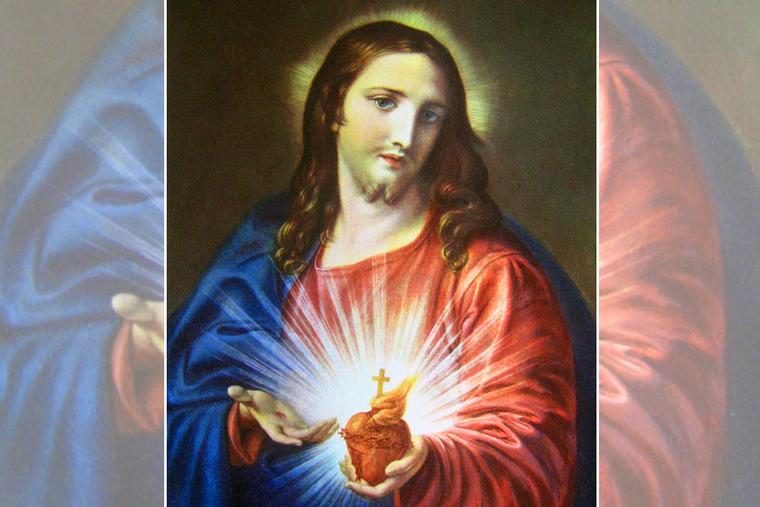
One of my favorite places to pray as a seminarian and young student priest in Rome was before a famous image of the Sacred Heart of Jesus in a side chapel of the Jesuit Church of the Gesù. It is an 18th-century painting by Pompeo Batoni that depicts Jesus holding out his pierced right hand toward his enflamed heart, which he holds in his left hand as it emits a luminous glow. His heart has a little cross on top and is surrounded with a crown of thorns. I find it consoling to pray before this image and to listen in my heart to Jesus’ words: “Come to me, all you who labor and are burdened, and I will give you rest. Take my yoke upon you and learn from me, for I am meek and humble of heart; and you will find rest for yourselves. For my yoke is easy, and my burden light” (Matthew 11:28-20). These words of Jesus are a call to friendship with him and to discipleship. Devotion to the Sacred Heart deepens this friendship.
Reparation is an essential part of the Sacred Heart devotion. We must remember that Christ’s Heart “was pierced for our sins,” as the prophet Isaiah foretold about the Suffering Servant (Isaiah 53:5). And St. John quotes the messianic prophecy of Zechariah in his account of the Crucifixion: “They will look on him whom they have pierced” (John 19:37; cf. Zechariah 12:10). Devotion to the Sacred Heart encourages contemplation of the wounded, loving Heart of Jesus and fosters a desire to make reparation for sins. Our Savior’s pierced Heart invites us to return to our Father’s love with repentance.
Through his death on the Cross, Jesus, the new Adam, “[makes] amends superabundantly for the disobedience of Adam” (Catechism of the Catholic Church, 411). As members of his Body, the Church, we join with him in making amends for sin — our own sins and those of others. We make amends to his Sacred Heart by uniting our sufferings, prayers, and penitential acts with his perfect atonement on the Cross. I remember when growing up how this was emphasized in our observance of Fridays, the day of Our Lord’s death. It is a practice I hope we can revive today. Pope Francis wrote: “In union with Christ, amid the ruins we have left in this world by our sins, we are called to build a new civilization of love. That is what it means to make reparation as the heart of Christ would have us do. Amid the devastation wrought by evil, the heart of Christ desires that we cooperate with him in restoring goodness and beauty to our world” (DN, 182). In this semiquincentennial of the United States of America, with our consecration to the Sacred Heart of Jesus, may we cooperate with Jesus in restoring goodness and beauty to our nation, which has been harmed by sins of violence, racism, greed, and disregard for the dignity of the unborn and immigrants. May our prayers and acts of reparation also help heal the harmful divisions in our political and media culture.
The Miracle Man of Notre Dame
One of the many blessings of my ministry as bishop of Fort Wayne-South Bend is serving the University of Notre Dame. It is well-known both that the Blessed Virgin Mary is the patroness of the university (its French name, “Notre Dame du Lac,” means “Our Lady of the Lake”) and that there is a strong tradition of Marian devotion there. What is perhaps less known is the deep devotion to the Sacred Heart of Jesus throughout the history of the university. The beautiful church adjacent to the campus’s main building was named in honor of Our Lady of the Sacred Heart of Jesus by Notre Dame’s founder, Father Edward Sorin, in 1875, and was consecrated by Fort Wayne Bishop Joseph Dwenger in 1888. Pope St. John Paul II designated the church a minor basilica in 1992.
Father Sorin considered the Lady Chapel (also called the Chapel of the Sacred Heart of Jesus), located in the apse of the church, to be the heart of the university, “the center of all campus devotions and the source of all blessings” at Notre Dame. The stained-glass windows of the chapel depict biblical scenes associated with the Sacred Heart of Jesus as well as scenes of the apparitions to St. Margaret Mary. One window depicts the consecration of the city of Marseilles to the Sacred Heart of Jesus in 1720 during a terrible outbreak of the bubonic plague. During this time, the bishop of Marseilles distributed Sacred Heart badges, and new cases of the illness reportedly stopped. These badges became popular in France and around the world as reminders of Our Lord’s love and protection.
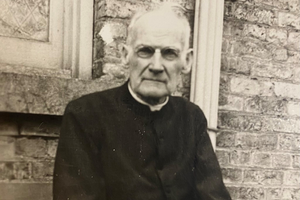
The Sacred Heart badges became very popular at Notre Dame due to their distribution by a humble Holy Cross religious, Brother Columba O’Neill. Born John O’Neill, he was raised by his Irish immigrant parents in a very small town in the coal regions of Pennsylvania, near to my own birthplace. His father was a coal miner like my ancestors. Undoubtedly, John also imbibed the Sacred Heart devotion from his parents. He was not able to work in the mines due to his being born with deformities of his feet, so he became a cobbler instead. Called to the religious life, he entered the Congregation of Holy Cross at Notre Dame in 1874. After his final vows, Brother Columba worked at an orphanage in Lafayette, Indiana, for nine years, then returned to Notre Dame where he worked repairing shoes until his death in 1923.
When students and others in the community would come to Brother Columba for new shoes or to get their shoes repaired, he would give them badges he had made of the Sacred Heart of Jesus and of the Immaculate Heart of Mary, and he would encourage them to pray certain prayers. Cures and favors began to be reported by those who had prayed with the Sacred Heart badges he had given them. Word spread beyond South Bend. People from near and far in need of healing or other graces would visit or write to Brother Columba asking for Sacred Heart badges and prayers.
The archives of the Brothers of Holy Cross at Notre Dame contain some 8,000 letters written to Brother Columba, many testifying to physical, spiritual, and psychological healings following his instruction to pray to the Sacred Heart of Jesus. Just as St. André Bessette, another Holy Cross brother, was known as the “Miracle Man of Montreal” through his prayers and devotion to St. Joseph, Brother Columba O’Neill became known as the “Miracle Man of Notre Dame” through his devotion to the Sacred Heart of Jesus.
Brother Columba’s confreres in Holy Cross and others who knew him witnessed his exemplary religious life of poverty, chastity, and obedience, his humility, his boundless trust in the Sacred Heart of Jesus, his devotion to the Immaculate Heart of Mary, and his love and compassion for all who came to him with their needs. I accepted the petition of the Congregation of Holy Cross to pursue the cause for his canonization and opened the diocesan inquiry into his cause this past April. We have already seen much interest in his cause, including among many Notre Dame students who not only wish to learn more about Brother Columba but are also eager to learn more about the Church’s doctrine and Catholic theology regarding the Sacred Heart of Jesus. Several are now carrying Sacred Heart badges and praying that Brother Columba will become Notre Dame’s first canonized saint.
The Sacred Heart for a Living Mission
I cannot help but see all that is happening at this time as providential: Pope Francis’ encyclical on the Sacred Heart of Jesus, the opening of Brother Columba’s cause for canonization, and the upcoming consecration of the United States to the Sacred Heart. And all this is happening immediately after the Eucharistic Revival here in our country. This is significant since devotion to the Sacred Heart of Jesus is intrinsically Eucharistic. As Pope St. Paul VI taught, the Eucharist is “the outstanding gift of the Heart of Jesus.” The Holy Eucharist is the sacrifice of Jesus on the Cross made present for us on the altar, the sacrament of his love “unto the end.” Pope Leo XIII, commenting on the image of the Sacred Heart, said that the love of Christ “moves us to return love for love” (see DN, 166). When we receive Jesus’ Body and Blood in Holy Communion, he gives us the grace to do so.
Given the confusion and the hopelessness of an increasing number of people today — including young people who are searching for meaning and purpose in life — devotion to the Sacred Heart of Jesus is a true remedy. Forty years ago, Pope St. John Paul II sent a message to the Society of Jesus that is perhaps even more needed today: “From the Heart of Christ, man’s heart learns to know the genuine and unique meaning of his life and of his destiny, to understand the value of an authentically Christian life, to keep himself from certain perversions of the human heart, and to unite the filial love of God with love of neighbor.”
In evangelization and catechesis, it is important that we guide students to contemplate the mystery of God’s love revealed in Christ. Teaching, fostering, and promoting devotion to the Sacred Heart of Jesus helps them to arrive at the conviction of St. John: “We have come to know and to believe in the love God has for us” (1 John 4:16). We come to this knowledge and faith not primarily through study but through an encounter in our hearts with the Heart of our Redeemer. It is through friendship and prayer that we come to know and believe in Christ’s love. It is a gift we receive when we open ourselves to him who pours out his love into our hearts through the Holy Spirit who has been given to us (cf. Romans 5:5).
Beholding the Heart that loves us so greatly impels us to be witnesses of his love in the world. Jesus calls us to spread the goodness and love of his Heart to others, especially to the poor and suffering. Pope Francis wrote of our Christian mission as “a radiation of the love of the Heart of Christ” (DN, 209).
In our mission of evangelization and catechesis, teaching true devotion to the Sacred Heart of Jesus is a beautiful way to help our students discover the source of truth and goodness for their lives. As the Litany of the Sacred Heart of Jesus teaches us, the Heart of Christ is the “wellspring of all virtue,” and the “delight of all the saints.” May we all grow in this devotion and spread it! In doing so, we are spreading the truth and beauty of the Gospel.
Most Reverend Kevin C. Rhoades is bishop of Fort Wayne-South Bend, Indiana, secretary of the USCCB and chairman of the USCCB’s Committee on Priorities and Plans.