Women Are Being Left Out of the AI Conversation: Should We Care?
As the world increasingly turns to the Catholic Church for guidance on the ethical challenges posed by artificial intelligence, is the feminine genius being stifled out of the conversation?
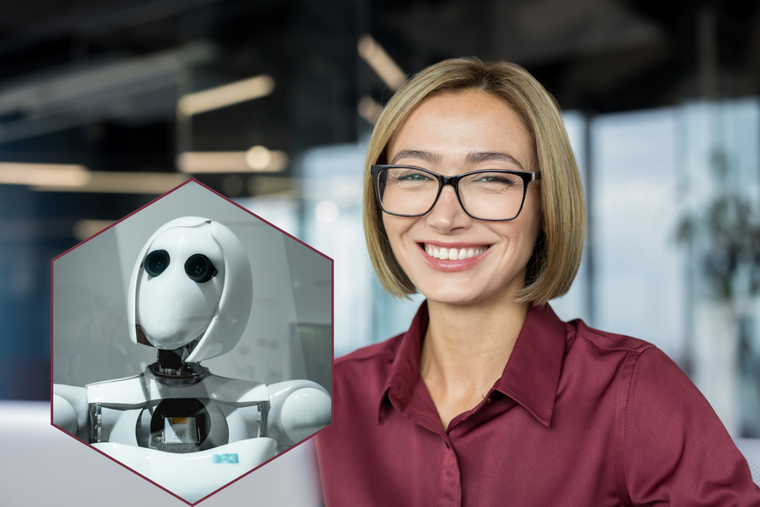
Women are significantly underrepresented in the field of artificial intelligence (AI), as official figures have consistently demonstrated over the past decade. The Catholic world, typically less concerned with gender parity and more focused on creative complementarity, has so far shown little interest in this absence. Yet the stakes extend far beyond questions of mere representation. The principles now embedded in the DNA of emerging AI technologies will help shape the civilization of tomorrow — with the technological development being driven predominantly by men, and if contributions from the “feminine genius” remain underrepresented, what could this mean for the future of humanity?
This concern stems naturally from Pope Leo XIV’s first encyclical, Magnifica Humanitas, signed May 15 on the anniversary of Rerum Novarum and presented to the world 10 days later. The document does not address the role of women in AI per se, but rather the safeguarding of human dignity, agency and authentic relationships in the age of artificial intelligence and the warning against technologies that risk replacing human workers, manipulating emotions through chatbots, or degrading the moral fabric of modern warfare.
Yet such a vision cannot materialize out of thin air. The legitimization of the human in the age of AI depends in part on who is present when fundamental choices are made — and on whether the voices that have historically most often championed human connection, receptiveness and empathy are truly heard.
Beyond the Parity Question
The figures tell a consistent story. UNESCO’s 2024 report “Fostering Women’s Leadership” found that women hold only 8% of CEO positions and 22% of executive board seats in the world’s top 100 high-tech companies. The Stanford AI Index has documented that this imbalance has shown no meaningful improvement since 2010.
What the figures do not tell is how to interpret them. For Fernanda Psihas, a particle physicist and professor at Franciscan University of Steubenville in Ohio with significant experience in AI development, the explanation lies less in active exclusion than in something subtler. “It is not really that men are pushing women out of these fields,” she told the Register. The deeper pressure in her reading often comes from a cultural definition of competence that tends to exclude the very traits women are most likely to bring. “There’s this perception in some fields that competency is a very masculine trait. And then you have to lose your feminine traits to be competent.”
Women inside technical fields, she observed, can find themselves projecting a strength “that almost feels masculine in order to appear competent,” while the fields themselves are robbed of what women uniquely bring — the global view, the attentiveness to others, the encounter with the human person on which good teams depend. “It would be useless,” she added, “to have more women in technical fields if they all are tempted to suppress their femininity to ‘succeed.’”
Feminine Genius and Pattern Recognition
Psihas reads this dynamic against the broader papal magisterium. Quoting John Paul II’s 1995 “Letter to Women,” in which the expression “feminine genius” was coined, she highlighted how the late Pope warned that “times when women have been prevented from truly being themselves” have produced “spiritual impoverishment of humanity.” The same intuition, she believes, runs through Magnifica Humanitas and Leo XIV’s insistence on preserving the relational and the personal in a technological age. That, in her telling, is “precisely the arena where femininity shines in and outside of the technical fields.”
For Stacy Trasancos, a chemist and undergraduate program director at Holy Apostles College in Connecticut, the feminine genius manifests especially in the specific cognitive faculty of pattern recognition. “Women naturally recognize patterns,” she told the Register. When a mother raises a household, Trasancos noted, she is constantly reading patterns — the differences between her children, the rhythms of their development, the dynamics of family and community. “That is part of being a nurturing caregiver.”
Such a trait, she reckons, is at the heart of AI itself, as AI is fundamentally a pattern-recognition technology, trained on aggregates of what humanity has already produced. Women, Trasancos argued, can shape what it learns to reflect back simply by using it. “Every time we type a prompt, we are changing AI.”
Trasancos thus sees engagement with AI as a cultural responsibility. She herself practices what she preaches, keeping a dedicated AI thread she calls “family system” where she journals about her seven children, her seven grandchildren and her marriage — and where the technology returns patterns in human development that inform her care for those entrusted to her.
What Cannot Be Programmed
If Trasancos’ outlook leans toward what AI can become when women shape it well, Kerri Christopher of the Humanum Institute is more attentive to what AI must never be allowed to become. For her, the decisive line runs between an AI that aids human beings and one that replaces them. The danger she most fears is the one Pope Leo XIV anatomizes throughout Magnifica Humanitas: the substitution of programmed responsiveness for genuine encounter, made visible in the rise of AI companions, AI therapists, and even avatars with which young people have begun to form emotional and romantic attachments.
Christopher believes that identifying this threshold is itself a contribution women are well-positioned to make. Much of what they have always done — in care, in nursing, in teaching or mothering — is, in her words, “intuitive, quiet, hidden and difficult to quantify.” She argued that women increasingly need to articulate why these forms of care matter and why some aspects of human presence remain irreducible.
In her own conversations, Christopher has noticed a pattern that may reflect the same intuition. Men, she observed, are “frequently more enthusiastic and excited by the possibilities” of AI, while many of the women she has spoken to are “instinctively cautious or hesitant.” The pattern repeating across different groups of people makes her wonder whether that caution may itself be a form of the feminine genius, “a particular sensitivity to what may be lost when human relationships and human presence begin to disappear behind technology.”
The Courage of Femininity
For Psihas, the stakes are much higher than questions of parity or professional advancement. “This might be a moment where the core values of society really need the voices of women and the character of women that fully embrace their feminine genius to realign what it is that we’re prioritizing.” Being authentically feminine in such spaces, she adds, is in itself “an act of courage that we need women in these fields to be willing to do.”
She feels that the same urgency runs through Pope Leo XIV’s sharpest call to action in Paragraph 214 of Magnifica Humanitas, which considers how the use of words, particularly in the digital realm, shapes the way we perceive one another and the world itself. “The first contribution we can make toward a more humane civilization is to be mindful of our words,” the encyclical reads, adding: “Let us disarm words and we will help to disarm the world” (repeating Leo’s words from a May 2025 address).
“Women have such a talent for communication,” Psihas added, “and I think it’s especially important for women in these fields and in positions of importance and authority.”
At a time when the encyclical has drawn the world’s attention to what the Catholic Church has to say about a technology even its own creators no longer claim to fully understand, the feminine genius may be called upon to renew itself in creative ways.
For Trasancos, that renewal must begin with women themselves. “We can’t wait around for society to tell us we’re geniuses because of our femininity. We have to recognize that in ourselves — and ‘get your hands dirty’: It is our responsibility to get in there and start using AI and helping shape the algorithms that will influence future generations.”