Meet God in St. Louis
Observing the rich, rare reverence inside and out the Cathedral Basilica of St. Louis, the visitor can easily understand why that city was once called ‘the Rome of the (American) West.’ The Church celebrates the feast of St. Louis on Aug. 25.
St. Louis, Missouri
For all its grandeur, the Cathedral Basilica of St. Louis must be humble — like the Church herself.
Earlier this year, the high drama of Holy Week rightly overshadowed a milestone in the history of this great house of God: the 10-year anniversary of its dedication as a basilica on April 4, 1997.
Now, for the rest of this year and beyond, it can be said that the St. Louis landmark deserves to be celebrated as one of America’s great religious sites. For it carries on a long tradition of Catholic life in the city, which once centered around the “Old Cathedral” first built in 1770.
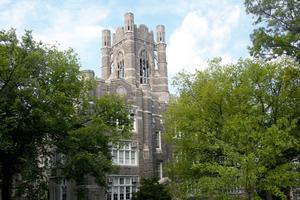
From inside and out, the cathedral inspires awe — the wide stone facade and Duomo-like rosette window, the bell towers and the soaring arc of the dome. Even longtime residents can hardly believe that this breathtaking “New Cathedral” somehow ended up in our city, as though time had warped to deposit a bit of the Renaissance on the corner of Newstead and Lindell. As for tourists, who make up about a third of the cathedral’s weekend Mass attendees, they wander around with necks craned.
Inside, the nave seems to stretch for miles. Nowhere outside Europe have I encountered a church of such immense dimensions. Nowhere else at all have I seen a church with colors so bright and vivid.
The detailing, too, is rare. Portraying myriad events and figures of salvation history and much of the foundation story of Catholicism in St. Louis, the collection of mosaics here is the world’s largest.
Already, you begin to understand why St. Louis used to be called “the Rome of the West.” You also understand how the building’s mosaic artwork, begun in 1907, took more than 80 years to complete.
And that was surely with the intercessory prayers of St. Louis himself helping things along. The Church celebrates his feast Aug. 25.
Four jewel-like side chapels nestle within the cathedral, one in each corner. If the nave is the great gathering place for St. Louis Catholics in worship, then these chapels, hidden away by arches, recall the cloister as an intimate place set apart for souls to get alone with God.
Each chapel has its own distinctive theme. The marble of All Souls is sheer jet; the mosaics of All Saints recall Florentine Renaissance art. The Chapel of Our Lady blushes with roses and lilies in springlike greens and pinks; its votive candles are cobalt blue. The latter two chapels were designed and created for the archdiocese by Louis Tiffany of the famous Tiffany and Co.; his use of trademark glass is the reason for the distinctive, muted coloring.
But the Blessed Sacrament chapel, vibrant and regal, is by far the most beautiful. Crimson tesserae glint along its walls, while gilded glass pieces cascade down its arched ceiling. The colors recall Christ’s passion and resurrection, as do the angels depicted on the ceiling.
Other Church imagery is evoked here: Emerald vines run between the windowpanes, symbolizing new life. Tall peacocks in wrought iron, the many eyes on their tails signifying the universal vision of the Church, serve as lampstands. Marble angels kneel by the altar. Every elaborate detail calls attention to the bright gold tabernacle where Christ rests.
At any time of day or evening, this is a perfect spot to sit, delight in beauty and encounter Christ — but especially on Saturday afternoons, when the Eucharist is exposed here for adoration. Students from nearby Saint Louis University stop by, perhaps with a Bible or a book of the saints’ writings, sitting near longtime residents of the local neighborhood.
During the same hours, the sacrament of reconciliation is offered. Before the Saturday evening Vigil Mass begins, the service of vespers or evening prayer is read, and benediction is given.
These and other vital signs show that, alongside the church’s iconic status for ceremony and tourism in the area, the spiritual life of the cathedral parish is in good health. Any soul brave enough to appear at 7:15 on certain weekday mornings will find a small group of parishioners saying morning prayer before the early Mass. This practice has been affectionately dubbed “Linus lauds” after the layman who organized the group. Vespers are also read on Sundays before the 5 p.m. Mass, and the Angelus is prayed at noon on weekdays.
You’ll be welcomed if you leave your private devotions to join them. But be prepared. You may find yourself being grilled with the question by which a St. Louisan of the old school sizes up all comers: “Where did you go to high school?” You may also find yourself being informally shown around, like a guest in a grand house, without having to wait for a tour guide.
Just don’t believe anyone who tells you, as someone might, the old story about the hats hanging from the ceiling of the All Souls chapel. Each belongs to a former archbishop of St. Louis who was later promoted to the status of cardinal. Each is attached rather loosely — and each, as humorous legend has it, will fall when the cardinal to whom it belonged is released from purgatory.
All joking aside, here in the cathedral one can get a sense of the real vibrancy and solidity of the Church’s inner life. From the visible, one passes to the invisible; from the beautiful, one gives glory to God for all beauty.
Katy Carl writes from St. Louis.
Cathedral Basilica of St. Louis
4431 Lindell Blvd.
Saint Louis, MO 63108
(314) 533-2824
cathedralstl.org
Planning Your VisitThe Cathedral Basilica of St. Louis is open daily from 7 a.m. to 5 p.m. Tours may be scheduled in advance from 10 a.m. to 3 p.m. on weekdays. Call (314) 373-8241. If planning for a larger group, you can also use the form posted at cathedralstl.org/tourism/tourform.html.
- Keywords:
- August 19-25, 2007