‘Leo XIV: Portrait of the First American Pope’ Chronicles the New Holy Father
FROM EWTN PUBLISHING: ‘Pope Leo XIV has seen and experienced the Church in more contexts than perhaps any other person currently living...’

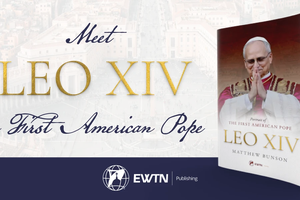
Editor’s Note: The following is an excerpt from Matthew Bunson’s new book, Leo XIV: Portrait of the First American Pope, from EWTN Publishing and available at EWTNRC.com.
The pontificate of Pope Leo XIV is still only days old. And yet, there is a sense of clarity and mission about it that began from his walk onto the world stage on May 8. Among the reasons for the sense of certainty and immediate stability is the deliberate decision he made to dress in the traditional vesture of the popes, adding to the papal white soutane and pellegrina the red mozzetta and stole. This was not a rejection of the deliberate simplicity of Pope Francis but a conscious effort to connect himself “and with it his pontificate” to his predecessors and the long customs and symbols of the papacy and the Church.
This drawing of a line of continuity and integration goes far beyond the merely symbolic or sartorial. There is a manifest desire to achieve the integration of recent pontificates, the Second Vatican Council, and the Fathers of the Church. This is not some effort to placate perceived factions or camps in some ecclesiastical power struggle. Rather, it is mining the rich treasures of teaching that characterized the great Fathers, the Council, and the modern popes to build unity in the Church in a fractured era. Pope Leo XIV believes that these teachings can impel the Church toward unity rooted in Christ, and prepare all of us for the immense task of evangelization to which all of us are called.
This integration has been on display since the first Urbi et Orbi blessing on May 8 and has continued virtually every day since. It is obvious in the use of references in his public speaking and preaching to the Second Vatican Council (especially the seminal documents Lumen Gentium and Gaudium et Spes); to Church Fathers, including Augustine, Pope St. Gregory I the Great, Ephrem the Syrian, and Ignatius of Antioch; and to all his recent predecessors.
Father Thomas Joseph White, O.P., the rector magnificus of the Pontifical University of Saint Thomas Aquinas in Rome, wrote in his commentary for First Things, “A Leonine Revival,” on the particular use of the modern popes:
“Perhaps there is something to learn, then, from each of the pontificates, in search of a more comprehensive unity: from St. John Paul II, his evangelical witness to the teaching and practice of the Catholic faith, in ways that were radical and sometimes counter-cultural in the face of a secularized world; from Benedict, the search for a deeper liturgical life in the Church and his commitment to scholarship and theological reflection; from Francis, his message of universal mercy, his concrete and policy-oriented solidarity with the poor, his consultation of the faithful, and his outreach to those previously alienated from the Church’s hierarchy.”
Like these and many other predecessors in their times, Pope Leo XIV faces a host of challenges at the start of his pontificate. Today, they include war in Ukraine and Gaza and elsewhere; the technological revolutions and the threat to the human person; growing secularism and atheism and the hatred of religious belief; mass migration and the quest for work and dignity; social and cultural fragmentation; threats to the family and human life from gender ideology, abortion, euthanasia and surrogacy; and divisions within the Church, most conspicuously the German Synodal Way and its heterodox enterprise for the Church in Germany.
Our new Holy Father seems convinced that the road ahead for the Church and the world is by hearing and applying the timeless teachings of the Church in new situations and circumstances. This is why he is so consciously integrating Augustinian and Leonine thought in a deeply Christocentric way.
Chicago. Peru. Rome. Pastor. Teacher. Missionary. Prior general. Bishop. Cardinal. Pope Leo XIV has seen and experienced the Church in more contexts than perhaps any other person currently living. He understands that the needs of the People of God are, in many respects, quite different in each of those contexts. He knows that the Church must be responsive to those needs in a nimble and humble way.
But, most of all, to repeat some of Leo’s most important words from earlier in this book, “the underlying challenge that Christ left to us to preach the Gospel and this is the same everywhere.”
What Pope Leo XIV, following the great St. Augustine himself, will bring to the papacy is an uncompromising emphasis on the Divine Person of Jesus Christ. This is the same everywhere, because He is the same everywhere. He is the One whom everybody needs, whether they are materially poor or spiritually parched. He is the only principle of unity that can unite Chicago and Peru and Rome and every place and every person in between.
In illo uno unum. In the One, we are one. That, more than anything else, is what Pope Leo XIV believes the world needs to know today.
- Keywords:
- 'pope leo xiv'