Bucking the Trend, Large Catholic Families Reflect the Beautiful Fruits of Fertility
Though experts see high living costs and low social support as the main drivers of plummeting birth rates, recent polling has shown that many people forgo having children simply because they don’t want them.
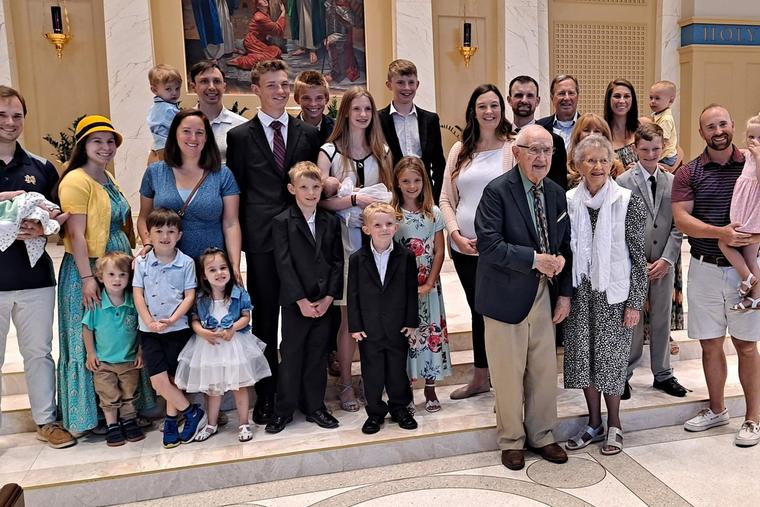
For Jonas and Ashley Batemen, the growth of their Mid-Atlantic family has been a “transformative experience.”
The Batemans were married in 2008 and have six children. Prior to getting married, the two “knew we wanted children but had very little discussion about how that would look,” Ashley said.
“Then, as each new baby arrived, we were awestruck,” she said.
Neither Ashley nor Jonas were fully aware of the Catholic Church’s teachings on families and children when they first began their marriage.
But “at some point I turned to Scripture and meditated on motherhood,” Ashley said, “and I could find no reason, even with health complications, to not have as many children as God chose to gift us with.”
The Church “is so well-balanced here in recognizing the response to life as a lifelong commitment that must be considered with great respect and dignity for the entire family,” Ashley observed.
“I know [God’s] plan for our family is better than anything we could dictate,” she added. The oldest of the couple’s children is 13.
The Batemans know that human life “is not a problem. It is a gift.”
Those were the words of Pope Francis last year when he addressed the audience at the 2024 Italian “General State of the Birth Rate” conference. The annual event is meant to address in Italy what is happening everywhere — namely, a fertility crisis, with too few people being born every year.
The problem is acute and ongoing, with experts warning that a shrinking population in the next several decades could wreak havoc on much of the civilizational infrastructure built up over the past few centuries as well as lead to epidemics of loneliness and grief among childless people.
And notably, Catholics aren’t immune to this trend. Majority-Catholic countries are seeing fertility rates plunge to levels similar to everywhere else, while U.S. data indicate that Catholic families have fewer than two children on average.
These numbers have helped contribute to considerable problems in the U.S. Church, not least among them countless parishes that are rapidly closing often for — simply put — a want of Catholics.
And yet there are many parishes around the country that are rejecting this trend — parishes where families tend to be large, where parish life is vibrant and expanding, and where many husbands and wives like the Batemans embrace what the Catechism of the Catholic Church calls an “openness to life.”
These are communities where faithful Catholic families are defying not merely national or global fertility trends, but those within the Catholic population itself.
Bishops and priests looking to revitalize Catholic communities with new life might consider listening to such families, and to the experts who say that the Church needs to rediscover and evangelize its ancient teachings on families and children.
Church is Doing ‘Very Little’ to Promote Its Teachings
Dr. Ray Guarendi, a Catholic psychologist and EWTN TV and Radio host, said that in the past, the Church actually didn’t do a tremendous amount to proactively promote its teachings on family life — in large part, he said, because it didn’t need to.
“It was just understood,” he said. “Children were viewed as something necessary for the family.”
“And they were seen as positive,” he added. “The Church didn’t have to speak much on it.”
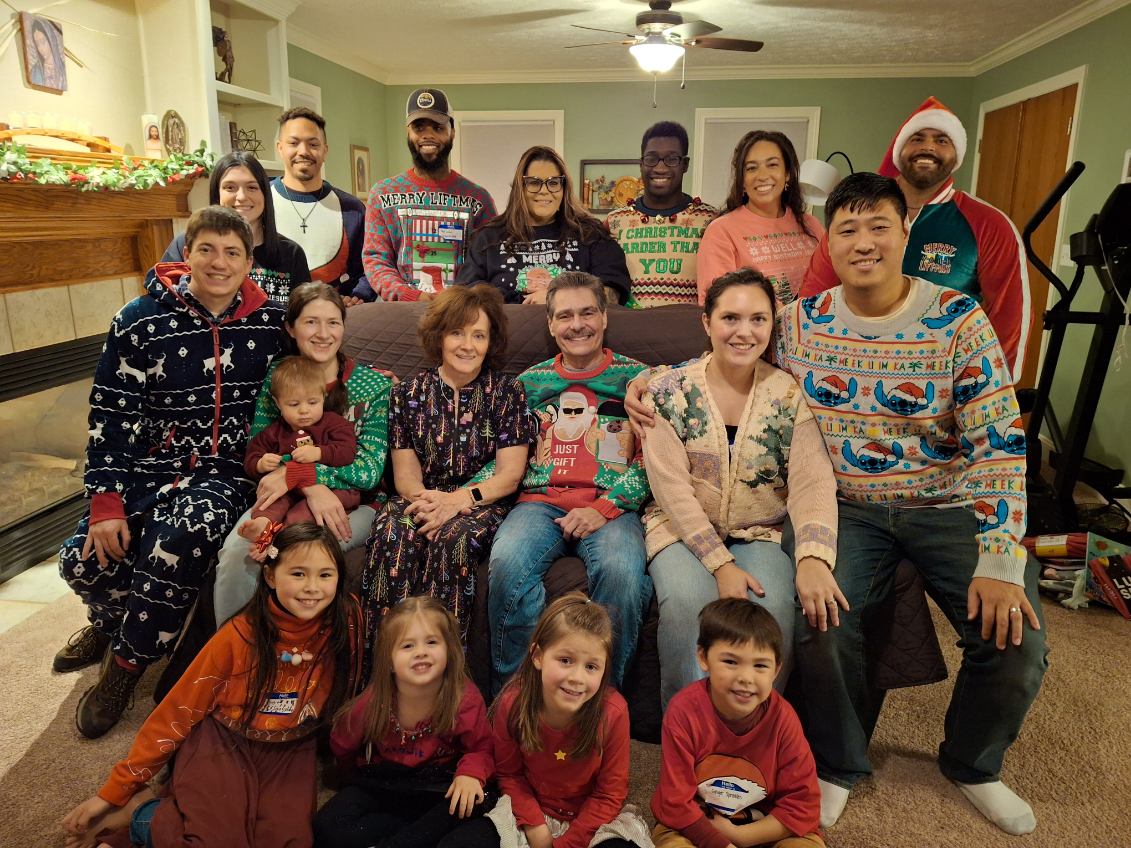
Modern feelings about children, in contrast, increasingly view them as a negative. Though experts have argued that high living costs and low social support are some of the main drivers of plummeting birth rates, recent polling has shown that many people forgo having children simply because they don’t want them, with respondents explicitly stating that they “just don’t want” kids and many arguing that they want to “focus on other things.”
But being open to life has enriched the home of Greg and Christine Williams, who live in Virginia and have nine children, though when they began their marriage Greg was not Catholic and Christine said she “pretty much just knew that the pill was ‘bad.’”
By the time they had three children, they had heard about Pope St. John Paul II’s theology of the body teachings. “It was amazing to hear God’s plan for our marriage through our bodies and our openness to children,” Christine said.
Their large family has been “the pleasure of my life,” Christine said.
“The best parts are the relationships and the memories we have together,” she said. “There are now some married children and some grandchildren, while at the same time preteen and teenagers at home. I am thankful for it all.”
Difficulties Surpassed by Joy, Growing
Those with large families are not shy about admitting the difficulties that often come along with them.
Jonas Bateman said the “hardest part” is “usually the daily struggle for cohesiveness,” the need “to get everyone moving in the same general direction for the good of the family.”
“Everyone is unique, so that can be a struggle,” he said, “but that also may be the best part.”
Christine Williams said there have been “hard parts” to their journey, particularly earlier in their marriage.
“In the beginning, money was not abundant,” she said. “We tried to live within our means and trust.”
The sheer number of children in the house, she admitted, has been “physically and emotionally hard at times.”
“Practically speaking, it is hard making large dinners every night,” she said, adding that she has baked “almost 200 birthday cakes” over the course of their family life.
“I have learned to ask for help when I need it,” she joked.
Sometimes married couples pursue large families even in the face of significant medical challenges. Michael and Becca Landrigan, who live in Indiana, had six children despite an abnormality affecting Michael’s bladder and bone structure from birth.
A willingness to have a large family, Michael said, was handed down from his parents.
“Mom always treated the arrival of a new child as an incredible gift,” he said. “That joy was true at the arrival of each of their children and subsequently with the arrival of each of their grandchildren and great-grandchildren.”
The extended Landrigan family is voluminous and, Michael said, contains considerable numbers of religious and clergy.
“About half of my parents’ grandchildren are married,” he said. “My oldest sister and her husband have 11 children. The three oldest girls are married with families; the next three girls are Carmelites. Four of the boys are priests with the Confraternity of St. Peter.” A grandson, meanwhile, is a priest in the Diocese of Fort Wayne-South Bend.
Above all, families stressed that, whatever practical difficulties may come along with large families, the rewards are vastly greater.
“God doesn’t give any gift without the grace to pursue holiness through it,” Ashley Bateman said. “Children will force you to grow and form. If you were called to the vocation of marriage you were called to motherhood or fatherhood in a specific, beautiful way.”
“A large family is difficult, but you become more intimate as a couple when you become more faithful,” Jonas said. “Life is complicated, but you are able to shoulder more with the Church as your foundation.”
Michael Landrigan said the rewards of having a large family have been imparted to their own children in turn.
“We don’t tell our children to have large families, but they want the joy of a large family,” he said.
Guarendi is quick to stress the joys of large family life — as he is the father of 10. He said that over years of ministry, “I have never once talked to an elderly parent who said I have had too many children. But I have talked to hundreds who said I wish I had more children.”
“You cannot measure how much your child will climb into your heart,” he said. “Childless couples see children as an abstract. … They don’t understand the emotional connection. [I tell them] you will be shocked at what this child will come to mean to you.”
He said Church leaders should work to “knock down” the numerous popular arguments against having children, including that they’re too expensive, too time-consuming and impossible to control.
“The culture just assumes these are a given,” he said, “and the Church can attack them.”
Christine Williams, meanwhile, urged young Catholic husbands and wives to “be assured God wants what is good for you and your marriage.”
“Your fertility is a gift,” she said. “To cooperate with God in bringing life into the world is a great, unrepeatable miracle.”
She urged couples to “be open to one more child,” to “study the Church’s teachings,” and to “find a friend group that can be a source of support when days are hard.”
“Hard days will come and go,” she said. “Bring your basket. He will bless your efforts.”