The Story Behind Fra Angelico Masterpiece — Hidden for Centuries, Restored Near Florence
This 600-year-old ‘Crucifixion’ fresco has been restored to its original splendor, thanks to the support of U.S. nonprofit Friends of Florence.
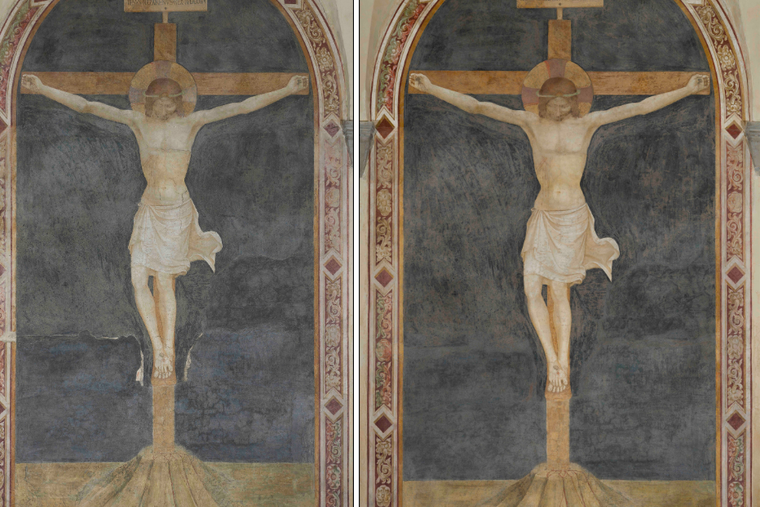
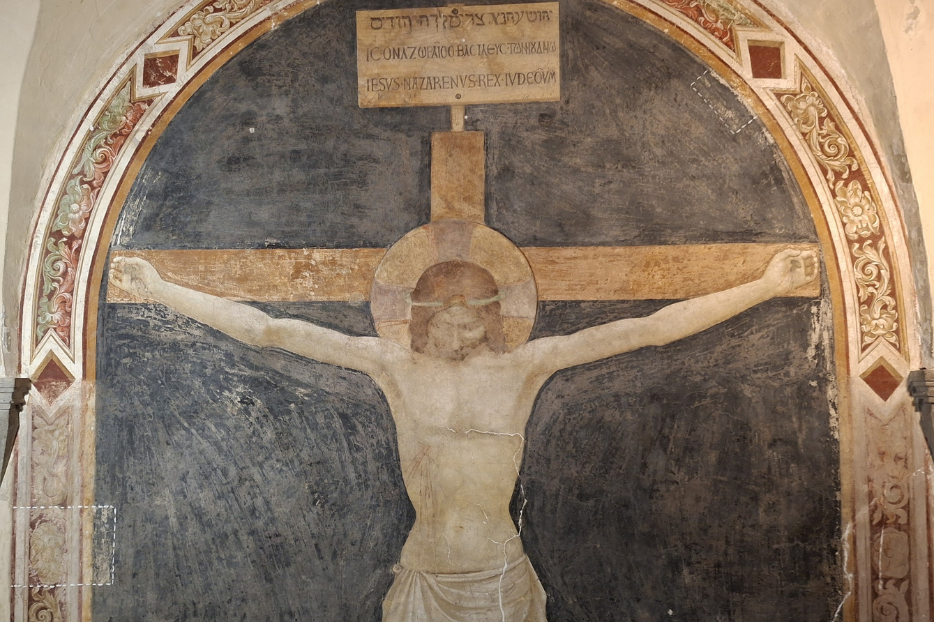
A fresco depicting the crucifixion of Christ by Fra Angelico, one of the most revered artistic figures of the early Renaissance, has been meticulously restored at the convent of San Domenico in Fiesole, near Florence, Italy. This 600-year-old masterpiece, which had been hidden for centuries beneath layers of paint, has now been revived, thanks to the support of Friends of Florence, a U.S. nonprofit.
Fra Angelico, known as The “Angelic Painter” for his ethereal use of color and light, was a pioneer who bridged the spiritual traditions of the Middle Ages with the technical brilliance of the Renaissance. His paintings were more than artistic expressions; they were acts of devotion, created through prayer and profound spiritual conviction.
A Hidden Gem
Cristiana Conti and Alessandra Popple, the restorers behind this project through their company S.A.R. snc, have been working together for 40 years. Despite their extensive knowledge of Italy’s great masters, Fra Angelico’s Crucifixion had escaped their radar.
“I didn’t know about this particular fresco,” Conti told the Register. “It is hidden inside the convent, making it relatively unknown to the public. Art historians have certainly studied it, but for me, it was a discovery — and a pleasant surprise.”
The Crucifixion, painted in the early 15th century, was originally located in the convent’s chapter house. Designed to foster prayer and reflection among the Dominican friars, the work’s composition is simple yet profound. Set against a deep blue background, it depicts Christ on the cross, with his head bowed in serene humility, conveying a meditative image.
The fresco had been concealed for much of its history. In 1566, the entire wall of the chapter house was whitewashed — likely for hygienic reasons, as revealed in the 19th-century chronicle of the convent. It wasn’t until the late 19th century that the fresco was rediscovered by Dominican priest Raimondo Magrini and subsequently restored in the 1880s. Despite further restorations in the 20th century, including significant work by Dino Dini in the 1950s and 1980s, the fresco had deteriorated over time, due to the effects of humidity, soot from heating systems, and previous restoration attempts.
Unveiling the Angelic Painter’s Techniques
The restoration process involved careful scientific analysis to understand Fra Angelico’s technique. The team discovered that the fresco had been painted over the course of nine days. “For the body of Christ, it was painted in one day, a day of execution solely dedicated to the body of Christ,” Conti said. “We found traces of direct incisions on the fresh plaster, where the artist made lines for the decoration.”
The team also uncovered traces of dusting, a technique used to outline the frame. “These small dots were placed on the surface of the fresh plaster and then black powder was used to create outlines for the frame,” Conti said.
Other details about the painting technique were revealed upon closer examination. “When we got closer to the fresco, we saw brushstrokes used on Christ’s chest and loincloth. These were basic yet executed with remarkable skill. The loincloth had small decorative dots along the perimeter that weren’t visible from a distance but became apparent in the restoration,” she continued.
She also pointed out the unusual portrayal of Christ. “This Christ, unlike the other works of Fra Angelico, has his head reclined, and his hands are somewhat closed around the nails.”
“We went to the San Marco convent in Florence [where the painter spent a number of years] to examine his other Crucifixions, and only one seemed to have a similar recumbent head, but it was very degraded.”
The restoration of the Crucifixion was made possible through the initiative of a group of dedicated visitors to the San Domenico Church in Fiesole, along with the support of the Belacqua medical group. Friends of Florence Foundation, recognizing the significance of this restoration, stepped in to fully fund the effort.
The same organization also funded the recent restoration of Fra Angelico’s Deposition From the Cross, a monumental task that took two years to complete and is now displayed at San Marco Museum in Florence. This effort showcases the dedication of this U.S. nonprofit to preserving priceless works of art, which are vital to both Italy’s cultural heritage and the history of Christian art.
‘Spiritual Presence’
For the two seasoned restorers, working on a piece by Fra Angelico was not just a challenging technical task, but also a deep spiritual experience. “This fresco has such a powerful spiritual presence,” Conti explained. “It’s a simple yet profound depiction of Christ’s sacrifice. The serenity in the face of Christ, the way the figure is depicted with his head bowed, creates a sense of peace that transcends the material world.”
The fresco’s purpose, as Conti explained, was never just artistic. “Father Giovanni Monti, the prior of the convent, often recalls that the fresco [is] first and foremost designed to be a tool for meditation and interiority,” she said. “It was meant to communicate deep spirituality to the friars gathered in the chapter room, to help them reflect on the importance of their mission and calling.”
Never before in her long and fruitful career has Conti had the opportunity to work on a piece by the Angelic Painter. “It has been such an extraordinary experience, especially as we near the end of our careers, to work on such an important artist,” she said.
The fresco’s unveiling aligns with the upcoming major Fra Angelico exhibition in September 2025, set to open at Palazzo Strozzi and Museo di San Marco in Florence. It is hoped that, in parallel to the exhibition, the convent in Fiesole will offer some opening hours for visitors, allowing those attending the exhibition to also view the Crucifixion in its original location in Fiesole, further enhancing the experience.
Fra Angelico’s ability to combine sacred themes with artistic mastery is what makes his work timeless. The Crucifixion is a prime example of this, with the fresco’s meditative nature inviting viewers into a deeper spiritual experience. As Fra Angelico once claimed, “He who wishes to paint Christ’s story must live with Christ.” This deeply held belief that every brushstroke was a divine act permeates his work and is particularly reflected in this Crucifixion rendering. The restoration aimed to ensure that this message, and its spiritual essence, would continue to resonate with viewers for generations to come.
- Keywords:
- sacred art
- fra angelico