Father Spitzer’s New AI App Takes Apologetics to Another Level
Jesuit philosopher and EWTN host’s writings power a new app that answers fundamental questions about faith and science.
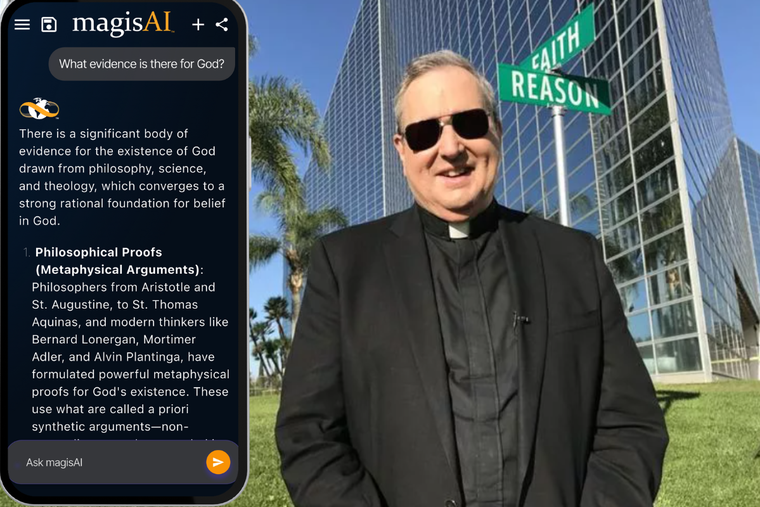
For young people engaged in debates with teachers or peers over the fundamental questions of human existence — science, the Divine, and how they fit together — reliable answers can be difficult to come by, even with the help of Google.
A new Catholic apologetics app, driven by artificial intelligence (AI) and trained on Jesuit Father Robert Spitzer’s considerable body of work, aims to change that.
First announced last fall, MagisAI, which is available now for free on various app stores, is among the latest in a series of popular apps that aim to provide comprehensive answers to questions about the Catholic faith by drawing on explicitly Catholic sources — including Magisterium AI, Truthly, and CatéGPT.
The primary mission of the MagisAI app, Father Spitzer told the Register, is to serve as a comprehensive resource for answering complex questions at the intersection of Catholic faith, science, philosophy, and social sciences. It aims, the priest said, to be part of an “antidote to the secular culture” by equipping users with the information and rationale to defend their faith confidently.
In response to user queries — for example, “What is the evidence for God from science?” — the app can produce written answers in 60 different languages. Users can specify their level of understanding (e.g., “I’m a fifth grader”) to receive an age-appropriate answer. Users can also ask follow-ups like “simplify that” or request definitions of technical terms.
“For half of our kids, science is the most credible method for getting to truth. If they can be convinced that science and faith are antithetical, that they’re contradictory, it’s all over,” said Father Spitzer, who has communicated and taught on the harmony of faith and science for decades through the work of the education organization he founded, Magis Center, and on his long-running EWTN program, Father Spitzer’s Universe.
‘Antidote to the Secular Culture’
The central objective of MagisAI is to stop the erosion of faith caused by unanswered questions and to build on the work the Magis Center has done for decades in countering the perception that science and faith are contradictory. The initiative, he said, is driven by the need to address a critical vulnerability in faith formation, particularly among the young. Father Spitzer described the app as a way for users to have his expertise available on demand — akin to having the priest right next to you to answer questions.
From a technical standpoint, the app is constructed using a sophisticated AI agent called Weaviate and a curated, continually growing database of Father Spitzer’s works, scholarly articles and peer-reviewed scientific studies, with “guardrails” built in in an attempt to ensure the app’s answers are always in alignment with Church teaching and provide a safe experience for all users, Father Spitzer said.
The team running the app is currently working on ensuring that answers also include relevant citations, to ensure the answers’ credibility and allow users to read further on topics of interest.
Educating ‘Vulnerable’ Populations
Father Spitzer said the app is strategically designed to serve three specific demographics within the Catholic community, starting with teachers and catechists, assisting them by removing barriers to teaching apologetics courses that integrate faith and science. Father Spitzer said he has found that teachers sometimes find science intimidating and worry about being unable to answer student questions on topics like the multiverse theory, evolution, or quantum mechanics.
The second target audience, he continued, is young people in a critical phase of their intellectual and spiritual development. The app is designed for the dorm-room discussion where faith is challenged as irrational or disproven by science. It equips students to defend their faith with logical, scientific answers, Father Spitzer said.
“Boys, especially, are super vulnerable. But if they can get an answer, a really logical, scientific, good answer to their question, and can defend their faith, those boys are going to be your best evangelizers ever,” Father Spitzer said.
Finally, the third target group is parents, who face difficult questions on faith and morality from their children and, in Father Spitzer’s experience, often feel underequipped to answer them. Ideally, parents who learn how to use the app will find it can answer their children’s questions “precisely and with good science.”
To those parents who are seeking answers, Father Spitzer said: “Now, you’ve got a tool. It’ll answer any of those questions — and tens of thousands more.”
Though MagisAI is not the first Catholic app of its kind, Father Spitzer said it is designed with a distinct purpose and emphasized that it has several key differentiating features.
He said: “Truthly is great. Magisterium AI is great. God bless them. But boy, we are doing something in the area of fundamental apologetics that the other apps simply don’t do, in the area of science that the other apps simply don’t do, in the area of social science and psychiatry ... that the other apps simply do not do. … We cover a range of areas that are super, super important to the kids but are not yet covered by these other apps.”