Eucharistic Devotion Serves as Catalyst for Young Men Discerning Priesthood
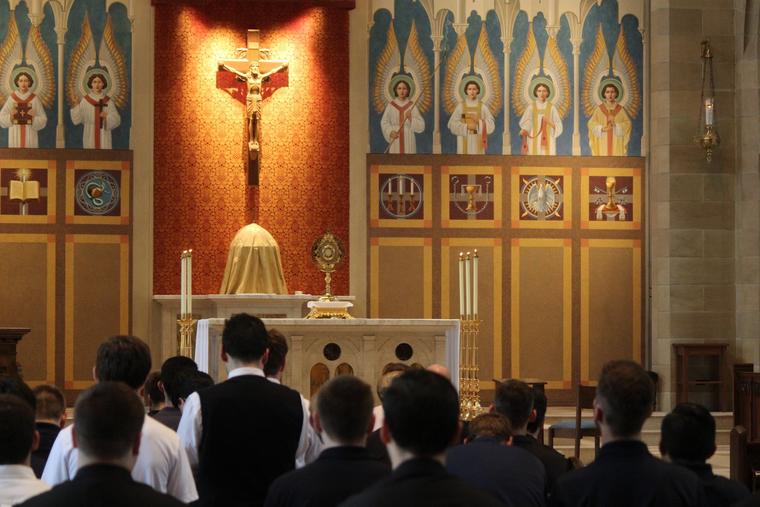
The solitude and silence offer a sacred space to converse with the Lord about the future.
Like most high-school students, Robert Bollinger had no idea what he wanted his life to look like. At the time, he was dating a girl and found marriage and family life very attractive. By his senior year, in 2016, however, he felt drawn to the priesthood.
Bollinger, now a priest for the Archdiocese of Philadelphia, having been ordained on May 17, began making regular visits to his parish’s 24/7 adoration chapel.
There, in the solitude and silence of the simple adoration chapel, Father Bollinger recalled how he found a space to converse with the Lord about his future.
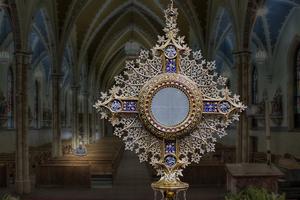
“This idea of becoming a priest kind of popped into my head out of nowhere, and I knew that it was not an idea of my own and that it was definitely something that God placed in my heart,” Father Bollinger told the Register. “I made it a point to just sit in the presence of the Blessed Sacrament once or twice a week throughout high school, and that was a real catalyst for being able to cement my vocation and say ‘Yes’ to God.”
Father Bollinger is far from alone in this story. In its annual study analyzing ordination classes, the Center for Applied Research in the Apostolate (CARA) Institute reported that 78% of the men in the 2025 ordination class regularly participated in Eucharistic adoration prior to entering seminary.
Jesuit Father Thomas Gaunt, the executive director at CARA, has worked with the U.S. Conference of Catholic Bishop’ Secretariat for Clergy, Consecrated Life and Vocations to conduct this survey for the past 20 years to help bishops and vocation directors better understand why young men are drawn to religious life.
In recent years, CARA has reported that more and more men report that regularly spending time in front of the Blessed Sacrament has an outsized impact on discernment.
“In recent years, in terms of prayer practices, we find repeated that participation in Eucharistic adoration has been significant for those being ordained as adoration has become more common among younger adults,” Father Gaunt told the Register.
This statistic, he says, shows the importance that prayer has.
“I think it shows that having an active and consistent prayer life is key to discernment,” Father Gaunt said. “We now expect men to say that they regularly visited adoration; we would be more surprised if they said, ‘No, adoration was not significant in my discernment process.’”
A Personal Relationship With the Lord
Across the country, vocation directors and seminary formators have seen the impact that regular prayer before the Blessed Sacrament has on a man’s discernment journey.
In the 1990s, parishes throughout the Diocese of Wichita, Kansas, established 24/7 adoration chapels. Since then, the diocese has seen an increase in vocations. Father Chad Arnold, the director of seminarians for the Diocese of Wichita, believes there is a direct correlation.
“In our diocese, for many years, we’ve been blessed with vocations, but before all of those vocations started, there was a concerted effort in our diocese for parishes to offer perpetual adoration,” Father Arnold told the Register. “As a diocese, we have always seen a connection between the number of adoration chapels, the number of people praying before the tabernacle in our diocese, and the blessings of vocations we’ve experienced.”
In his conversations with men discerning the priesthood, Father Garett Burns, the vocation director for the Diocese of Wichita, believes that adoration is often the first place where young Catholics choose to pursue God through their own volition.
“Many of these guys grew up in solid families or in schools where they did pray, maybe even before the Eucharist. For them to make a decision every week or even every day to spend some time before the Blessed Sacrament just opens them to see that they actually want this relationship with Christ,” Father Burns said. “By going to adoration, they realize the faith is not just something that’s demanded of the Church or by God, but they have a desire to go and be with him and experience that peace in the chapel.”
For young men, adoration quickly becomes an anchor point in their life, formation directors have found. As they begin spending more and more time in adoration, they gain a deeper awareness of the way that the Lord is at work within their hearts. Father Paul Hrezo, a formation director at the Pontifical College Josephinum in Columbus, Ohio, told the Register that this awareness helps men to discern their vocation.
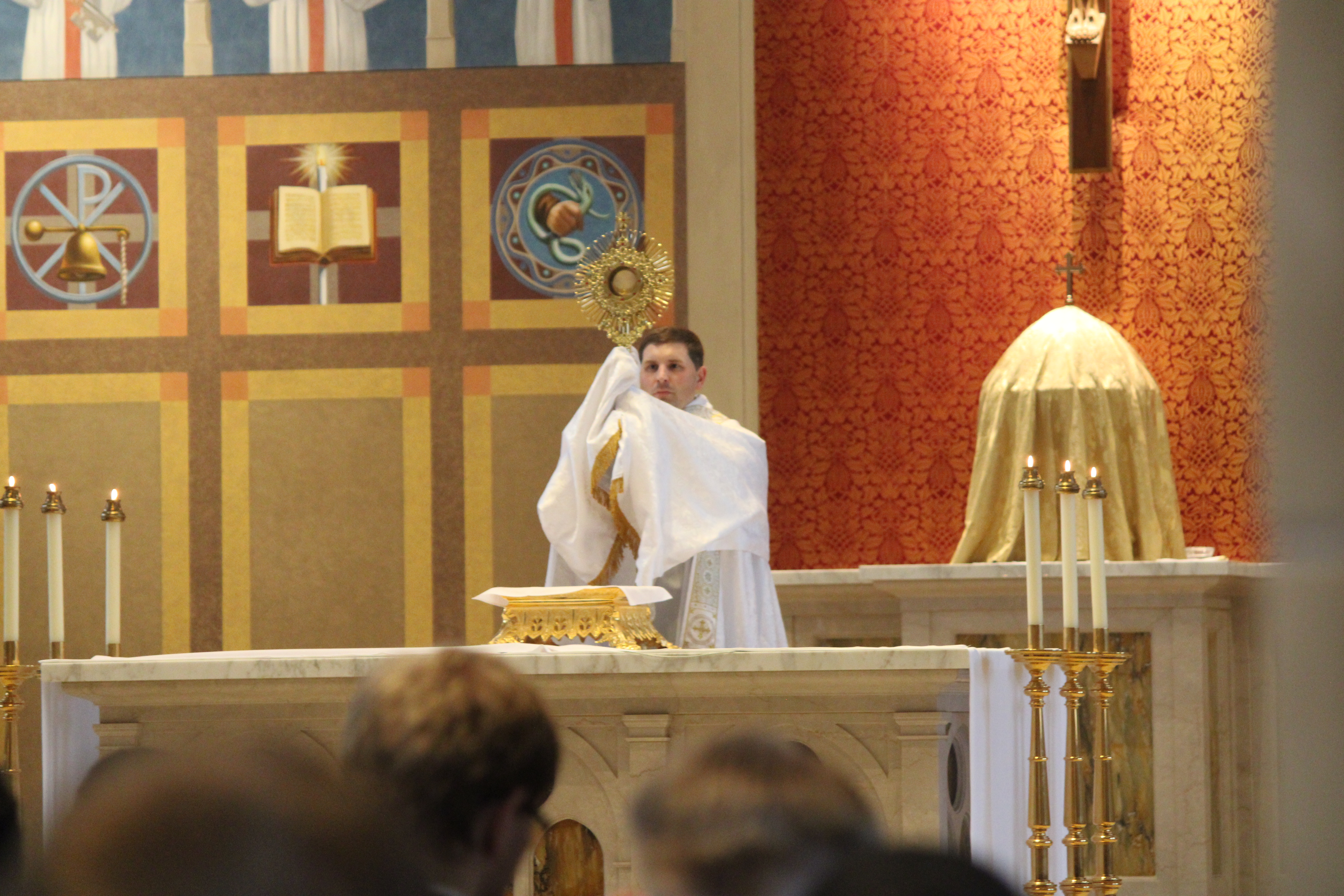
“When they go to adoration, they have gained this awareness that the Lord is personally present there for them, which becomes a very important anchor to discerning priesthood,” Father Hrezo said. “It’s so important to have that personal connection with the Lord, and especially that personal Eucharistic connection, since the Eucharist is going to be the foundation and the focus of life as a priest.”
Spending time in adoration became a constant practice for Father Bollinger as he discerned whether God was calling him to go to seminary. Those many hours before the Blessed Sacrament gave him the grace and confidence to say “Yes” to God.
“When I went to adoration, I focused on just letting myself be loved by God,” Father Bollinger said. “I realized that I could just kind of sit there and be with God. I didn’t have to perform. I didn’t have to do anything but just sit there and be loved by God.”
“This outpouring of his love gave me the confidence to trust in his plan and that he will always be there for me.”
In Seminary
Throughout a man’s seminary formation, Holy Hours before the Blessed Sacrament become a staple in their daily routine. At the Diocese of Wichita House of Formation, five days a week, the seminarians have a mandatory, scheduled Holy Hour, ensuring that the priests-to-be spend time before the Eucharist.
“At the crux of [seminary formation] is the belief that you are going to be a priest of Jesus Christ that calls for an intimate and personal relationship with him,” Father Arnold said. “If you are not continually in communication with Our Lord, if you’re not regularly coming into contact with him, it can be an unhealthy relationship.”
These daily hours help men to build the habit of regular prayer and see the importance in having a robust spiritual life so that they are prepared to serve as priests rooted in prayer.
“Priests need to have that personal discipline of daily prayer; it needs to be something that it’s just part of who you are, where you want to have that time in the morning,” Father Hrezo said. “Here at the seminary, we have a community with scheduled hours, but diocesan priests are almost like hermits because you’re out there, sometimes on your own, and they need to be rooted in prayer.”
Beyond forming lifelong habits, though, the regular Holy Hours provide men the space to continue to discern their vocation and to converse with Christ on whether he is calling them to serve as his priest, according to those who work in seminaries and Father Bollinger, too.
“Throughout seminary, the Holy Hour has really been an anchor for me. There were a lot of ups and downs for me throughout seminary, there were years that were difficult, and there were times that I was on fire to become a priest,” Father Bollinger said. “But the thing that always brought me back to balance that brought me hope was my daily Holy Hour.”
And that hasn’t changed — his Holy Hour will remain on his schedule, as he serves Blessed Virgin Mary parish in Philadelphia.
“I plan to pray early in the morning before daily Mass at my parish assignment.”