Who ‘Owns’ Catholic Phrases? Artists Navigate Thorny World of Trademarks
Catholics making use of the protections afforded to creators under U.S trademark law is nothing new, but it's a balancing act not easily managed.
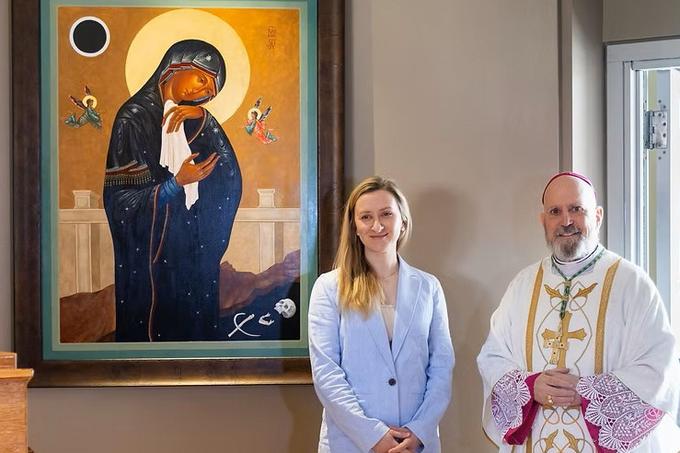
Countless Catholic artists over the years have painted, sculpted, drawn or otherwise interpreted Catholic devotions — the Immaculate Heart of Mary, for example — and then offered their original artwork for sale. That, in itself, is far from unusual.
What is far stranger to see is a Catholic art piece carrying a TM (“trademarked”) symbol in its name: as in, “Immaculate HeartTM Pendant.”
A debate over the trademarking of Catholic phrases, which has simmered for several years, bubbled up again last fall when users online began pointing out that a large Catholic jewelry shop, The Little Catholic, has in recent years applied for and been granted several trademarks on Catholic phrases, most notably “Holy Family Hearts” for both jewelry and T-shirts and “Mystical Rose” for jewelry.
Founded by Priscilla Huerta in 2018, The Little Catholic notes on its website that its trademarked names and phrases may not be used in any way — including in advertising, promotions, product descriptions or product designs — without prior written consent, adding that doing so without permission “may result in legal action.”
The backlash was swift, as customers and fellow creatives online criticized the optics — what appeared to be happening was that a large, successful Catholic business was aggressively policing smaller creatives, ostensibly for using names and phrases that any Catholic ought to be free to use.
“Imagine receiving cease-and-desist letters for naming a product after the Holy Face, the Sacred Heart or the Immaculate Heart. If you can[,] send the company a note of complaint,” read one such post from Catholic artist Fabiola Garza.
For her part, Huerta told the Register that her intention from the beginning was to protect The Little Catholic’s original jewelry designs. They’ve had a problem with “overseas counterfeiters,” she explained in a September blog post, detailing how such bad actors have copied her company’s designs to sell cheap, chemical-laden imitations online.
Huerta said that in the early days of her business, she “briefly explored” trademark filings for a few devotional phrases — such as “Immaculate Heart” — specifically on jewelry. She ultimately abandoned those filings because, she said, it became clear that “pursuing protection for devotional language was not appropriate to me personally nor necessary for our work.” (She also maintains that she herself coined the phrase “Holy Family Hearts,” though references to the term existed online prior to when The Little Catholic started using it.)
“Our intention has always been to honor the beauty of the faith, not to restrict it. We do not and will not try to own Catholic devotions or limit anyone’s ability to reference them,” Huerta told the Register in written answers to questions.
Catholics making use of the protections afforded to creators under U.S trademark law is, of course, nothing new. (Even the Register has a trademark.)
But ensuring the protection of specific products and brands while taking care not to appear to be claiming ownership over Catholic devotions is a balancing act not easily managed.
The Basics of Intellectual Property
Intellectual property (IP) is a catchall term for “creations of the mind,” such as inventions or literary and artistic works. The most common forms of IP protections are patents, copyrights and trademarks.
Under U.S. law, the primary purpose of a trademark is to identify the source of a specific good or service. Among other things, doing so protects the goodwill that a business has built between itself and its customers. Trademarks benefit consumers by protecting their expectations and by incentivizing companies to invest in making their branded products better.
Registering a trademark doesn’t grant a business a monopoly over a product. Moreover, a trademark holder is only allowed to police the “sectors” in which they are registered. For example, The Little Catholic’s trademark for “Holy Family Hearts” applies only to jewelry, T-shirts and goods closely related to them and does not apply to, for example, stickers.
As for the other two common forms of IP protection: Patents specifically protect inventions or designs, and copyright protection is conferred automatically the moment an original work is created and fixed in a tangible form, such as written down on paper or saved on a computer. Formal registration is not required for copyright protection, but it is necessary if a creator wants to file a lawsuit for infringement.
What Can Be Trademarked?
When it comes to determining whether a word or phrase can be trademarked, IP law in the U.S. classifies terms based on their “distinctiveness.”
“Generic” terms get the least protection — for example, the common name for a class of products, such as “soda” or “jewelry.” A Catholic company that sells sacramentals could not trademark the term “scapulars,” for example.
Moving up slightly, “descriptive” terms also are generally not protectable under trademark, unless they’ve acquired a secondary meaning in the minds of consumers. These terms can include descriptions of a quality or characteristic of the product, such as “fizzy soda.”
In contrast, a “suggestive” term is one which suggests the quality of a good but which requires some imagination on the consumer’s part. These kinds of terms are generally protectable with a trademark. A secular example of this type is “Netflix,” which is a portmanteau that suggests that the service provides “flicks”, i.e., movies, via the internet. Within the Catholic sector, an example might be “Blessed Is She,” a name that takes a little — but not much — imagination to connect to the service it provides, which is devotional products primarily aimed at women.
Finally, there is the category that enjoys the highest level of protection under trademark law: “arbitrary/fanciful.” This can take the form of a common word used in an unusual way, such as “Apple” for the tech company, or a coined word like “Kodak.”
What About Religious Phrases?
So how do Catholic phrases fit into this legal framework?
Thomas Berg, professor of law and public policy at the University of St. Thomas in Minnesota, told the Register that religious phrases like “Sacred Heart” and “Immaculate Heart” often face significant hurdles in the trademark process because the U.S. Patent and Trademark Office (USPTO) tends to rule those phrases “descriptive” or “generic,” and thus not eligible for registration. If Catholics are likely to perceive a phrase like “Immaculate Heart Pendant” as simply describing what the product is, rather than indicating that it came from a specific brand, then the phrase fails to function as a trademark, Berg said.
This doesn’t mean that Catholic devotional phrases can never be used within a trademarked name. “Sacred Heart University” is protectable, for example, because the phrase “Sacred Heart” in this case suggests that the university offers a Catholic education but is not technically descriptive of the service being offered — namely, education — in the way that a name like “Learning University” would be.
‘A Spirit of Support’
Jana Zuniga, founder of Colorado-based January Jane Shop, told the Register that she thinks Catholic creators should have the right to protect their original ideas if they are truly convicted that they “invented” a particular concept — but it feels to her “greedy and selfish” to try and own universal phrases that aren’t original or unique, especially if they are phrases commonly used within the Catholic faith.
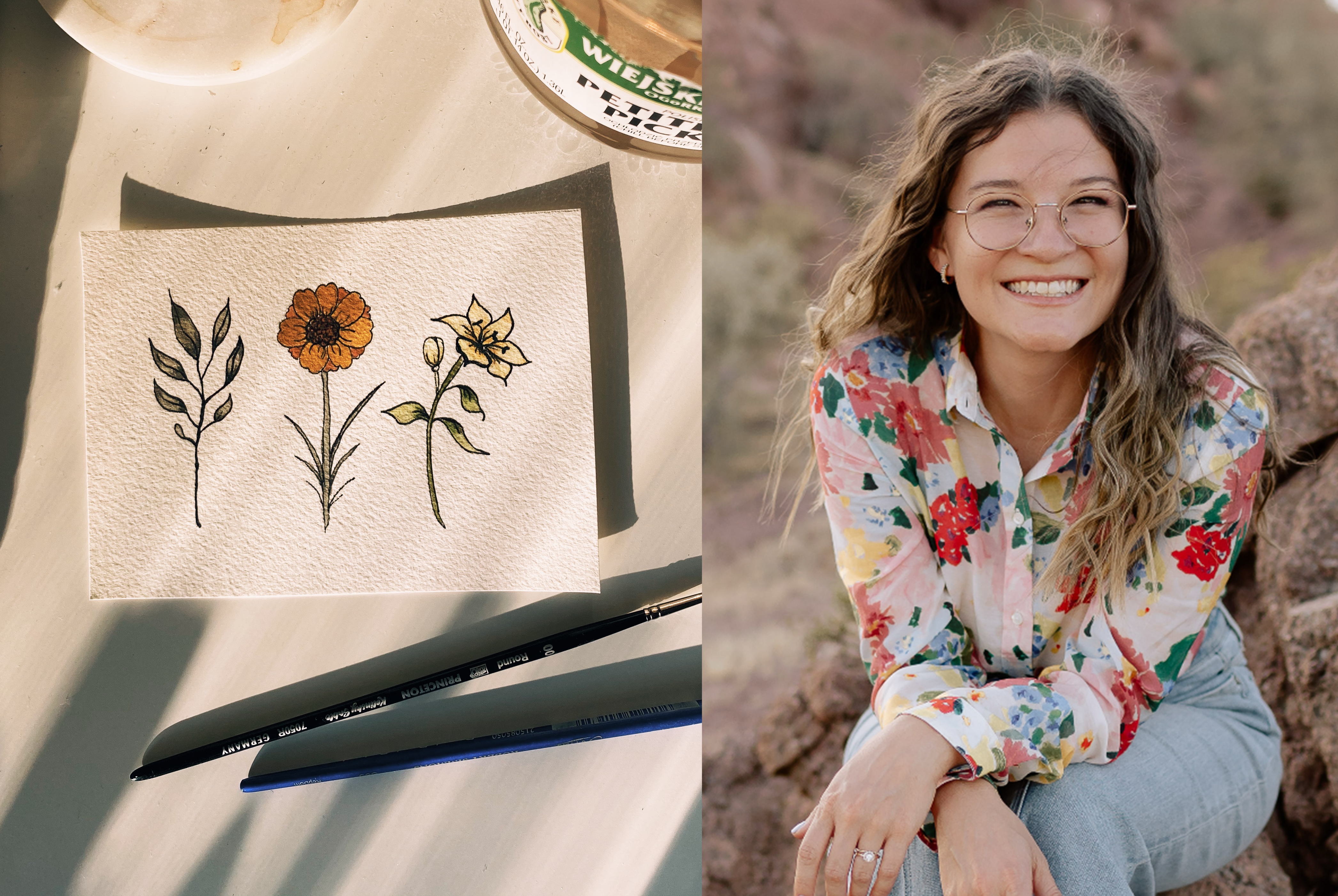
For example, Zuniga created a floral representation of the Holy Family, called the “Holy Family Floral Trio,” that became her store’s logo and appears on many of her products. Zuniga hasn’t attempted to trademark the phrase or the design.
“If someone were to try and come up with a floral version of the Holy Family, I would probably reach out and ask where they came up with their inspiration — but I’m also not the first person to put spiritual meaning behind florals. If someone used all the same symbols as I did, I would have more of an issue,” Zuniga told the Register.
“I don’t think there is anything wrong with protecting your work as a business owner and striving to build a successful and lucrative operation, but I don’t think it’s fair to do that by monopolizing universal Catholic phrases and claiming them as your own,” she continued.
“If your intention is to increase devotion and enrich the spiritual lives of our Catholic community, there should be a spirit of support rather than competition among us.”
‘Those Distinctions Matter’
Elizabeth Zelasko, a Catholic artist also based in Colorado, told the Register that it’s understandable, and not uncommon, for Catholic creators to want to protect names or phrases that are “highly specific” and “unmistakably tied to their brand and product.” Where things begin to feel uncomfortable, she continued, is when ownership claims creep too close to language and imagery that “belong to the whole Church.” As Catholic artists, “the themes we portray do not belong to any one of us,” she noted.
“There is a real difference between protecting a brand and fencing off what has always been held in common by the faithful. Those distinctions matter,” she said.
The modern internet makes Catholic art infinitely more accessible than ever before — but thanks in part to artificial intelligence (AI), theft is also easier than ever, too. The stunning speed at which new IP challenges are arising has left many artists — some of whom can’t afford lawyers — “stunned, unsure how to respond,” Zelasko said.
She said: “We have to be patient and charitable with one another as we learn how to navigate this new terrain together. It is not easy to have your work stolen, and it is not easy to know how to protect yourself well. The line is difficult to get right. But this community —Catholic creatives and Catholics who choose to shop responsibly — can find that balance together and do so with grace.”
- Keywords:
- trademarks
- patents
- catholic business leaders




![‘The Holy See has made clear that the clergy of the Society [of St. Pius X] are now to be regarded as schismatic,’ Bishop Frank Caggiano said in a statement.](https://publisher-ncreg.s3.us-east-2.amazonaws.com/pb-ncregister/swp/hv9hms/media/2026070617078_0ab6902d-8c02-4eac-aba4-1ec174e52618.png "‘The Holy See has made clear that the clergy of the Society [of St. Pius X] are now to be regarded as schismatic,’ Bishop Frank Caggiano said in a statement.")