A Silent Reflection on Mother Teresa and Serving the Poor
COMMENTARY: The witness of Mother Teresa sheds light on how Christians are called to serve in every vocation.
Four days is an awfully long time to dwell in silence — especially when you’re reevaluating your calling in life. That’s the situation in which I found myself during a recent silent retreat. I’ve done this spiritual exercise annually for 10 years, hosting 30 fellow business leaders at my home in Palm Springs, California. This time, we all pondered a distinctly difficult question that struck me during the meditations: How do we square our professional lives with the Christian call to serve?
Let me back up. Silent retreats are a big part of the Catholic spiritual life. The name says it all — remaining silent for days, a week or even longer. Instead, the focus is on the interior life, listening to God and discerning the direction he wants you to take. Often, retreats are led by priests or other spiritual authorities, who provide framing thoughts or ongoing guidance to keep your mind focused.
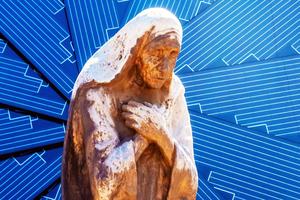
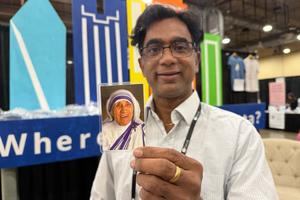
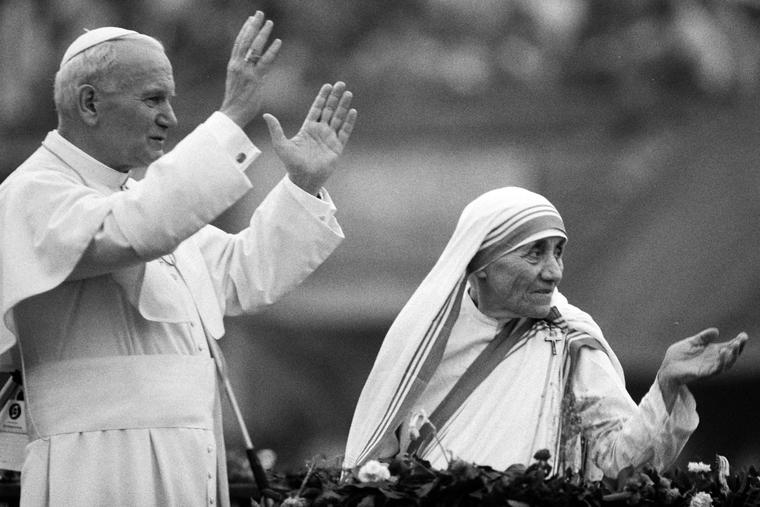
That’s where my struggle arose. At each meal, we gathered and listened in silence to the audio version of To Love and Be Loved, Jim Towey’s deeply personal book on St. Teresa of Calcutta. The book relates how Mother Teresa convinced Towey to abandon his career as a D.C. powerbroker, sell his possessions, and devote himself fully to helping the most vulnerable. He became a close confidante of Mother Teresa as she traveled the world and inspired millions.
As Towey’s story of sacrifice unfolded, I found myself deeply convicted. I’ve been in business since elementary school, when I figured out how to combine multiple paper routes to create a mini monopoly in my Michigan hometown. Since then, I’ve founded a law firm, an accounting firm, a wealth management firm and a hotel business, to name a few ventures. I’m now 71 years old, but I still have two or three more ideas to bring to fruition.
But Towey got me wondering: Have I done it all wrong? Should I have given it all up earlier in life?
I’ve also founded some Catholic schools and faith-driven nonprofits, but was that a halfway house at best? In the Gospel of Matthew, Jesus says: “If you wish to be perfect, go, sell what you have and give to the poor, and you will have treasure in heaven.” Perhaps, I worried, I’ve squandered my time here on earth.
My fellow retreatants ranged in age from the early 30s to late 70s, with the average attendee running just under 50. Many are only a few years into starting or running a business. They all see an upward trajectory, not least in their own earning potential. Was God asking them to give it all up?
I wanted to break my silence — to ask them if they were questioning, too. But instead, I turned to prayer and Scripture and the Catechism of the Catholic Church. As I meditated, the doubt turned into a deeper understanding of heroic charity and how it differs for every person.
My life isn’t meant to be that of Jim Towey — or Mother Teresa. Few people are cut out to do exactly what they did. But the spirit that animated their service absolutely ought to animate mine.
I have a moral obligation to lift up the less fortunate through job creation and products and services that improve lives. As the Catechism teaches, what I acquire “by work” must be used “in ways that will benefit the greatest number.” This reflects the fact that God “entrusted the earth and its resources to the common stewardship of mankind.” Everything I do in business must reflect this sacred duty.
Some may view this realization as a self-serving attempt to validate my life, but that ignores the all-consuming nature of the Christian mission. My silent epiphany reminded me that my business decisions — both large and small — should always be preceded by spiritual reflection and prayer. Am I starting this business to improve the lives of others? Am I trying to stifle competitors through unfair or immoral practices? Am I putting self-interest above the common good? These are tough questions that I must ask and answer on a daily basis.
I ended the retreat with a renewed desire to fight my innate human selfishness — a dangerous temptation in any line of work. Then, and only then, can I embrace God’s calling for me to put others ahead of myself. Then, and only then, can I put all my resources at God’s disposal, so that he may use them through me for the good of the many and his greater glory.
When the silence ended on the retreat’s last day, I shared my realization with the other attendees. Some had reached a similar conclusion; others were visibly buoyed by my words.
Perhaps that’s the most important message of Mother Teresa’s life — the real reason she’s a saint. She reminds us that each person has the ability and duty to pursue heroic charity, no matter our station or vocation in life. May that lesson, learned in silence, be the deafening message that guides all our actions.
- Keywords:
- mother teresa of calcutta
- sanctity
- universal call to holiness
- business
- catholic business leaders